Author: Eric Gardner

  • Ranking the 23 books I read in 2022

    Ranking the 23 books I read in 2022

    It’s the eight installment (wow) of my annual year in reading. You can see past lists here.

    23. God Bless you, Mr. Rosewater – Kurt Vonnegut Jr.

    It’s pretentious and doesn’t have much of a plot. Read Cat’s Cradle or Slaughterhouse Five instead. Wikipedia

    22. Cold Mountain – Charles Fraiser

    Struggled to finish this novel about returning home after the Civil War. Surprised it’s considered a modern classic. Wikipedia

    21. Thinking Basketball – Ben Taylor

    Ben Taylor is an incredible basketball writer. His writing taught me an incredible amount about not only analytics, but strategy. I didn’t love the book, but that’s because it’s aimed at a more general audience. If you feel comfortable talking about usage rates and efficiency ratings, skip the book and head over to his wonderful website.

    20. The Money Culture – Michael Lewis

    A collection of Lewis op-eds and articles from the 1980s-1990s. Thriftbooks

    19. Financial Literacy for Managers: Finance and Accounting for Better Decision-Making – Richard Labert

    Good basic book on understanding corporate finance. Website

    18. Operations Rules: Delivering Customer Value Through Flexible Operations – David Simchi-Levi

    High level overview on building an agile organization. MIT Press

    17. Bloodchild and Other Stories – Octavia Butler

    Short story collection from one of America’s best science fiction writers. Wikipedia

    16. How the World Really Works: A Scientist’s Guide to Our Past, Present and Future – Vackav Smil

    A “realist” look at societies impending transition to a green economy. Smil frames the book around a handful of different commodities (concrete, fertilizer) and essentially argues that it’s going to be a lot harder to transition to green energy than promoters will admit. My general complaint is that it suffers from a lack of imagination. He devotes a chapter to the production of industrial fertilizer, which is an important commodity and required for America’s industrial food system. However, he never stops to ask if an industrial agricultural system is the one we should have. Website

    15. The Dawn of Everything: A New History of Humanity – David Graeber

    One of the bigger “big picture” books of last year. It’s fine. I just get tired of reconsidering the past. Website

    14. The Nineties – Chuck Klosterman

    One of America’s foremost cultural critics examines the last era of monoculture. Website

    13. The Kelloggs: The Battling Brothers of Battle Creek – Howard Market

    The story of how a celebrity doctor and his brother revolutionized America’s breakfast. It’s surreal how primitive society’s understanding of nutrition was 100 years ago. Impossible to consider how our modern system will look 100 years from now. Bookshop

    12. Financial Statement Analysis: A Practitioner’s Guide – Martin Fridson

    A fairly detailed look at understanding specific nuances around financial statements. As is all business analysis, industry context and expertise matters. Website

    11. The Goal – Eliyahu Goldratt

    There’s a reason this book is on every single operation’s person’s reading list. A wonderful fictional tale about how to optimize a manufacturing plant. Wikipedia

    10. The Lords of Strategy: The Secret Intellectual History of the New Corporate World – Walter Kiechel

    A thorough and detailed look at the rise of management consulting and its impact on the corporate world. Who would of thought that the industry took off because they were the only ones who knew how to calculate detailed profitability for far-reaching conglomerates? Harvard Business Review

    9. Blood, Sweat & Chrome: The Wild and True Story of Mad Max: Fury Road – Kyle Buchanan

    Oral history of the best modern action movie. Website

    8. The Thousand Autumns of Jacob de Zoet – David Mitchell

    I picked this up because Cloud Atlas, the science fiction novel that redefined a genre, is one of my favorite books. Turns out Thousand Autumns of Jacob de Zoet is historical fiction. The first third is slow, the second third is fine. The last third of the book is great. Wikipedia

    7. Merchants of Grain – Dan Morgan

    Food is inherently political. In America, affordable food is taken for granted, but a lack of it can destabilize governments and topple regimes. Dan Morgan investigates how five private companies control what the world eats, and what people pay. The book is dated (first published in 1979) but timeless in its analysis. Amazon

    6. Gangsters of Capitalism: Smedley Butler, the Marines, and the Making and Breaking of America’s Empire – Jonathan Katz

    Explores the origins of modern American imperialism through the lens of one of America’s most decorated Marines—Smedley Butler. Website

    5. The Money Machine: How KKR Manufactured Power and Profits – Sarah Bartlett

    The mechanics behind private equity are simple, but the industry spent decades and billions of dollars convincing people that it’s somewhat mystical. Financers aren’t simply stripping American industry for profit—they’re financial engineering! Written in the early 1990s, before the ensuing PR blitz to rebrand the industry, Bartlett examines the rise of one of America’s most notorious and profitable leveraged buyout firms—KKR. Abe Books

    4. Narrative and Numbers: The Value of Stories in Business – Aswath Damodaran

    If you’re starting out in finance, I highly recommend checking out the work of Professor Damodarn. Here he’s produced a book on the importance of crafting stories out of finance. Columbia University Press

    3. The Night the Lights Went Out: A Memoir of Life After Brain Damage – Drew Magary

    A suspenseful and empathetic book about surviving a brain hemorrhage. Website

    2. A Memory Called Empire – Arkady Martine

    A mystery science fiction novel that is both gripping and thought-provoking. Martine delves into the nature of consciousness while simultaneously examining colonialism. It deservedly won the 2020 Hugo Award for Best Novel. Wikipedia

    1. The Lords of Easy Money: How the Federal Reserve Broke the American Economy – Christopher Leonard

    For my money, Christopher Leonard is one of the best business writers working in America. Here, he takes a look at qualitative easing and its spiraling effects on the economy. Very modern business writers understand monetary policy. Leonard is one of them, and he explains it brilliantly. Website

    Photo by Alexander Grey on Unsplash
  • Consumption is still strong at Target, despite inventory woes

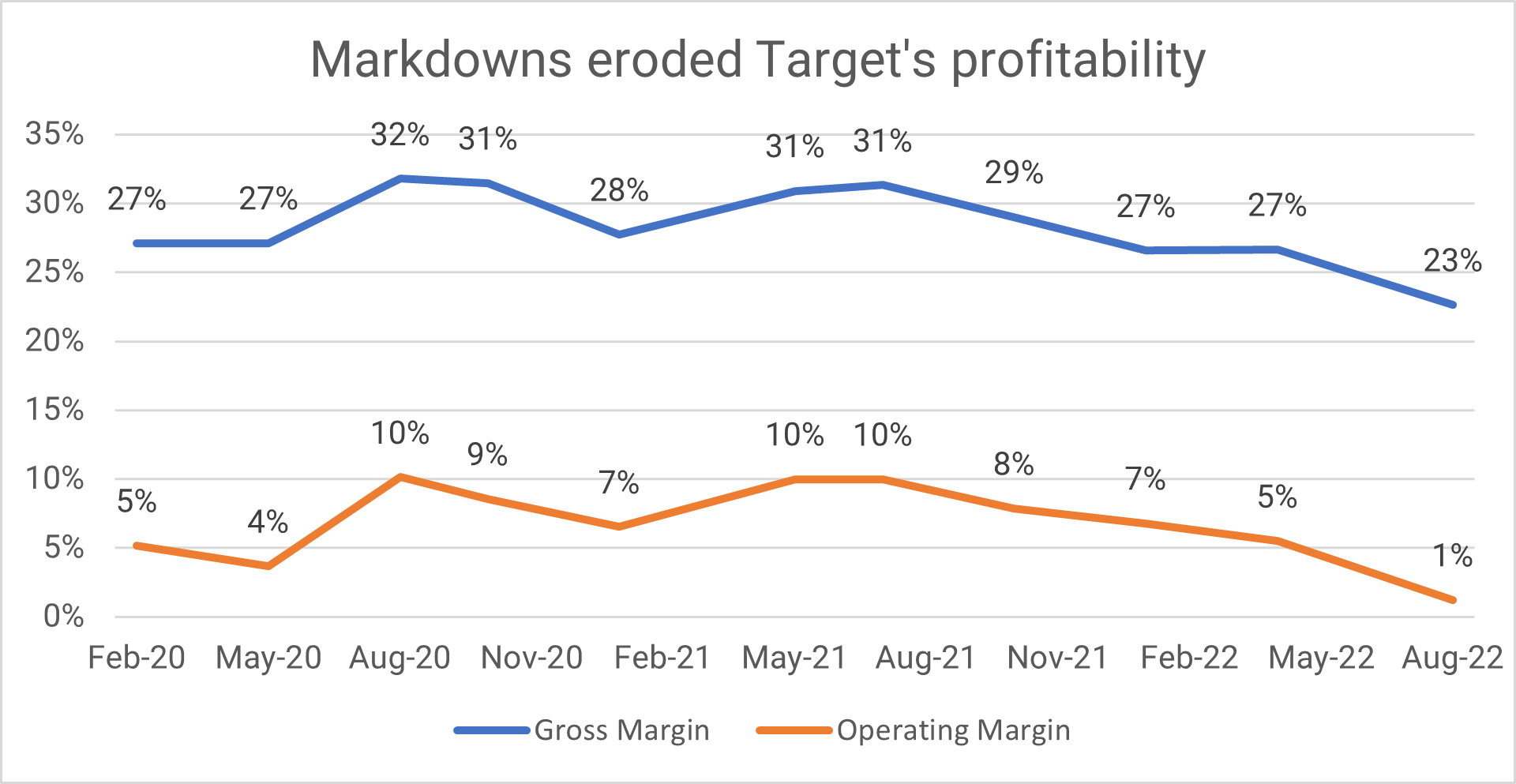
    Target saw operating margins crumble after a forecasting miss pushed the company to rapidly mark down billions of dollars of apparel in a few short months. The Minnesota-based retailer typically earns around 30% gross margin across its portfolio but saw that number decline to about 23% this quarter. The numbers fall even further when accounting for operating expenses—down to about 1%. “Our focus throughout the second quarter was to ensure that we took care of the excess inventory of our network and adjust future receipts to reflect the rapid change in sales trends we’ve seen so far this year,” CFO Michael Fiddelke told investors. “We accomplished this goal to the benefit of our operations, our team and our guests.”

    Inventory levels should stabilize at Target

    According to management, inventory markdowns accounted for almost all margin compression, and it expects profitability to return to normal levels. “Based on the success of our Q2 inventory actions and our current performance,” CFO Michael J. Fiddelke said, “we remain positioned to deliver an operating margin rate in a range around 6% in the fall season.”

    Despite the poor profitability, Target had strong sales growth. Overall, comparable sales increased almost 3%–on top of nearly 9% a year ago. Essentially, sales are up 11% from the pre-pandemic era. It isn’t just inflation. According to management, Target is growing in unit share and traffic. Even for discretionary items, where the company had significant markdowns, sales were still strong. There just wasn’t much margin. “Sales were softer than a year ago,” Chief Growth Officer Christina Hennington said, “but remained nearly $3.5 billion or more than 35% higher than the second quarter of 2019.”

    As you can imagine, the composition of sales will change moving forward. Target is prioritizing food and beverage while supplementing it with high-margin categories like Beauty, toys, and its brands. The company now boasts 12 $1 billion brands. Given that Target took a big inventory loss over the last two quarters, management feels they have an efficient machine that should start returning significant returns.
    “Time and time again”, Hennington said. Share and traffic “have proven to be a better barometer for lasting success than growth solely through average retail prices. That’s why I’m so encouraged that across all 5 of our core merchandising categories, we grew unit share in the second quarter.”

  • In Q2, Walmart managed inflation and inventory levels

    Weeks after lowering sales guidance, Walmart delivered reasonable sales growth amid heightened inventory levels. America’s largest retailer saw U.S. sales grow 6.5% compared to the previous year’s quarter while increasing in-store fulfillment for online ordering by nearly 40%. Management noted a fair number of shifts in consumer behavior, with shoppers trading from deli meats to canned tuna. “We finished the quarter on a strong note,” CFO John David Rainey told investors on the call.

    A new normal for Walmart Inventory Levels?

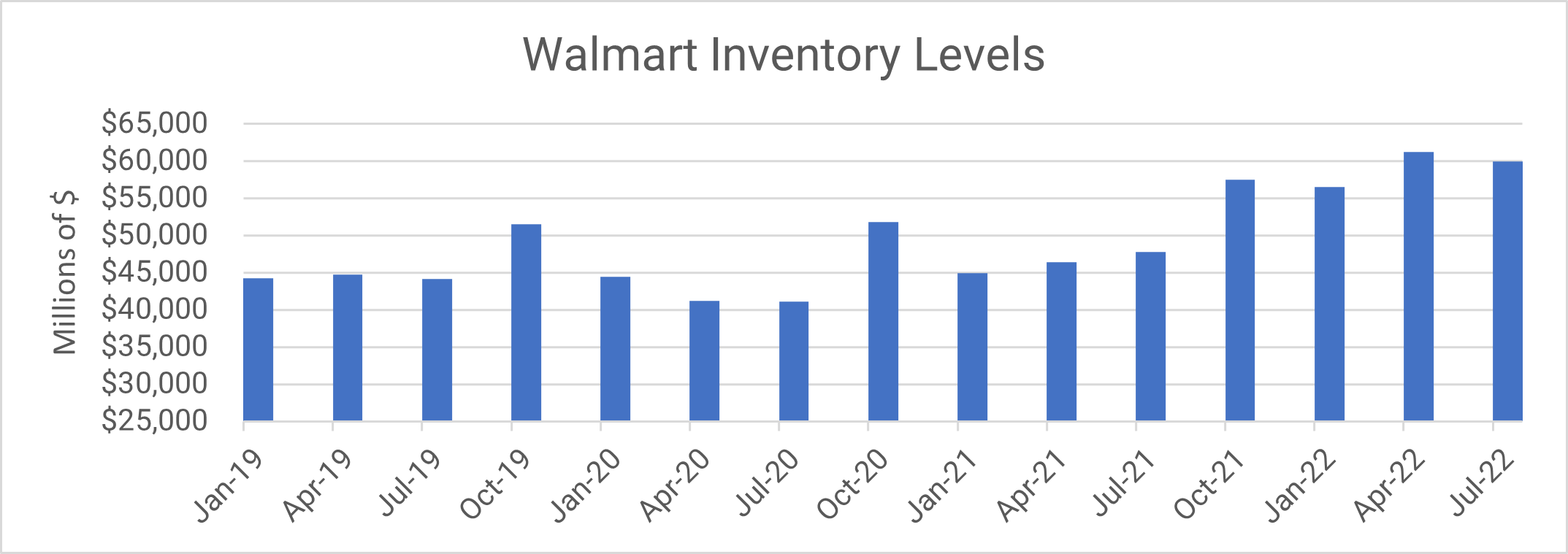
    Last quarter the company announced it was going to aggressively mark down apparel after forecasting errors flooded the company’s warehouses with unneeded items. “We’ve made good progress to reduce inventory levels where we’ve focused and taken markdowns,” CEO Doug McMillion said. Inventory is down from last quarter’s high, but still almost $15 billion higher than the pre-pandemic era. The absolute number is slightly misleading, as a fair amount of the cost is inflation related.
    McMillion explained:

    Take the U.S. inventory increase in the second quarter of $11 billion. If you decompose that, about 40% of that is due to inflation. So don’t think units, think just dollars.

    And then you look, as Doug noted, at things like the fact that we’re growing as a company that we’ve got less in stock next year, and you normalize for all of that, you whittle that down to about $1.5 billion of inventory that if we can just wave a magic wand, we’d make go away today.

    Rising out of stocks hurt the company early in the pandemic. To compensate, the company placed massive orders in 2021. The company was left with a glut of apparel after rising interest rates reduced inventory turnover. Unlike Target, who ripped the band-aid off and marked down all extra inventory immediately. Walmart is taking a more targeted approach. The last quarter was apparel, with electronics being added to the list moving forward.

    Spiraling inventory had some hidden costs as well. The company increased the number of shipping containers in the system as it scrambled to meet demand. “We’re making good progress in reducing costs,” management said, confirming it had halved the metric.

  • Utz Brands uses a fast follower strategy to grow sales

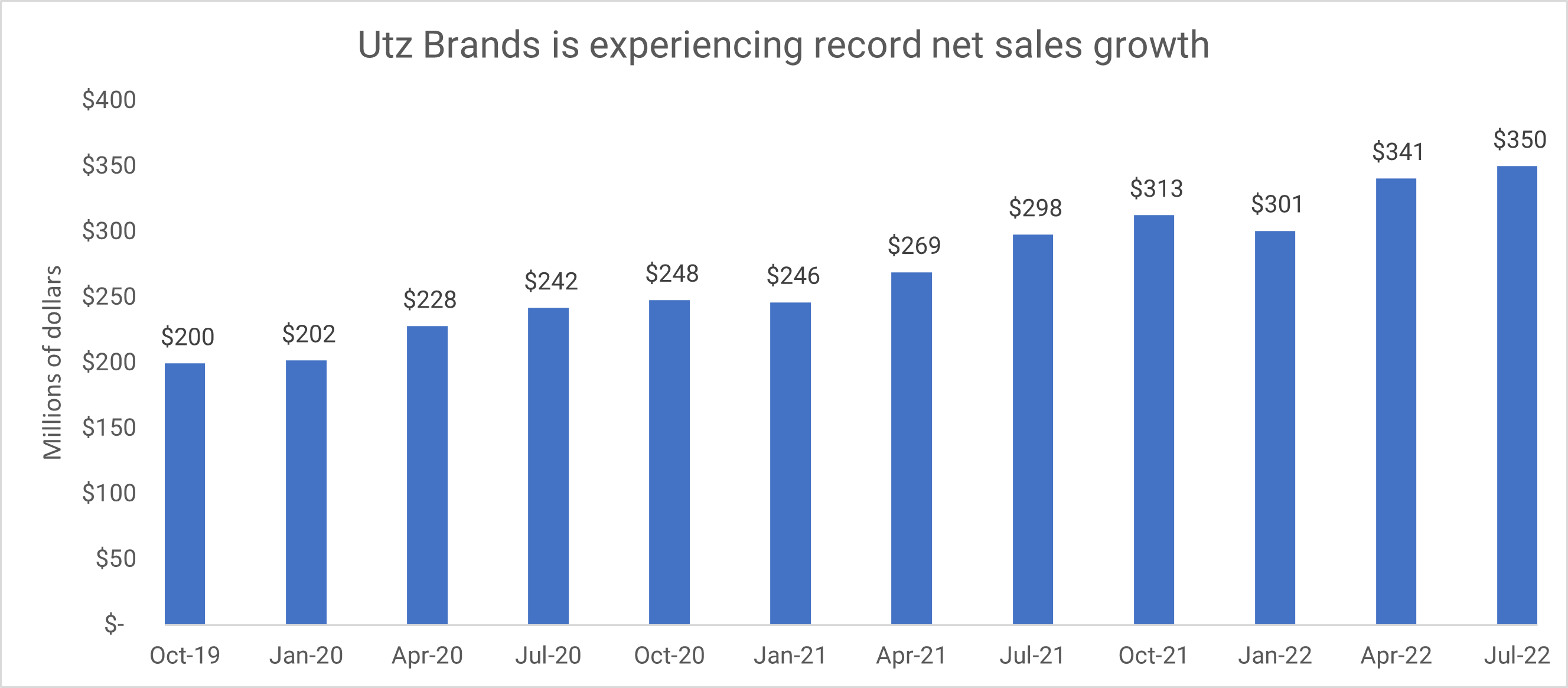
    Utz Brands, the Pennsylvania-based company behind Utz and ON THE BORDER chips, delivered record net sales this quarter. During Q2 2022, Utz produced net sales of $350m, an with organic sales increasing 13.6% from the prior year. Most impressive, the company grew its category share. For the 13 weeks ending on July 3, retail sales grew 16% versus an overall category increase of 14.8%. Based on the success and limited price elasticities, Utz raised sales guidance for the year. “We now expect total net sales to grow 13% to 15% and for organic net sales to grow 10% to 12%,” CEO Dylan Lissette told investors on the earnings call.

    One of the biggest standouts is the ON THE BORDER brand, which grew 15.4% in the quarter. The company bought the tortilla chip brand in 2020. Today, management estimates that it’s a $350m a year brand and projects it to grow to $450m. Not bad for an investment of $480m.

    The Fast Follower Strategy

    The fast follower strategy is a common strategy within the CPG world. Here, second-tier brands mimic the strategies and pricing of dominant brands. They get away with it because they’re typically lower priced. Companies maintain reasonable margins because they spend less on R&D. Utz Brands will never have the first exciting entrant in a category, but they’ll always follow shortly after.

    Back in June Ajay Kataria, EVP & CFO, of the company, spoke about the strategy with price increases.

    So really the entire category has been taking prices multiple rounds in the last 12 months. And the good thing about our salty snack category, it has a very rational category leader, which has an outsized share of the category. And they have been moving price up to cover inflation, and we have been fast following the category leader. And we have been sort of activating pricing as necessary to close the gaps where we see them, and that’s been the plan.

    And we have taken three sort of broad-based rounds of pricing Q4 last year, February this year, and then again May this year. And then in between, we have been taking sort of closing the gaps, optimizing mix, doing things here and there across customers, across subcategories and product portfolio that we have.

    And we are seeing us do that, and we’ve seen competition do the same. There have been at least three rounds of broad-based pricing in the last 12 months. And then people have been moving up packages and optimizing mix as necessary.

    He continued the discussion when talking about the company’s trade promotion plans. Like most consumer goods companies, Utz cut back on promotional activity through the pandemic. Now that things are normalizing, will they increase spend to drive share?

    We have found is we have been in lockstep in terms of how we are promoting, where we are promoting with the competition, with the category leaders in every subcategory.

    And in most cases, it’s not the frequency of promotions that have come off the table. It’s the depth. So if we were running two for fives before, we were running two for sixes late last year. And we are up to two for sevens now, et cetera — is an example.

    So I would say, we are in lockstep with the category leaders. But we are being mindful of what works on the shelf. If you go cold on promotions, that does not work with the consumer. You just have to work with the depth and the form of the promotion as well.

    So not really. Utz management will watch and mimick how Frito-Lay approaches promotions.

    Just don’t call them a budget alternative. When asked if being a lower-priced alternative for consumers resonated with retailers, here’s what CEO Dylan Lissette had to say.

    We’ve never positioned ourselves as a lower price alternative to any of the more national brands.  

    Sure. Just don’t tell anyone on your strategy or pricing team.

  • Lancaster Colony reports a poor Q3, but it has good problems

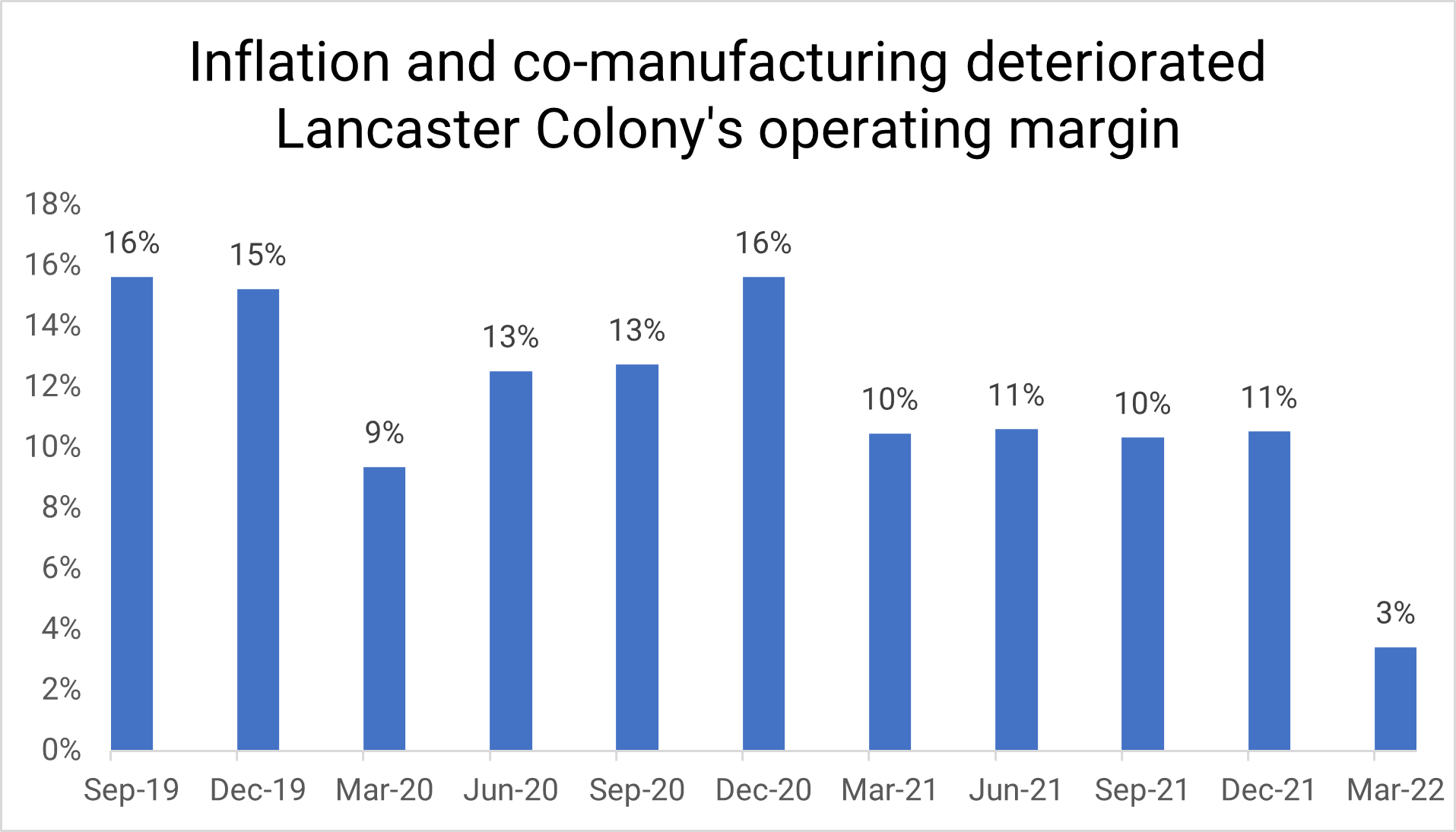
    Lancaster Colony reported poor earnings in Q3 of 2022. Sales increased about 13% for the quarter, but gross profit declined by $22 million. The Ohio-based company, most known for its Marzetti salad dressing brand, faced a perfect storm of negative headwinds. Rampant commodity inflation, combined with a reliance on co-brands and co-packing, devastated the company’s margins. The operating margin for the quarter was about 3%, down from 10% the previous year. “Our third quarter financial performance fell short of our expectations,” CEO Dave Ciesinski told investors, “We have the action plans underway to help us overcome the many challenges of the current operating environment.”

    Marzetti isn’t unique in facing high commodity costs. It is unique in that it’s been severely impacted by Russia’s invasion of Ukraine. Soybean oil, a key component in salad dressing, reached its highest price ever. The US dominates the soybean oil market, but sunflower oil shortages (Ukraine is a major player), have sent others scrambling for substitutes. “The soybean oil increase drove approximately half of our commodity cost inflation,” CFO Thomas Pigott said.

    Marzetti’s licensing platform boosted sales while destroying margin. Lancaster develops, produces and markets a variety of licensed sauces for Olive Garden and Chic-Fil-A. Sales for the platform have tripped in the past two years—from $29 million to $89 million. Marzetti pays the brand partners a royalty on each item, and incredible sales require management to utilize co-manufacturers to meet demand. The company should be able to migrate from the co-manufacturer model this summer, as a planned line extension is scheduled to complete this past June.

    Margin should recover in Q4, as the company experiences benefits from the new production line and price increases take effect. Management is also looking to potentially reformulate entire products to combat inflation.

    Ciesinksi explains:

    But given the nature of this inflation that we’re seeing, particularly around things like grains and oils, we’re finding that it’s increasingly important to look beyond just the way we’re manufacturing our product to look and go in to look at the intrinsic nature of our products, ourself. We’re looking at, hey, are there ways that we can lightweight plastic in our bottles? Are there ways that we can down gauge the corrugate in our boxes? And we’re also actually even looking at formulas to say, are there things that we can do to the formulas that won’t be considered a diminution of value to the consumer, let’s say, and the way mom experiences the product.

    Honestly, most of these problems are good problems to have. Using co-manufacturers to meet massive demand is a problem that can be solved in-house over time. Reformulation can drive lasting value. If things go as planned, the company could leave the COVID era in better shape than it started. 

    DISCLOSURE – I was previously involved with a strategy project at Lancaster Colony. I no longer have any connection to the firm.

  • Kellogg Co. raises sales guidance, hypes cereal

    Kellogg Co. was the latest in consumer goods giants to raise sales guidance after demand remained relatively elastic after numerous price hikes. The Michigan based company, who manufacturers a variety of cereals, Eggo waffles, and snacks like Cheese It, now predicts 4-5% operating profit growth—up from the 1-2% predicted earlier this year. “We feel good enough about our business,” CFO Amit Banati told investors, “That we can today raise our full year guidance on all key metrics while using our strong cash flow to both return more cash to shareholders and preserve a strong balance sheet.”

    The biggest Kellogg Co. news of the year is that management plans to split the company into three separate companies: Cereal, Snacks, and plant based. Snacks has been the company’s key performer of the last few years. It has generated most of the company’s growth and commands the most attention from management. That attention is a key driver for the decision. In the future, CEO Steven Cahillane predicts that, “Frosted Flakes does not have to compete with Pringles for resources.”

    Independently, cereal should be a strong business—well at least the way Cahillane framed it to investors last week.

    We have 5 of the top 11 brands. They are strong brands. All the information, research and data that we have suggests or reinforces how strong these brands are, how relevant they are. The category, as you know right now, is very healthy. It’s showing incredible pricing power. Even the last 4 weeks is better than the last 13 weeks. The category is quite healthy. It’s versatile. It’s showing, especially in challenging times, that it is a very affordable meal for people. A bowl of cereal with a glass of milk is $1, and that’s really helping the category.

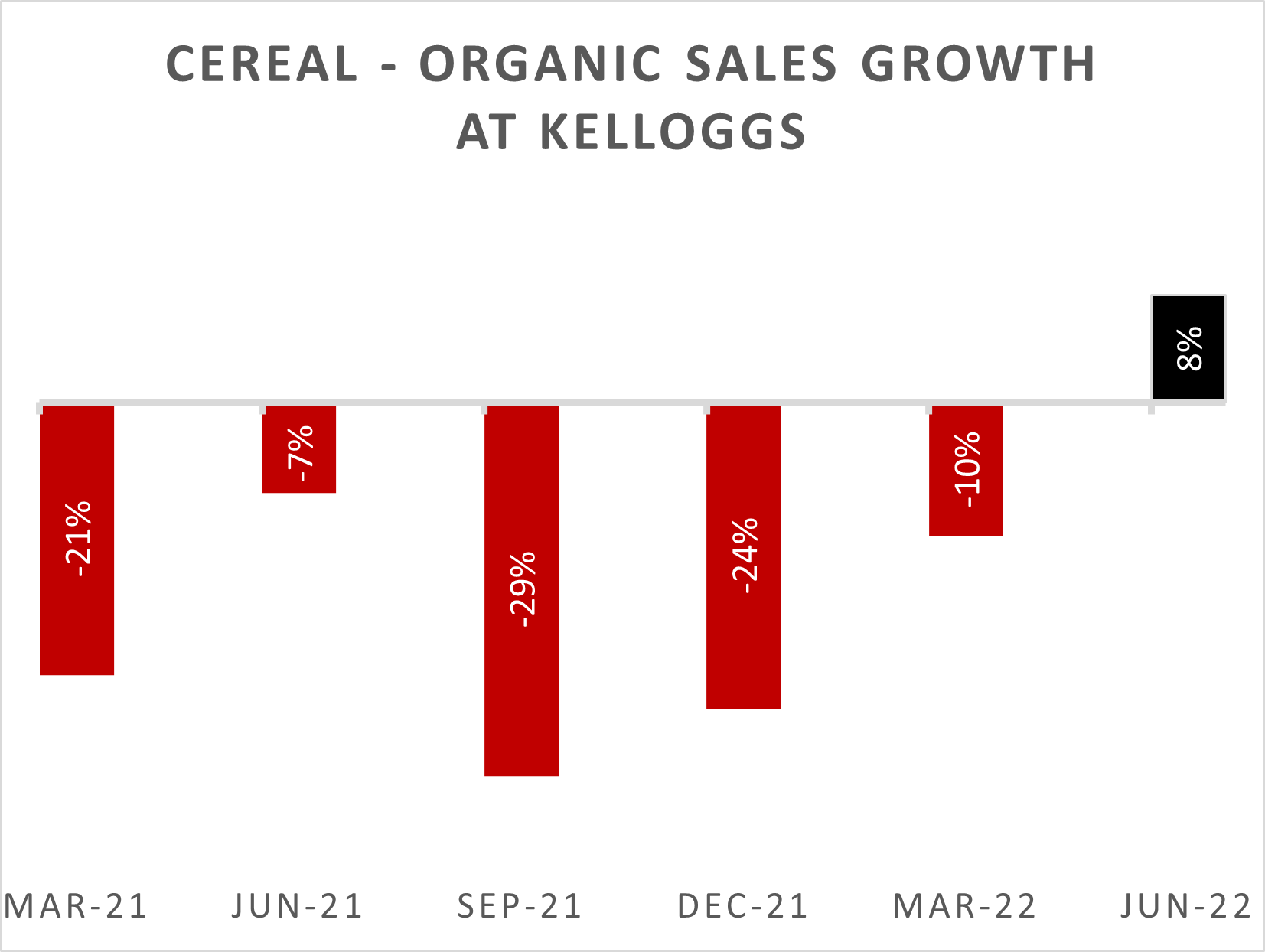
    He believes that because of the firm’s focus on snacks, it has been underinvesting in cereal. Despite this under investment, the category as a whole is up 9% on the quarter. It’s rival General Mills regularly delivers 20% margins on the product, so it’s reasonable to assume that Kelloggs could get there. Prior to this quarter, North American organic sales for Kellogg’s cereal were, quite frankly, a disaster. Partly driven by a return to the pre-COVID norm, but also made worse by Kellogg’s management’s inability to manage labor relations, the company hemorrhaged share and millions of dollars.

  • Led by advertising efficiencies, P&G post another solid quarter

    P&G delivered fine earnings for the fourth quarter of 2022. The company behind Tide, Pampers, and Head and Shoulders shampoo earned $19.5 billion in the last three months, an increase of 3% from last year. Like most CPG companies, the big sales driver was price. The company used an 8 percent price increase to compensate for a 1% decrease in volume. From a profitability perspective, gross margin decreased by under 4 percent for the quarter. The primary culprit was an increase in commodity and freight costs. The company predicted about $3.3 billion in additional costs for the next year for the two. “We’re working to mitigate the impact of these cost headwinds,” CFO Andre Schulten said. The company will use “a combination of innovation to create and extend the superiority of our brands, productivity in all aspects of our work, and pricing.”

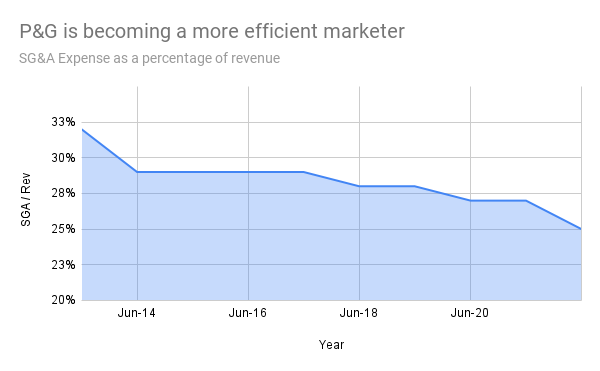
    One hidden area of productivity is advertising spending. According to management, P&G has been incredibly successful at generating more impact without increasing spend. “We have delivered significant productivity over the past years,” Schulten said. Since it’s P&G one of the strongest brand managers in the world, the company took the efficiency savings and reinvested them in more advertisements. The composition of the spending is also telling. P&G revealed that “more than 50% of our advertising is in digital.” In 2021, P&G spent $8.2 billion on advertising. More than $4 billion was once earmarked for television, radio, and print and is now spent with Facebook, Google, and Amazon.

    The efficient advertising is paying off for the company. There’s a general trend migrating towards private label—P&G hasn’t seen that yet. Outside of paper products and family care, management doesn’t forecasting much competition from private label moving forward. “Overall,” Schulten concluded, “we’ve been able to drive share growth on an all-outlet basis.”

  • Mondelez raises guidance after fantastic Q2

    In Q2 of 2022, Mondelez delivered exceptional results, increasing quarterly organic net revenue by 13.1% to $7.2 billion. The great news for Mondelez is that the maker of Oreo and Wheat Thins saw both price and volume increase by 8% and 5.1%, respectively. “Our core chocolate and biscuit businesses continue to demonstrate volume and pricing resilience,” CEO Dick Van de Put said, “As consumers worldwide continue to seek out our trusted and iconic brands to meet their snacking needs.” Based on the outlook, the company raised guidance to 8% for the year.


    Mondelez has not seen customers migrate to cheaper private-label options unlike some CPG manufacturers. “Private label is either flat or down in the vast majority of our markets,” Van de Put said. He noted that biscuit and chocolate brands are typically more resilient to private label competition, and today’s environment is no exception.


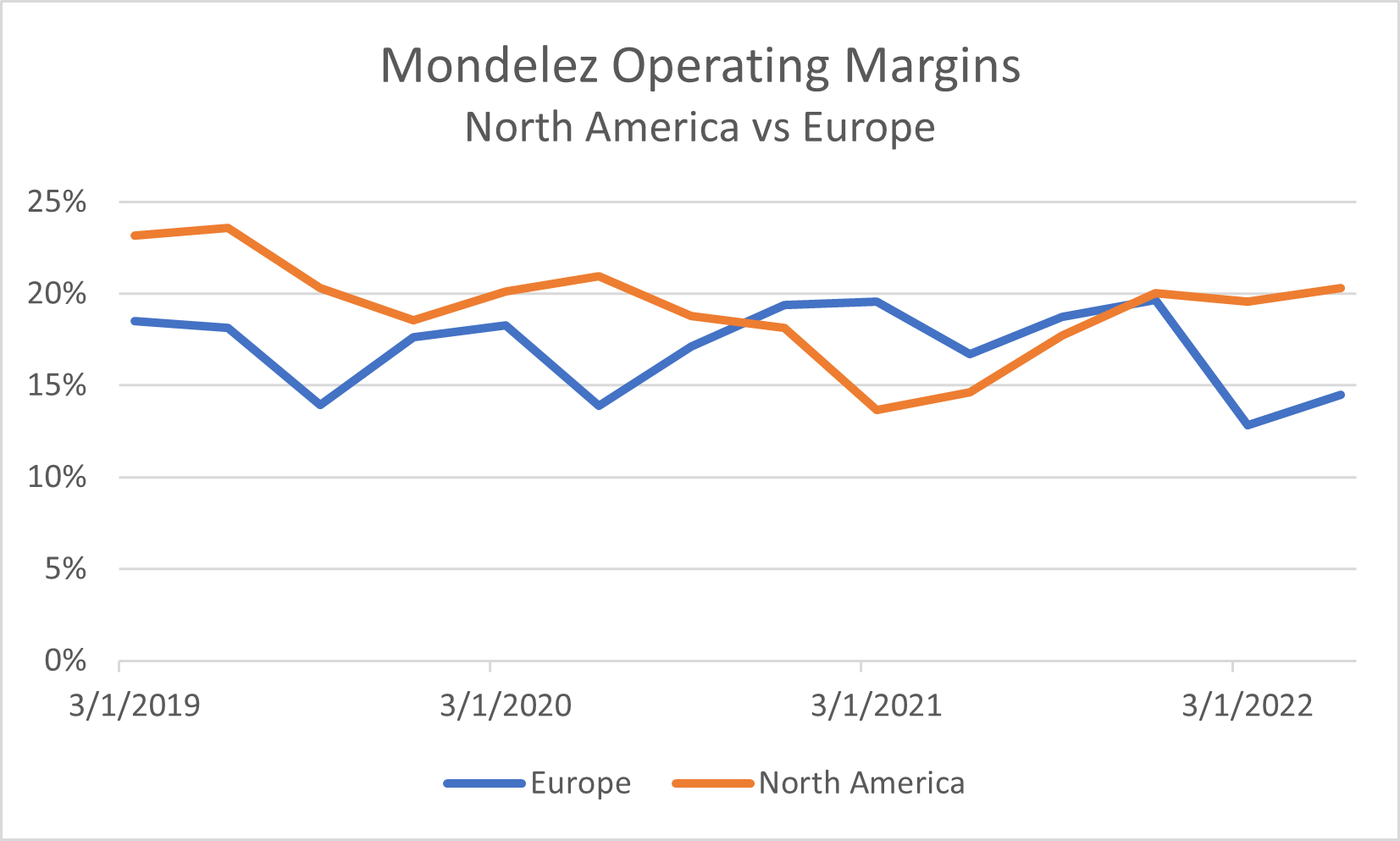
    One interesting thing to watch is that management signaled that the company was facing margin pressure from being unable to sell in European price increases. That’s because generally speaking, Europe is a more difficult operating environment for manufacturers selling in price increases. Part of this is Europe’s more active regulatory enforcement leading retailers to push back against passing on inflationary costs to consumers proactively. The other is that retailer pricing contracts are typically two years in Europe, offering significantly less flexibility for price spikes.

    Europe and U.S. margins have taken turns leading the way throughout the pandemic. Although in the last two quarters, North American operating margins have run around 20% while European lag behind at 14%. According to management, about 35% of the second wave of price increases in agreed upon in Europe. In America, it’s 100%, with an eye towards more. “More pricing has to happen,” the CEO concluded, “Most of it has been announced, and we’re now in the discussions and implementation of it.”

  • No price rollbacks. Coca-Cola says high prices are here to stay.

    Coca-Cola management reported the company’s second quarter 2022 results this morning. The Atlanta-based sparkling beverage company grew organic revenue by 16% compared to the same quarter the year before. Management said that price/mix actions caused 12% of the growth—and attributed more than half of that to mix changes. Consumers are migrating towards higher-margin products post-COVID, including smaller package sizes.

    The company has utilized RGM to manage inflation. Management reported that the comparable operating margin dropped 1.7% to 30.7%. Despite the slight decline, it’s still 10% higher than the average non-alcoholic beverage company. CEO James Quincy mentioned that the company has tried to pass on all commodity increases to consumers, but it has scheduled price increases to lag inflation.

    The hidden check against inflation at Coca-Cola

    Unlike other CPG companies, Coca-Cola’s distribution system is somewhat of a check against inflation. For bottled products, Coca-Cola sells syrup to bottling partners, who then sell finished goods to retailers. Cost increases will be absorbed by the bottlers first. That means there is a group with significant bargaining power to push back against greed-inflation. 

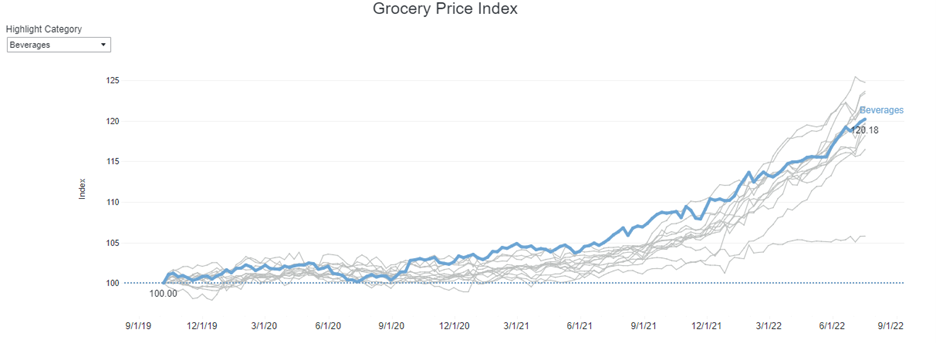
    Image via Datasembly

    The company has no plans to rollback pricing if inflation steadies. “Basically, for the price to roll back, we need the overall economy to enter deflation,” Quincy said. According to data from Datasembly, beverage costs have increased by around 20% since the pandemic’s start. If Quincy has his way, these high costs may be the new normal for consumers. “Price rollbacks seem very unlikely.”

  • Conagra Brands plans more price increases despite losing volume for four straight quarters

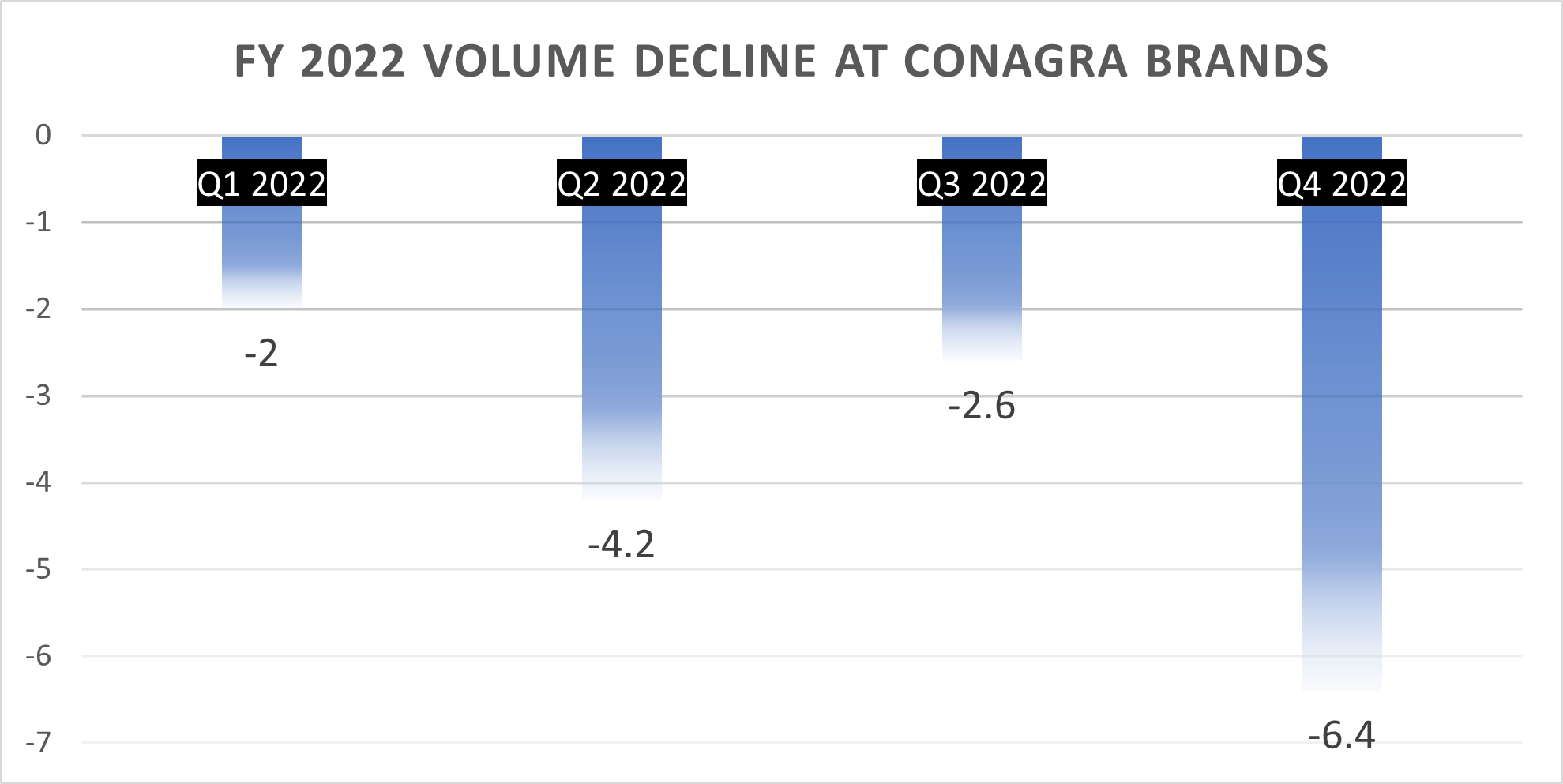
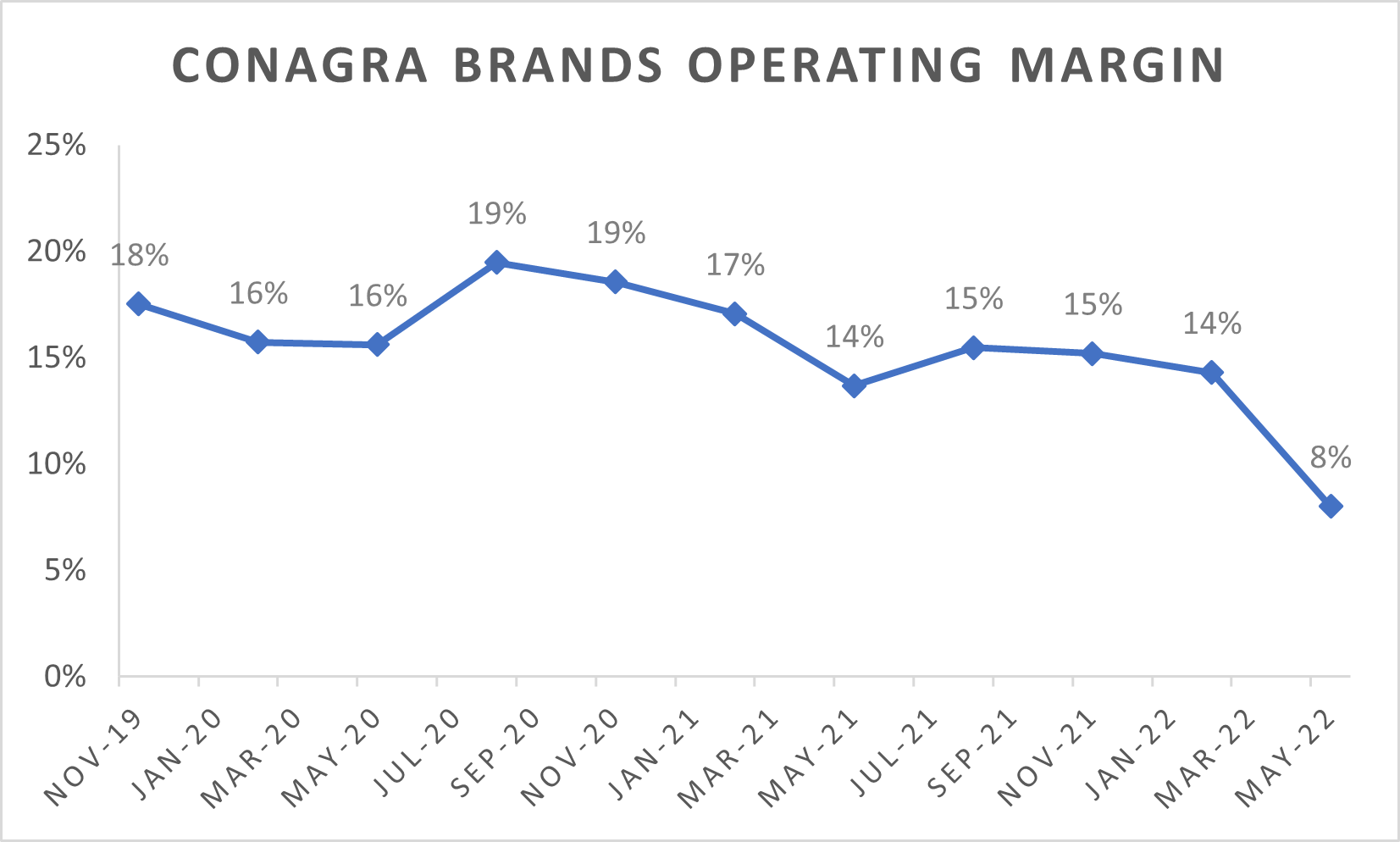
    Management at Conagra Brands said that in the next two quarters, it has more price increases planned even though price increases are beginning to impact volume materially. In Q4 of 2022, the maker of Slim Jims and Birds Eye frozen foods saw sales decline by 6.4%. That marks four consecutive quarters of volume loss.

    However, the volume was more than offset by a 13.2% price/mix improvement. The company reported a net sales increase of about 3% for the fiscal year, while operating margin compressed down 400 basis points to 11.7%.

    There was a bit of awkwardness in the call. The management team, led by CEO Sean Connolly, focused the discussion on supply chain constraints. “While we are making progress in supply chain, the constraints are still with us.” Connolly told analysts in this weeks’ investor call, “And they were still a factor in Q4 and we did see retailers burn through inventory faster than we could replenish it.”

    However, not all analysts were sold on the framing.

    Analyst: Okay. And maybe a follow-up, in your press release, when you talk about the reasons for the volume decline, it really is all about price elasticity. It doesn’t say anything about supply chain constraints or inability to serve customers. So is it just not material enough to show up in the price release that supply chain constraint?

    Dave Marberger: Yes, just I would just add when you do the press release, obviously, you talk more about the material drivers of the thing, right? So it’s clearly elasticities are the main driver of volume. There were some supply constraints, which we gave color to because we were asked. So — but the main driver were the elasticity.

    Perhaps the most interesting conversation came towards the end of the call, when Wall Street grew somewhat skeptical of the announced pricing plans.

    Analyst: I’m in an event right now with a lot of your customers. And it’s kind of depressing. They’re talking about all this cost pressure, the limited ability to pass it through the consumer, the meaningful margin squeeze they are under. And you’re the third food company in a row to get up and talk about the ability to price above inflation and get margin recovery, which we saw this quarter you’re guiding to for next year. It kind of flies in the face of how I’ve always thought about the balance of power between the industry.

    Was it may be a bit more balanced rather than the sort of incongruent balance that we’re seeing right now where CPG guys are saying they’re going to flex a lot of muscle, while your customers are feeling a lot of pain. What’s evolved to kind of cause that balance to pivot in this direction? And why do you believe it’s durable?

    Sean Connolly: No, I wouldn’t characterize it the way you’re characterizing it, Jason. I mean when you go into these macroeconomic dislocations that we’ve experienced, the pain tends to come in waves. And manufacturers get hit with a lot of the pain early in the cycle, and that comes in the form of margin compression as you’ve seen we’ve gone through in the last year, a lot of that associated with the lag effect. And then the lag effect is a transitory effect that you do emerge from. So it’s not as if what you’re doing as you move through that cycle is you’re recovering lost margin points as opposed to adding fresh new firepower at the profit line. That’s not what’s happening. 

    I’m somewhat with Connolly here. Conagra Brands has experienced significant margin compression. After boosting margins for a few quarters at the start of the pandemic, inflation caught up to the company. According to data from Seeking Alpha, in FY 2021, the company had operating margins of about 18%. In FY 2022, that number compressed to 12.2% (higher than the company’s reported number).

    Where I somewhat lose him is his additional rationale.

    This is about profit recovery. And that’s an important thing. Manufacturers have to recover their margin, why? Because the top priority for our retail customers is growth. And our retail customers here at Conagra know that our innovation has been the absolute key to driving growth for their categories. They need and want that innovation to continue, but they know that, that innovation costs us money. We have to have healthy margins to be able to build out that innovation and get it to our customers in the market. And so they know we’ve got to take inflation justified pricing to recover our margins after we go through these windows where we experienced the compression that happens early in the inflation cycle. And that’s exactly kind of how things are playing out.

    So I’m not opposed to companies regaining margin. However, in 2021 Conagra Brands sold about $2.8 billion in consumer staples. Americans eat these products daily: Hunts canned tomatoes, birds-eye frozen vegetables, peanut butter. I’m sure they’ll use some level of RGM to minimize the pain, but raising staple prices above inflation to bring new Reddi Whip options to retailers seems…not great.