Author: Eric Gardner

  • Is J.M. Smucker management overestimating its brand power?

    J.M. Smucker Co. (SJM) wrapped up the 2022 fiscal year with good results, but analysts are skeptical that its COVID-19 era success is anything other than being at the right place at the right time. For the fourth quarter, the maker of Jif, Folgers and Uncrustables saw net sales increase 6 percent compared to the same time last year. Management credited a 15% price increase for the sales growth. Surprisingly, they think there’s still room for more price increases. “We don’t believe there’s a (pricing) window,” CEO Mark Smucker told investors. “We’re obviously cognizant of (pricing) pressure on consumers, but as you know, we have a responsibility to our shareholders to protect our dollar profit.”
    Does J.M. Smucker Co. have the power to command additional price increases despite consumers showing more appetite for private label?

    Analysts are skeptical. According to Morningstar, at 6.9% of sales, Smucker’s brand investments far exceed its peer average of 5.4%. Management is paying more for marketing, but its brands are still only treading water. Part of that is because of the categories that Smucker sells. It primarily competes in peanut butter, fruit spreads, at-home coffee and pet food. Of those four, only pet food could be considered a growth market.

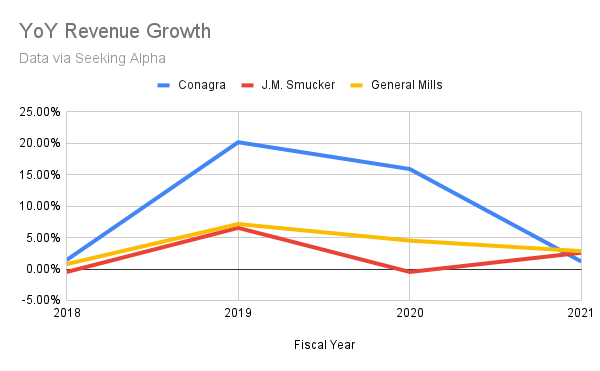
    Unlike other food manufacturers, the company has not seen explosive growth during the COVID era. Production issues and a costly peanut butter recall limited the company’s overall sales growth to 2% since FY 2019. Comparatively, General Mills competes with Smucker in pet food and snacks and has seen overall sales growth of 7 percent in that time. Conagra Brands, which sells mostly food basics, experienced an explosive 17%.

    Despite the lack of brand power and performance, Smucker raised next year’s sales guidance. For its part, Wall Street was skeptical. “I just think,” said a JP Morgan Analyst, “people are looking at this guidance and thinking, all right, it’s maybe aspirational to some extent.”


    Consider that two of us.

  • Kroger and the return of private label

    Kroger, America’s largest pure-play grocer, reported another consistent quarter. For its first quarter of 2022, the firm matched the previous year’s 4.1% percent sales growth while increasing operating margins. The big news is the composition of the company’s sales. For the first time in the pandemic era, private label led the way. According to management, sales of Kroger’s own brands increased by 6.3%–outpacing all national brands.

    Here’s CEO Rodney McMullen discussing it on his company’s most recent earning’s call:

    During the quarter, we saw tremendous growth in Our Brands, which had identical sales of 6.3% and outpaced all national brands. With 92% of households purchasing at least one of these products, we launched 239 new and innovative products during the quarter, reflecting many of the top food trend predictions we made at the beginning of the year. All of our new products continue to be tested and validated to ensure that they are as good or better than the comparable national brand.

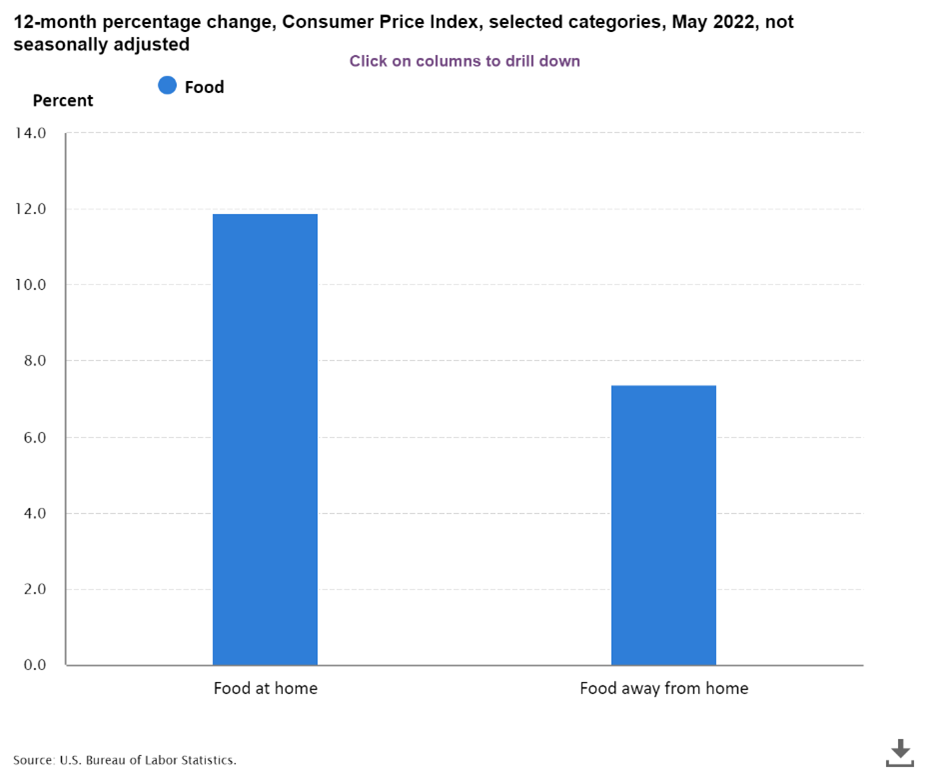
    What’s interesting is why this is happening. Of course, rising inflation is impacting wallets. According to the Federal Reserve, the cost of at-home food increased nearly 12 percent since last May.

    With no additional fiscal stimulus in sight, shoppers are looking for cheaper alternatives. However, an interesting component of the switch is supply constraints from branded CPG manufacturers.

    McMullen explains:

    I think there’s still a lot of capacity constraints among some of the national brands. So I would expect if it’s a national brand with capacity, you’ll see a typical trend where they get more aggressive in promoting as their tonnage goes down. But if they’re supply-constrained, I would be surprised. And part of that is just because all of us are exiting COVID at a level of volume higher than what we had going in, which has put different people at different points on supply constraints.

    Essentially, the Campbell Soups and Smucker’s of the world can’t produce enough products to meet demand. Since sales are brisk, their management sees no reason to offer promotions that would normally make their products more price competitive and spur incremental volume.

    The decision to cut back on promotions will also impact Kroger down the line. During the COVID-19 era, the company invested in new warehouse infrastructure. Unfortunately, it’s sitting somewhat idle as the lack of promotions means management doesn’t see an incentive to lock in lower prices through forward buying.

    For its part, Kroger management announced that it has no plans to gain market share by taking price. “We always think it’s important to remember it’s the total customer experience that we’re focused on,” McMullen concluded, “rather than price alone.”

  • Is the Hershey Company about to face private label competition?

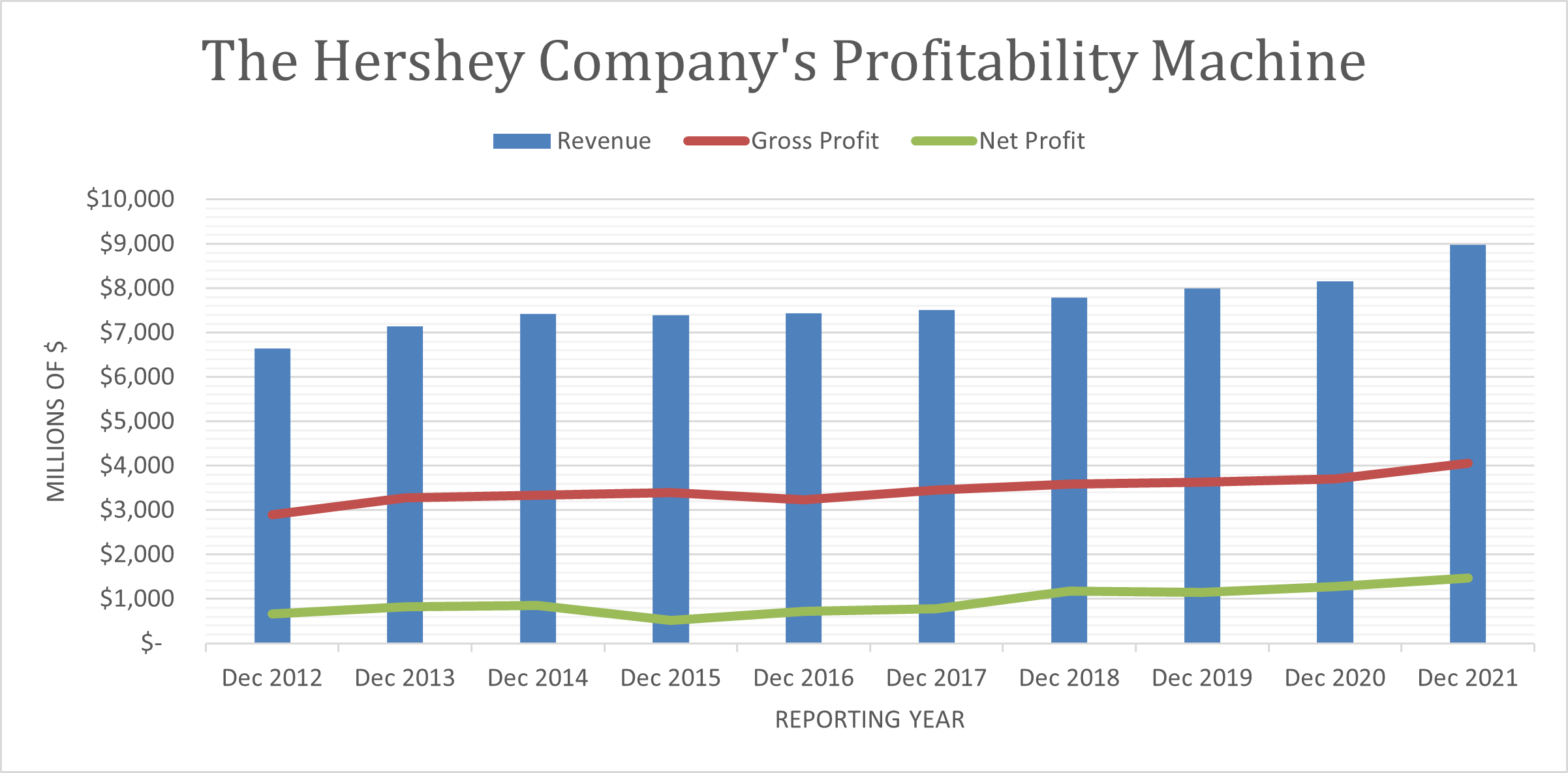
    The Hershey Company, one of America’s oldest and most profitable food companies, may finally experience private-label competition. Founded in 1894, the Pennsylvania-based food processor has experienced over a century of nearly unrivaled success. Today, Hershey owns about 43% of the American chocolate market, with second place Mars commanding about 25%. This dominance enables Hershey to post nearly unrivaled margins.

    Part of the success is due to great products and business execution; the other part includes an industry structure that makes it largely immune from private label competition. Hershey doesn’t face margin pressure from low-cost alternatives. A big component of this is distribution. Unlike other private label categories, candy distribution requires refrigerated trucks and is fairly labor-intensive to stock. It’s why Walmart uses McClane, rather than ordering directly. That underlying reality is why there aren’t many investors clamoring to produce lower-margin private-label alternatives.

    Here’s CEO Michele Buck talking about it in its Q1 earnings call. Buck is answering a question about how the company monitors consumers trading down to cheaper alternatives.

    And on your other question, we are constantly looking at a couple things relative to the strength of retail takeaway in other CPG categories, as well as our own. And also how much market share is going to private label as that has typically also been a predictor of the consumer. We’re fortunate in our category, not to have significant private label, but certainly in other categories where that’s present we do look at that as well.

    She made similar comments the previous quarter:

    At the same time, we do know that there’s significant pressure out there, and we just want to really keep our fingers on the pulse of it to make sure that we aren’t missing something. I mean certainly, we’re not a category where there’s a big private label component and people can easily just say, “I’m going to still participate but switch to lower brands.” That’s always been a benefit for us during times like this, but we do understand the pressure consumers are under.

    This week, one of the faster-growing convenience stores in America announced it invested in private label offerings—and candy is a prime driver. Casey’s General Stores operates 2,400 locations across the Midwest. Unlike many other retailers, Casey essentially self-distributes 90% of its in-store products from its three warehouses. This gives it an incredible amount of control and leverage over the quality and presentation of merchandise..

    Here CEO Darren Rebelez responds to a question about the company’s private-label initiative:

    You know, Anthony, we’re working on a lot of different categories right now in private brand. We actually participate in 26 different categories of private brands, and some of those are underpenetrated, some of those are more penetrated, but I can tell you where we’ve seen some success so far in the last quarter, we launched a line of Casey’s candy bars which is something we have never played in before, and they have become the number one standard size bar in dollars, units, and margins within the category. When I say that, I mean that’s outperforming Reese’s, Snickers, all of those national brands, and so I think it really illustrates the quality and the value that those products provide.

    Sure. It’s one company and one example. Or it could be the start of private label candy gaining share in the convenience store channel. 

  • Trade-up, trade-down, Campbell Soup Company has consumers covered

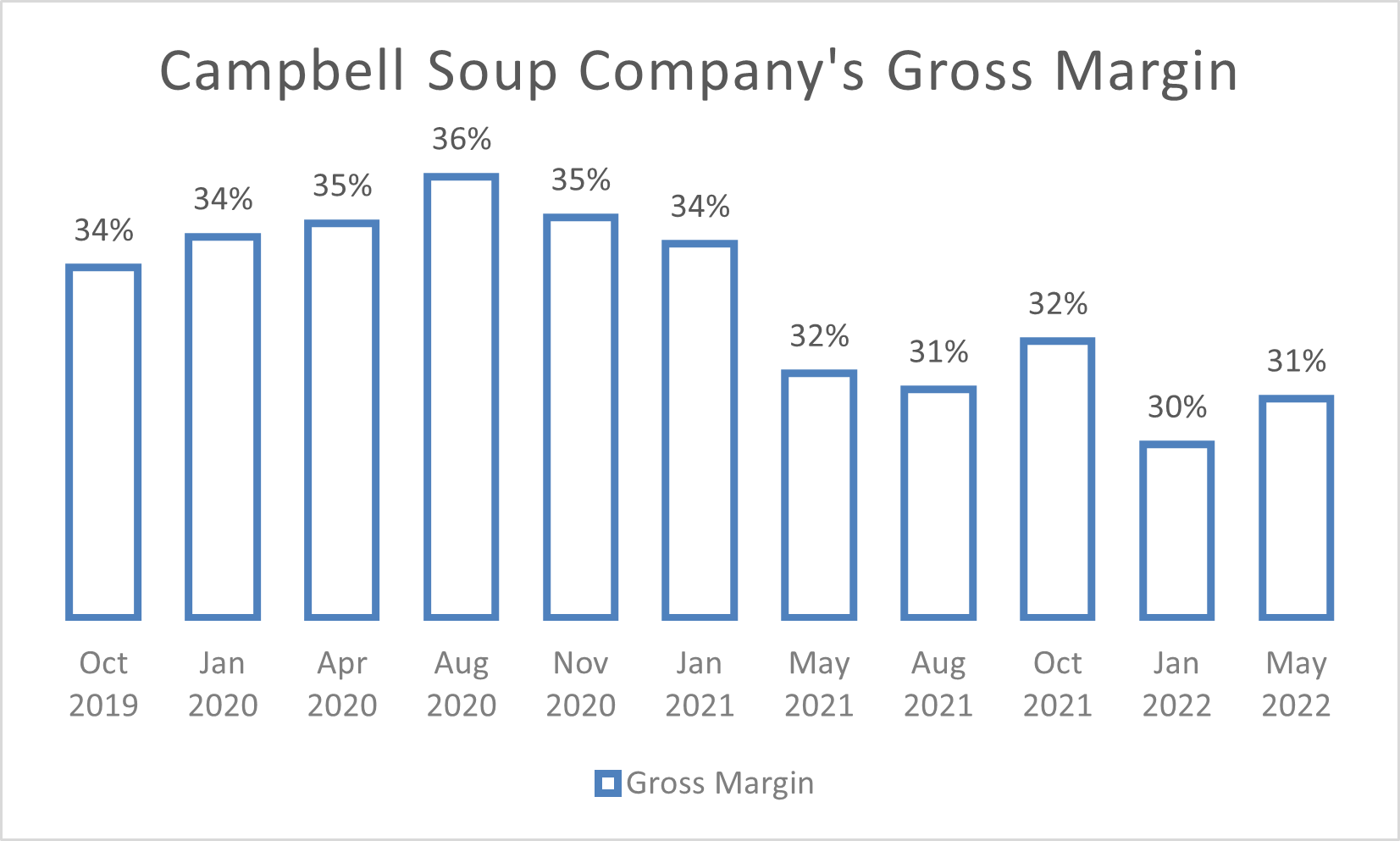
    Campbell’s Soup Company, America’s dominant soup maker, had a solid third quarter after price increases generated almost a double-digit increase in net sales. In absolute terms, the company posted sales of $2.1 billion with overall gross margins of 31%. The company has maintained margins throughout the COVID era through price increases and efficiency programs. Unlike Tyson, there isn’t any overt evidence of price gouging in the third quarter.

    Management predicts a strong end to the year due to successful innovation initiatives in crackers and leading brands in both the ready-made and condensed soup categories.

    In the question and answer portion of the call, CEO Mark Clouse answered questions about trade downs within the consumer goods world. The CPI recently reached the highest level of inflation in almost 40 years. With no future stimulus spending expected, experts expect consumers to switch from branded products to private labels. Campbell management believes it’s well-positioned.

    Let’s take condensed soup as an example, where we are seeing and expected to see some pressure from private label, you also have significant migration of trading down into the category. So that the overall category growth rates are up pretty significantly. And volumes are holding up very well, even in the face of pricing that can be double digits so far that we’ve seen.

    I think what’s been new about this or what’s been a little bit more unique than maybe what we’ve seen in the past is where we’re experiencing more of the trade down tends to be more in the baby boomer, a little bit older consumer that tends to be a bit more price sensitive. And we’re picking up a lot of these new consumers as they are moving into the category. Another great example of that is Chunky. Chunky’s pricing is up mid-teens right now. And what we’re learning is, although that seems like a lot of pricing, and it is, but for can of soup, it’s still under $3 for a large part of the population trading down into the ready-to-serve soup category becomes a very economic move for them. And that’s why on Chunky, we see right now, pricing mid-teens, consumption’s up 14 but units are still up 3%. And our volume was up 8% in the quarter.

    Clouse did not rule out additional pricing actions down the line.

    Q: I guess, Mark, in light of recent industry chatter regarding consumer behavior shifts and retailer commentary, I thought it might make sense to start with having you address this sort of building investor notion that the pricing window has sort of, all of a sudden, effectively completely closed for the industry, which obviously is an important topic given expectations for more inflation to come in — going forward in your fiscal ’23.

    A: And I think as you start to ask about future and this idea that there is no room for any more pricing, I don’t think that’s particularly accurate or realistic. I think what is true is that we’ve got to be incredibly mindful of the consumer dynamics and where consumers are relative to the elasticities that we’re experiencing and being quite strategic in our thinking about where there might be pricing and where we’re at limits and probably need to think of other tools within the bag to solve for inflation. So I certainly would hate to be sitting here today ruling out that there’s no chance for further pricing. I just think we’ve got to be very prudent about it.

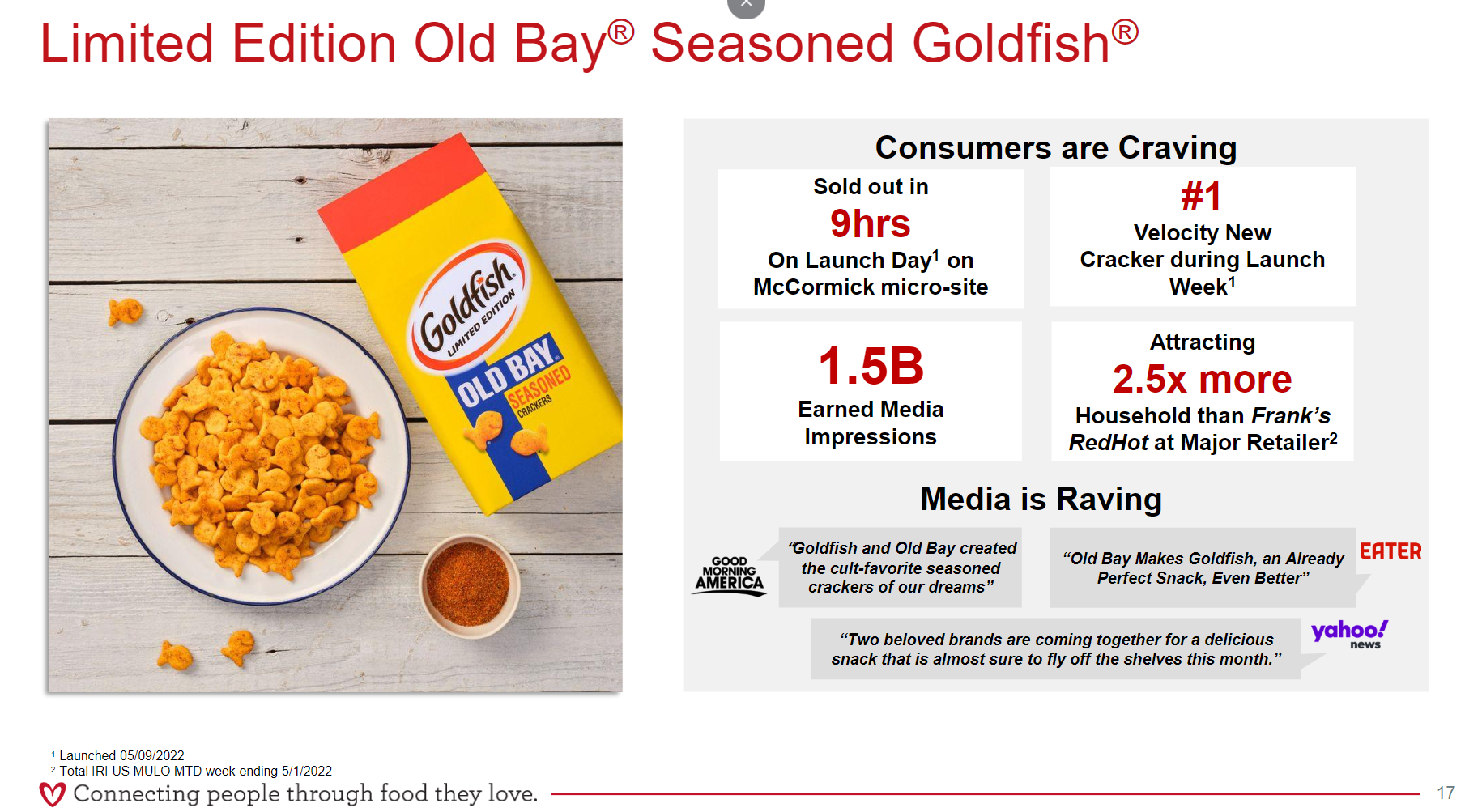
    A small part of this confidence may be due to the company’s success in innovation. Last quarter, the company did some really interesting and targeted product launches. Working with McCormick, it launched a limited-time offer for Old Bay seasoned Goldfish online and saw the product sell out in 9 hours. 

    via Campbell Soup Company 3Q Presentation

    Campbell management has done a decent job navigating the crisis. Their portfolio is still a bit processed heavy, but their strategy has been working. Combining established brands across the pricing spectrum with targeted innovation seems like a reasonable path forward.

  • A forecasting miss derails Walmart and Target

    This week management at Target and Walmart reported the worst earnings in recent memory, sending both stocks spiraling down. Shares of Target fell by 25%, while Walmart dropped by 11%. 

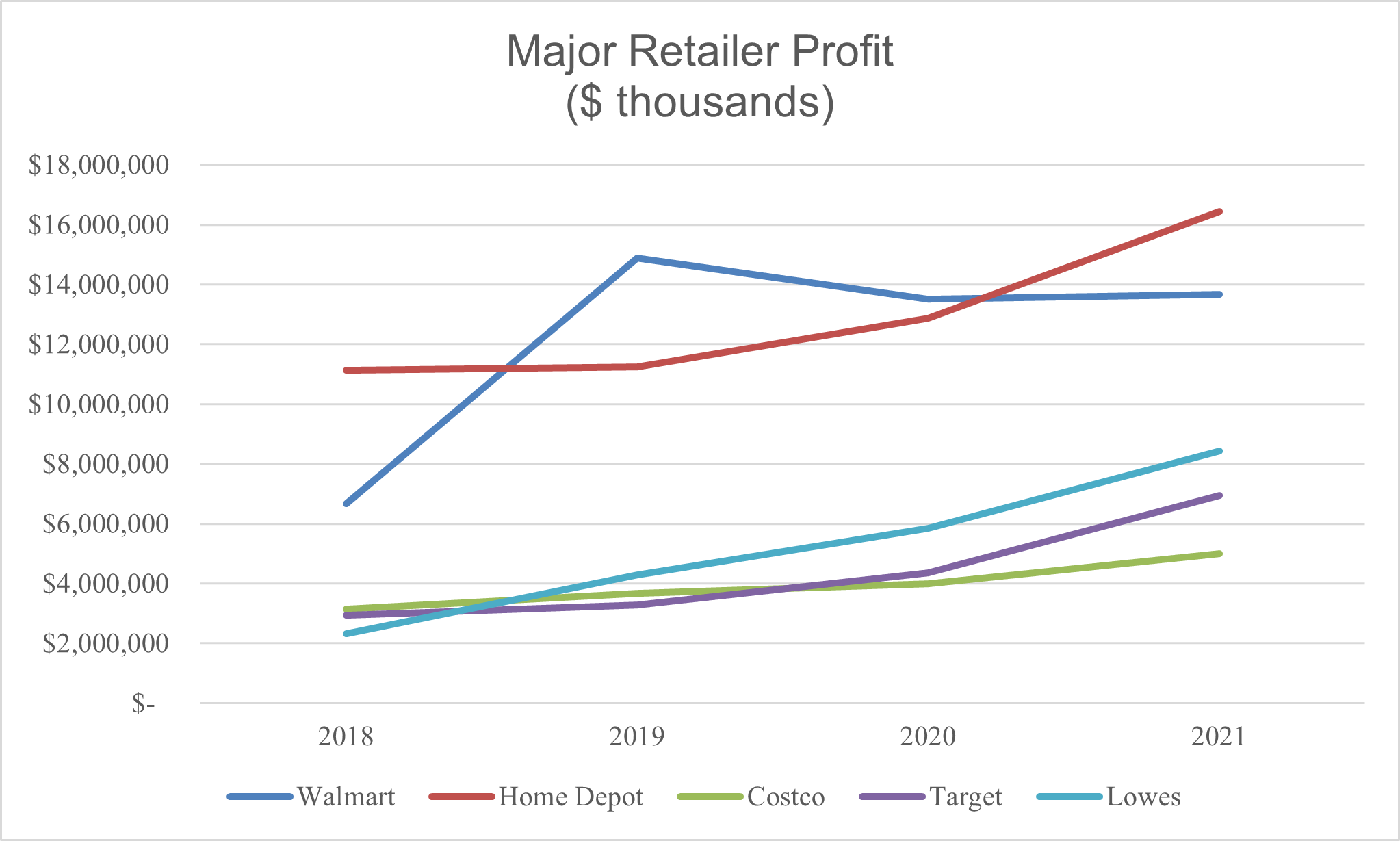
    Despite the shock, the news may be a decent sign for the American economy, as the primary culprit is an abrupt shift in consumer demand. The COVID-19 pandemic shifted consumer spending from services to goods as consumers dealt with lockdowns and quarantines. Many have argued that the resulting demand caused an onslaught of inflation by overloading an already fragile system. In the process, it enriched established retailers.

    Established retailers had the capital to accelerate a shift towards omnichannel retailing, allowing consumers to place orders online and receive the goods through pick-up or delivery. Smaller retailers weren’t so lucky. According to research by the Federal Reserve, the majority of COVID-era retailer bankruptcies were very small retailers with assets of under $95,000.

    Meanwhile, large retailers flourished.

    Select Major Retailer Net Income

    However, this era of outsized retailer profit may be ending. After 2+ years of concentrated buying, consumers finally shifted from goods and back into services.

    Here’s Brian Cornwell, Target’s CEO, talking about the switch on this week’s earnings call:

    While we anticipated a post-stimulus slowdown in these categories and we expect the consumer to continue refocusing their spending away from goods and into services, we didn’t anticipate the magnitude of that shift. As I mentioned earlier, this led us to carry too much inventory, particularly in bulky categories, including kitchen appliances, TVs and outdoor furniture. 

    While it is understandable, a forecasting miss is driving the inventory issue and the resulting markdowns. Forecasting is hard in typical years; translating demand forecasting signals into inventory is almost impossible during COVID. Everyone knew the bubble would pop, but it was essentially impossible to predict when. The result is that most retailers are carrying excess inventory. Target estimates that markdowns accounted for about 3% of its operating margin decline.

    The table below shows Walmart and Target’s inventory days. The metric looks at the time it takes for each retailer to sell inventory. Notice that Target dropped significantly during the worst part of the pandemic, only to shoot up this year. Walmart’s legendary operations saw some boost, but stayed pretty constant, until it regressed this year. In both cases, items were flowing in and out of stores at some of the highest levels in history.

    YearTargetWalmart
    201627945
    201726043
    201827243
    201927042
    202021641
    202123039
    202229848
    Target and Walmart Inventory Days via SEC Filings

    The next table shows inventory turnover. It’s a measure of how long each retailer cycles through inventory. Both firms did a great job at increasing turnover during the pandemic, only to see it drop 27% and 15% from the pandemic’s peak. 

    YearTargetWalmart
    20161.328.11
    20171.408.39
    20181.348.53
    20191.358.70
    20201.698.88
    20211.599.35
    20221.227.59
    Target and Walmart Inventory Turnover via SEC Filings

    Walmart faces similar headwinds, but its massive warehousing footprint may let it layer in rollbacks at a more measured pace. Walmart has 210 different warehouses spread across America, each with over 1 million feet of space. Last quarter, it started rolling back prices on high-margin goods like apparel and held back on larger ticket items. Target isn’t going down that route.

    It has 51 facilities across the company.

    John Mulligan, Target’s COO, explained:

    This quarter, we ended up carrying too much inventory in several categories where the slowdown in sales was more pronounced than expected, including home electronics, sporting goods, and apparel. In addition, capacity pressures were compounded by the fact that in several of these categories, including kitchen appliances, furniture, and outdoor living, items are bulkier than average and require higher-than-average amounts of storage capacity…

    Rather than jamming store sales floors with excess product, which would have made them more difficult to shop, our team secured temporary storage capacity instead. And as Christina mentioned, rather than carrying items beyond their relevant season, her team made the tougher call and marked items down to clear them and keep our presentations fresh and inspiring.

    The great unwind should be interesting.

  • All the exciting RGM work at Coca-Cola is happening internationally

    The COVID-19 recovery has been good for Coca-Cola. Globally, last quarter the sparkling beverage giant saw net revenues expand 16% to $10.5 billion. Organic revenue (acquisitions/divestitures taken out) slightly outpaced overall growth, nearing 18%. Active in hundreds of international markets, Coke has maintained operating margins above 31% via price increases, advanced revenue growth management (RGM), and commodity hedges. Management signaled that the firm may continue to raise prices despite mid-single-digit commodity inflation. Their position is that it’s better to lose some consumers through high prices than to enter a “recession being behind the curve.” 

    Revenue Growth Management at Coca-Cola

    One of the more interesting things this quarter was Coca-Cola management’s insight into its advanced RGM techniques. Like General Mills, the Atlanta-based beverage company is leveraging cross-functional teams to tailor product offerings and prices. The result is some pretty cool initiatives abroad.  

    The company recently rolled out refillable bottles in Latin America, where an ESG opportunity quickly becomes a comparative advantage. “The refillable, reusable packages tend to give you the opportunity, especially in larger sizes, to have a lower entry price point,” Coca-Cola CEO James Quincey told investors this week. The packaging and low price point caught on. Refillable bottles now account for 27% of sales in the region. In India, the company leveraged similar insights to add 500 million incremental transactions. According to the company’s press release, 70% of the transactions are attributable to “returnable glass bottles and affordable, single-serve PET packages.” 

    It’s doubtful that selling soda in reusable bottles will singlehandedly reverse climate change, but it’s still exciting to see a company introduce profitable and targeted sustainable changes at scale. However, those changes haven’t penetrated Coca-Cola’s most developed market, North America. The structure of Coke’s North American operations may be dictating the RGM possibilities. 

    In Q1 of 2022, North American operating revenue boomed to $3.6 billion, up nearly 22% from the previous year. Coca-Cola does not attribute the growth to any efficiency or sustainability program. Rather, management views smaller serving sizes (a higher per-ounce price) and pricing as primary drivers. According to internal estimates, mini can sales measured in retail dollars saw an increase of 45%. Hard to argue that this is as exciting and re-thinking the firm’s distribution.

    Coca-Cola’s North American operations are potentially driving the strategy. Domestically, the firm owns very few bottling plants. Instead, it focuses on manufacturing syrup at approximately 30 facilities and relies on a network of 90+ third-party bottling operators to bring the finished goods to consumers. The problem for the world is that it seems any sustainability program in North America must balance the interest of the bottlers, whose modern existence is dependent on a steady stream of non-reusable finished products exiting their facilities. 

    It wasn’t always that way. In the 1960s, 94% of Coca-Cola products were sold in reusable containers. Eventually, the high production and transportation cost of glass ate too much into margins and the company transitioned to plastic bottles. Today, those same pressures may be limiting Coca-Cola’s RGM options. Pack size, promotions, and price seem to dictate strategy. Quincey appears to agree. “We work with our system, our bottling partners,” he told investors, “to make sure we protect and sustain the margin structure over time.” 

  • A look at Strategic Revenue Management at General Mills

    Underneath the supply chain headlines, General Mills has built one of the more sophisticated analytical engines in American business. Last month the company behind Coco Puffs and Bisquik reported $660 million in third-quarter profit, an increase of 11% from the previous year. Compared to pre-pandemic levels, General Mills experienced a 6% growth in net sales. Perhaps the most impressive part of the achievement is that profit growth was accomplished while selling fewer products.

    The obvious culprit is that General Mills is the beneficiary of broad-based price increases driven by inflation. Price increases are a contributing factor, but a close reading of management’s comments reveals a fully integrated pricing strategy enabled by industry-leading analytics is the larger culprit. Combined with the company’s overall pricing power, it’s now paying dividends. “The pandemic,” Dana McNabb, the company’s Chief Strategy and Growth Officer, told investors at the annual CAGNY conference in February, “has highlighted the strength of our strategic revenue management capabilities.”

    Strategic Revenue Management, or revenue growth management, is a CPG industry term that refers to utilizing a variety of operational levers to increase overall firm profitability. These levers vary by company, but the four McNabb highlighted in her presentation serve as a reliable proxy for the general industry. This post will explain the four levers of strategic revenue management, and how General Mills applied them at Blue Buffalo.

    Strategic Revenue Management – The Four Levers

    In laypeople’s terms, General Mills is trying to increase the shelf price of each product by as much as it can without impacting a consumer’s demand for it. This involves careful coordination between the Finance, Sales, Supply Chain, and Innovation teams. The table below outlines the levers while explaining the interplay between the groups.

    NameDescriptionGroups(s)
    List PriceThe price General Mills wants to sell the goods to retailers before any pricing discounts. Price increases you hear about are typically done through this lever. Finance determines the targeted list price.
    Sales sell in the price increase to retailers and generate a forecast for the Supply Chain team.
    Supply Chain build forecasts to ensure product supply.
    Promotion OptimizationDetermining the right promotional price discounts to drive incremental sales.Finance: Determines budget and volume targets.
    Sales: Designs sales plan to meet targets and provides a promotional forecast for the Supply Chain team.
    Supply Chain: Ensures product supply.
    Pack Price ArchitectureDetermining the right product offering to enable the price increase. E.g., smaller pack sizes typically correlate with higher per-unit prices. However General Mills can’t simply offer all cereal in 1-ounce increments. General Mills excels at this, having seen price mixes increase each quarter.Innovation Team: Collaborates to develop new offerings at different price points across the company. E.g., It works with R&D to develop new product formulations after learning that research suggests consumers want more fiber and protein in offerings.
    Finance: Identifies the target list price for new offerings.
    Sales: Sells in the new offerings to retailers.
    Supply Chain: Ensures product supply
    Marketing Mix Management:Determining the right channel and amount to spend to drive consumer demand.Finance: Sets Budget.
    Marketing: Determines allocation.

    The Blue Buffalo Example

    About five years ago, General Mills decided to exit low-margin brands like Yoplait and enter high growth categories. Led by the $8 billion acquisition of natural pet food company Blue Buffalo, management successfully turned over about 15% of the company’s portfolio since FY18. Buying revenue is a key part of any major company’s strategic toolbox. Many purchases fall flat when management struggles to integrate new brands and opportunities into existing operations. General Mills has not had that problem, and it’s a credit to the firm’s strategic revenue management capabilities.

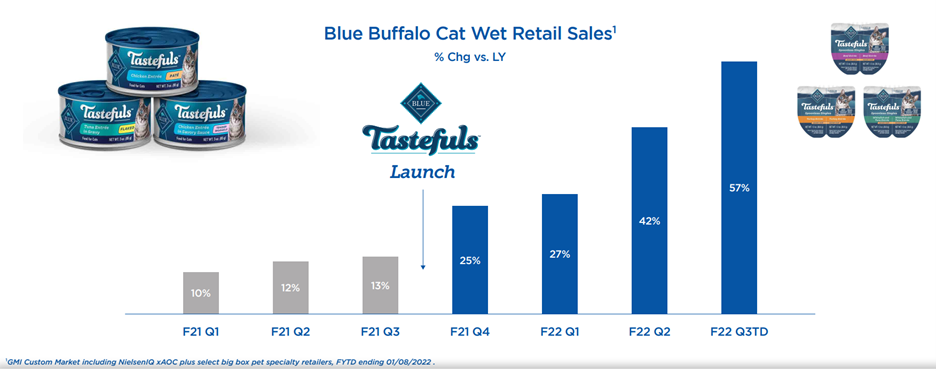
    In Q3 FY21, the firm launched Tastefuls, a single portion of wet cat food. It now controls 57% of that category, increasing 337%.

    How did SRM contribute?

    Via GIS CAGNY Presenation

    The innovation team identified unmet consumer demand in the cat wet retail market through price pack architecture. A list price signaled a premium product and margins acceptable for both General Mills and Retailers. Discounts and product placement boosted consumer trials through promotion optimization. Marketing Mix, which included digital and traditional media, drove consumer awareness.

    It’s only cat food, so it won’t make the front page of a major publication, but General Mills did an incredible job. There is also more work to be done. “Pet will be a meaningful contributor to the pricing step up we expect in Q4,” CFO Kofi Bruce told investors. Translation: The company will continue to work the list price and promotion optimization levers to raise consumer prices.

  • Constellation Brands pushes back against aggressive beer price hikes

    Leadership at Constellation Brands pushed back against instituting aggressive beer price hikes, arguing that future customer loyalty was more valuable to the company than a short-term profit boost. The New York based company, which maintains a de facto monopoly on Mexican beer imports to supplement its established wine portfolio, announced it would implement a 1-2% price increase on its beer portfolio. The increase would combat “mid to high single-digit” inflation across key inputs like wood pallets, metal, and corn. “It’s our view that this is not the time to try to put extra burden out on one of the critical things that many people have in their basket, which happens to be our beers,” CEO Bill Newland told investors last week.

    Investors seemed skeptical of the plan. The general argument is that the company had enough market power to command more than double the announced price increase. Why not take it? The answer has to do with customer profile and long term thinking. After all, the company targeted 2-4% price increases across its wine portfolio, including high single digits in the premium category.

    More and more consumers have adopted new consumption habits in the last decade. Led primarily by young people, more and more consumers are drinking wine, seltzer, or craft/import beer over a Budweiser. Constellation, which dominates the beer import market with Modelo, Corona, and Pacifico, has found itself as a bright spot in a declining segment. In 2021, after dominating store shelves for a generation, the US domestic beer market lost .8% of its volume. The import segment increased. “Imported beer and craft beer are the only segments projected to avoid volume losses in 2020 and even see gains through 2023,” an industry report declared.

    Constellation Brands has been well-positioned to capitalize on consumer tastes and preferences shifts. Last year, the firm added 30 million cases of growth and is now the number one high-end beer supplier and share gainer in America. In 2021, its flagship brand, Modelo Especial, became the number two beer brand by dollar sales. More impressive, it’s now the fifth most popular tap beer in America despite only having 11% in national distribution.

    Corona, Modelo and Pacifico are all small indulgences brands. They’re higher quality than typical mass beer while clinging to the margins of a similar price profile. From a distance, it seems as if Constellation management is doing its best to thread the needle between recovering costs while building a customer base. “We always say it’s a whole lot easier to keep your consumer,” Newland concluded, “than to lose them and have to reacquire them.”

    It will be interesting to see if investors have this same time horizon.

  • Post Holdings announced more price increases. Will it work?

    Management at Post Holdings announced earnings last week, and things aren’t looking good for the St. Louis based consumer goods holding company. Net sales increased by 12.7%, but gross profit declined by 6.9% compared to the previous year. They’re bringing in more money, but making less profit. The primary cause? Transportation and commodity inflation. “The business has underperformed.” CEO Robert Vitale told investors. 

    To Vitale and the rest of Post’s management, the solution to their underperformance isn’t re-evaluating the portfolio, a portfolio that doesn’t quite seem to fit, but price increases. “We’ve been on the wrong side of the pricing versus cost inflation,” Vitale said, “and we are attempting in fiscal ’22 to have a fairly significant catch-up on that.” Post Holding’s attempted price increases will be a good test case for 2022. Can a company with limited brand power, who operates in declining categories, continue to pass costs on to consumers? 

    Post Consumer Brands competes in a stagnant category with limited power

    In a certain way, consumer goods manufacturers are beholden to the whims of consumers. Great marketing only works so well when the category itself is in decline. It’s up to the companies to be ahead of the curve, bringing new products to market.

    Grocers and retailers are generally agnostic around what food categories they sell. They want the staples (milk, bread, and meat), but at the end of the day, a department manager isn’t that preferential to the brand on the shelves—just as long as it sells. If a category is down multiple years in a row, the category loses shelf space. It’s simple.

    Right now, cereal is a troubled category. The heydays of the mid-eighties are gone. From 1970 to the mid-1980s, cereal sales swelled from $660 million to $4.4 billion. During that era, cereal executives realized that sales would boom if they pumped grain full of sugar and bombarded the airwaves with advertisements. This strategy wasn’t without its drawbacks. It faced a mountain of bad press and eventually led to an FTC investigation.

    The category spent the next few decades flipping between a focus on sales, and health. The 1990s are best encapsulated by Rice Krispie Treat Cereal–a cereal whose per-serving sugar content rivaled Coca-Cola. The 2000s are personified by Kashi an organic cereal brand purchased by Kelloggs in 2000. In 2018, after a two decades of trying to sell healthier options, cereal manufacturers went back to the sugar playbook searching for sales.

    The Wall Street Journal explained:

    After working for years to remove the synthetic dyes in Lucky Charms’ marshmallows, General Mills has abandoned that goal and instead recently came out with a new unicorn-shaped marshmallow to boost sales. The unicorn has gotten a lot more attention from consumers than Ancient Grain Cheerios ever did, Ms. McNabb said. “Unicorns are popular. But unicorns and Lucky Charms are magical.”

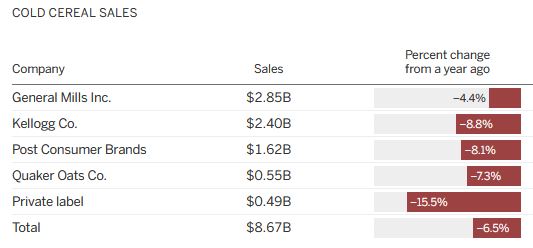
    This time the pivot to sugar didn’t work as well. Call it changing consumer sentiment if you want. In the end, category sales continued to decline from around $9 billion in 2018 to $8.6 billion today.

    Like most observers, Post CEO Vitale doesn’t see a comeback, telling analysts that his intuition is that cereal, Post’s primary business, is a “zero to 1, maybe 1.5% growth category” in the future. Making matters worse, cereal reflects around 37% of Post’s revenue each year but accounts for only 1.5% of overall grocery spending. 

    Post is a second-tier player in a stagnant category

    Despite the dozens of brands on grocery shelves, the American cereal market is dominated by General Mills, Kellogg, and Post Consumer Brands. It’s been that way for most of our lives. Nearly fifty years ago the FTC brought an antitrust lawsuit against the cereal industry, alleging that the dominant players coordinated pricing actions. The defendants are still the four largest cereal manufacturers in America.

    With about 19% of the market, Post is a distant third to its major rivals. Post is also up against some heavy price mix trends. Morningstar estimates that only 15% of its volume is premium priced, meaning the vast majority of the cereal it sells is around $.15 an ounce, while its competitors are selling for upwards of $.20.

    Just to recap the last two sections:

    1. Cereal is a stable / declining category within the grocery industry
    2. Cereal sales make up just 1.5% of grocery volumes, which means manufacturers have limited leverage against retailers
    3. Cereal is Post’s number one product
    4. Post is a distant third in the category and has limited brand power (evidenced by lower prices)

    And yet Post Holdings is looking to raise prices?

    The price increase at Post is a major consumer test

    For most of the 2000s and 2010s, the BLS’s At Home Food Index increased by 1.5%. Since grocery competition is fierce, manufacturers were mostly shy about increasing prices. Retailers are always looking for the lowest price, and if a manufacturer increased prices, it meant an opportunity for a competitor to swoop in. COVID-19 changed everything. The At Home Food Index ballooned to 6.5% compared to the previous year. Now, since everything is haywire, retailers and manufacturers seem to have implicitly agreed they have justification for mass price increases. You could certainly argue that the price increases bordered on the edge of profiteering.  

    Some companies, like P&G, sell premium products and justify the price increases through an innovation lens. Basically, we’re going to charge more, but we’re giving you more value. Others, like Kimberly-Clark, are betting on the existing power of their premium brandsWe’re going to charge more, but you’ll pay because you love us, and we dominate the shelves anyway. 

    Post Holdings is doing neither. Its brands are neither premium nor dominant. Yet here they are, raising prices.

    As I said, it’s going to be a big test. 
  • Kimberly-Clark signals more diaper inflation, and that’s just the start

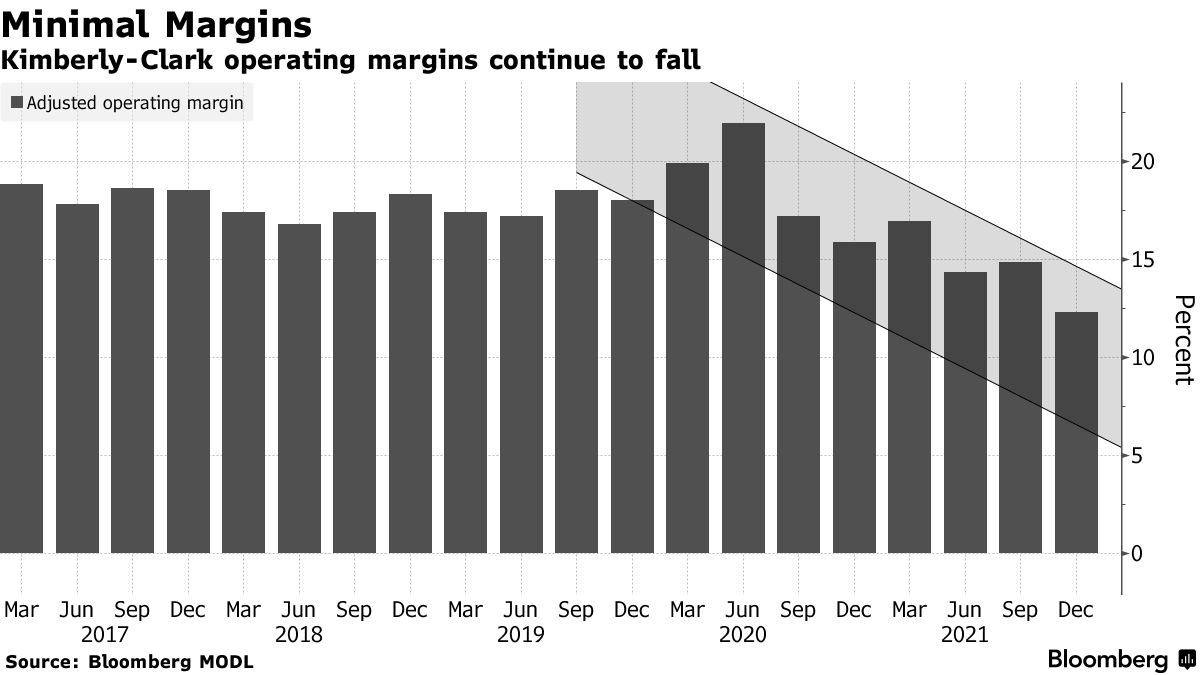
    Kimberly-Clark, the personal care giant, is facing unprecedented inflation across most aspects of its business and is struggling to maintain operating margins. “We are committed to recovering and eventually expanding our margins,” CEO Mike Hsu told investors. The company, which owns Huggies and Kleenex brands, saw a rapid decline in its operating margin since June 2020. The recovery strategy is almost singlehandedly reliant on price increases. While it could work, it also means that diaper inflation is still on the menu for 2022.

    Image via Bloomberg

    Raw material inflation is harming Kimberly-Clark 

    A mixture of supply chain bottlenecks, COVID-19, and increased demand means that almost every consumer goods company is facing unprecedented inflation right now. Kimberly-Clark is no different. The company saw input costs rise by $1.5 billion year-over-year. According to management, that’s double the previous high of 2018.

    Manufacturers like Kimberly-Clark often manage commodity purchases through yearly contracts. These contracts reset every year. With most of the inflation happening in the back half of 2021, the contracts reset to higher prices in January. Here’s how CFO Mario Henry estimated the impact of key components:

    • Fluff Pulp – UP
    • Recycled Fiber – UP
    • Nonwoven – UP
    • Super-absorbents – UP SIZABLY
    • Distribution – UP
    • Traditional Commodities – DOWN

    Based on the rising cost of these commodities, Kimberly-Clark estimates an additional increase of $750m – $900m in 2022.

    Diaper inflation is just the start

    Last year I wrote about how KMB management signaled that the company would manage inflation via targeted price increases on premium products. Well, that was wishful thinking. Last March, the company raised prices on 60% of its consumer business by mid-to-high single digits. That action continued, with the company raising prices across North America every quarter in FY2021. Hsu expects more down the line. “I would say we’re expecting our teams to be able to price to offset the majority of the inflation,” he reassured investors.

    Q1 – 2021Q2 – 2021Q3 – 2021Q4 – 2021
    2%2%5%5%
    Average KMB NA Price Increase across all SKUs (via company communications)

    Although it may just be incidental, one thing that is interesting to me is the framing. P&G announced similar price increases this month. However, management framed the increases around innovation. P&G’s strategy is based around combining new product benefits with price increases—resulting in consumers “trading up” the category.

    I haven’t seen much pretense of this in Kimberly-Clark’s management’s remarks. It’s somewhat odd because the company has a rich history of innovation—creating 5 of the major product categories it competes in today. 

    This approach seems somewhat risky, as management admits that the unprecedented times means forecasting isn’t as insightful as it once was—particularly around elasticities. “The trick of the elasticity modeling,” Hsu said, “is we’re beyond the range of estimations, So you’re kind of estimating what’s happened historically, and the price points are higher than they’ve been.”

    Instead, the company is betting on the power of its brands and existing sales and distribution network.

    Hsu concludes:

    What I can tell you though is that I’m very confident that we will take take the right actions to recover the margins of the business, whatever that looks like. So we’ve shared with you what our assumptions are for 2022 in terms of all of the moving pieces. And if it turns out to be different than that, if there turns out to be upside, that’s great for all of us. If it turns out that the environment is rougher than what we’re thinking, we’ll take the right action.

    So if inflation continues to run, we’ll continue to price. We’ll continually look at the cost structure of the business and take the right actions.