Category: Companies

  • All the exciting RGM work at Coca-Cola is happening internationally

    The COVID-19 recovery has been good for Coca-Cola. Globally, last quarter the sparkling beverage giant saw net revenues expand 16% to $10.5 billion. Organic revenue (acquisitions/divestitures taken out) slightly outpaced overall growth, nearing 18%. Active in hundreds of international markets, Coke has maintained operating margins above 31% via price increases, advanced revenue growth management (RGM), and commodity hedges. Management signaled that the firm may continue to raise prices despite mid-single-digit commodity inflation. Their position is that it’s better to lose some consumers through high prices than to enter a “recession being behind the curve.” 

    Revenue Growth Management at Coca-Cola

    One of the more interesting things this quarter was Coca-Cola management’s insight into its advanced RGM techniques. Like General Mills, the Atlanta-based beverage company is leveraging cross-functional teams to tailor product offerings and prices. The result is some pretty cool initiatives abroad.  

    The company recently rolled out refillable bottles in Latin America, where an ESG opportunity quickly becomes a comparative advantage. “The refillable, reusable packages tend to give you the opportunity, especially in larger sizes, to have a lower entry price point,” Coca-Cola CEO James Quincey told investors this week. The packaging and low price point caught on. Refillable bottles now account for 27% of sales in the region. In India, the company leveraged similar insights to add 500 million incremental transactions. According to the company’s press release, 70% of the transactions are attributable to “returnable glass bottles and affordable, single-serve PET packages.” 

    It’s doubtful that selling soda in reusable bottles will singlehandedly reverse climate change, but it’s still exciting to see a company introduce profitable and targeted sustainable changes at scale. However, those changes haven’t penetrated Coca-Cola’s most developed market, North America. The structure of Coke’s North American operations may be dictating the RGM possibilities. 

    In Q1 of 2022, North American operating revenue boomed to $3.6 billion, up nearly 22% from the previous year. Coca-Cola does not attribute the growth to any efficiency or sustainability program. Rather, management views smaller serving sizes (a higher per-ounce price) and pricing as primary drivers. According to internal estimates, mini can sales measured in retail dollars saw an increase of 45%. Hard to argue that this is as exciting and re-thinking the firm’s distribution.

    Coca-Cola’s North American operations are potentially driving the strategy. Domestically, the firm owns very few bottling plants. Instead, it focuses on manufacturing syrup at approximately 30 facilities and relies on a network of 90+ third-party bottling operators to bring the finished goods to consumers. The problem for the world is that it seems any sustainability program in North America must balance the interest of the bottlers, whose modern existence is dependent on a steady stream of non-reusable finished products exiting their facilities. 

    It wasn’t always that way. In the 1960s, 94% of Coca-Cola products were sold in reusable containers. Eventually, the high production and transportation cost of glass ate too much into margins and the company transitioned to plastic bottles. Today, those same pressures may be limiting Coca-Cola’s RGM options. Pack size, promotions, and price seem to dictate strategy. Quincey appears to agree. “We work with our system, our bottling partners,” he told investors, “to make sure we protect and sustain the margin structure over time.” 
  • A look at Strategic Revenue Management at General Mills

    Underneath the supply chain headlines, General Mills has built one of the more sophisticated analytical engines in American business. Last month the company behind Coco Puffs and Bisquik reported $660 million in third-quarter profit, an increase of 11% from the previous year. Compared to pre-pandemic levels, General Mills experienced a 6% growth in net sales. Perhaps the most impressive part of the achievement is that profit growth was accomplished while selling fewer products.

    The obvious culprit is that General Mills is the beneficiary of broad-based price increases driven by inflation. Price increases are a contributing factor, but a close reading of management’s comments reveals a fully integrated pricing strategy enabled by industry-leading analytics is the larger culprit. Combined with the company’s overall pricing power, it’s now paying dividends. “The pandemic,” Dana McNabb, the company’s Chief Strategy and Growth Officer, told investors at the annual CAGNY conference in February, “has highlighted the strength of our strategic revenue management capabilities.”

    Strategic Revenue Management, or revenue growth management, is a CPG industry term that refers to utilizing a variety of operational levers to increase overall firm profitability. These levers vary by company, but the four McNabb highlighted in her presentation serve as a reliable proxy for the general industry. This post will explain the four levers of strategic revenue management, and how General Mills applied them at Blue Buffalo.

    Strategic Revenue Management – The Four Levers

    In laypeople’s terms, General Mills is trying to increase the shelf price of each product by as much as it can without impacting a consumer’s demand for it. This involves careful coordination between the Finance, Sales, Supply Chain, and Innovation teams. The table below outlines the levers while explaining the interplay between the groups.

    NameDescriptionGroups(s)
    List PriceThe price General Mills wants to sell the goods to retailers before any pricing discounts. Price increases you hear about are typically done through this lever. Finance determines the targeted list price.
    Sales sell in the price increase to retailers and generate a forecast for the Supply Chain team.
    Supply Chain build forecasts to ensure product supply.
    Promotion OptimizationDetermining the right promotional price discounts to drive incremental sales.Finance: Determines budget and volume targets.
    Sales: Designs sales plan to meet targets and provides a promotional forecast for the Supply Chain team.
    Supply Chain: Ensures product supply.
    Pack Price ArchitectureDetermining the right product offering to enable the price increase. E.g., smaller pack sizes typically correlate with higher per-unit prices. However General Mills can’t simply offer all cereal in 1-ounce increments. General Mills excels at this, having seen price mixes increase each quarter.Innovation Team: Collaborates to develop new offerings at different price points across the company. E.g., It works with R&D to develop new product formulations after learning that research suggests consumers want more fiber and protein in offerings.
    Finance: Identifies the target list price for new offerings.
    Sales: Sells in the new offerings to retailers.
    Supply Chain: Ensures product supply
    Marketing Mix Management:Determining the right channel and amount to spend to drive consumer demand.Finance: Sets Budget.
    Marketing: Determines allocation.

    The Blue Buffalo Example

    About five years ago, General Mills decided to exit low-margin brands like Yoplait and enter high growth categories. Led by the $8 billion acquisition of natural pet food company Blue Buffalo, management successfully turned over about 15% of the company’s portfolio since FY18. Buying revenue is a key part of any major company’s strategic toolbox. Many purchases fall flat when management struggles to integrate new brands and opportunities into existing operations. General Mills has not had that problem, and it’s a credit to the firm’s strategic revenue management capabilities.

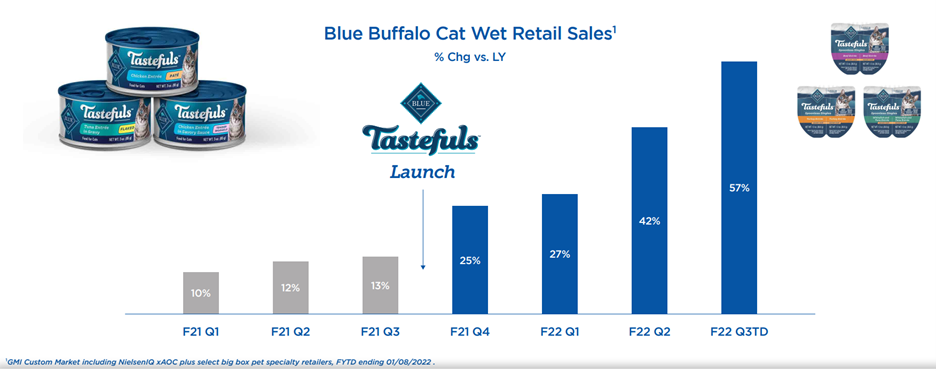
    In Q3 FY21, the firm launched Tastefuls, a single portion of wet cat food. It now controls 57% of that category, increasing 337%.

    How did SRM contribute?

    Via GIS CAGNY Presenation

    The innovation team identified unmet consumer demand in the cat wet retail market through price pack architecture. A list price signaled a premium product and margins acceptable for both General Mills and Retailers. Discounts and product placement boosted consumer trials through promotion optimization. Marketing Mix, which included digital and traditional media, drove consumer awareness.

    It’s only cat food, so it won’t make the front page of a major publication, but General Mills did an incredible job. There is also more work to be done. “Pet will be a meaningful contributor to the pricing step up we expect in Q4,” CFO Kofi Bruce told investors. Translation: The company will continue to work the list price and promotion optimization levers to raise consumer prices.

  • Constellation Brands pushes back against aggressive beer price hikes

    Leadership at Constellation Brands pushed back against instituting aggressive beer price hikes, arguing that future customer loyalty was more valuable to the company than a short-term profit boost. The New York based company, which maintains a de facto monopoly on Mexican beer imports to supplement its established wine portfolio, announced it would implement a 1-2% price increase on its beer portfolio. The increase would combat “mid to high single-digit” inflation across key inputs like wood pallets, metal, and corn. “It’s our view that this is not the time to try to put extra burden out on one of the critical things that many people have in their basket, which happens to be our beers,” CEO Bill Newland told investors last week.

    Investors seemed skeptical of the plan. The general argument is that the company had enough market power to command more than double the announced price increase. Why not take it? The answer has to do with customer profile and long term thinking. After all, the company targeted 2-4% price increases across its wine portfolio, including high single digits in the premium category.

    More and more consumers have adopted new consumption habits in the last decade. Led primarily by young people, more and more consumers are drinking wine, seltzer, or craft/import beer over a Budweiser. Constellation, which dominates the beer import market with Modelo, Corona, and Pacifico, has found itself as a bright spot in a declining segment. In 2021, after dominating store shelves for a generation, the US domestic beer market lost .8% of its volume. The import segment increased. “Imported beer and craft beer are the only segments projected to avoid volume losses in 2020 and even see gains through 2023,” an industry report declared.

    Constellation Brands has been well-positioned to capitalize on consumer tastes and preferences shifts. Last year, the firm added 30 million cases of growth and is now the number one high-end beer supplier and share gainer in America. In 2021, its flagship brand, Modelo Especial, became the number two beer brand by dollar sales. More impressive, it’s now the fifth most popular tap beer in America despite only having 11% in national distribution.

    Corona, Modelo and Pacifico are all small indulgences brands. They’re higher quality than typical mass beer while clinging to the margins of a similar price profile. From a distance, it seems as if Constellation management is doing its best to thread the needle between recovering costs while building a customer base. “We always say it’s a whole lot easier to keep your consumer,” Newland concluded, “than to lose them and have to reacquire them.”

    It will be interesting to see if investors have this same time horizon.

  • Kimberly-Clark signals more diaper inflation, and that’s just the start

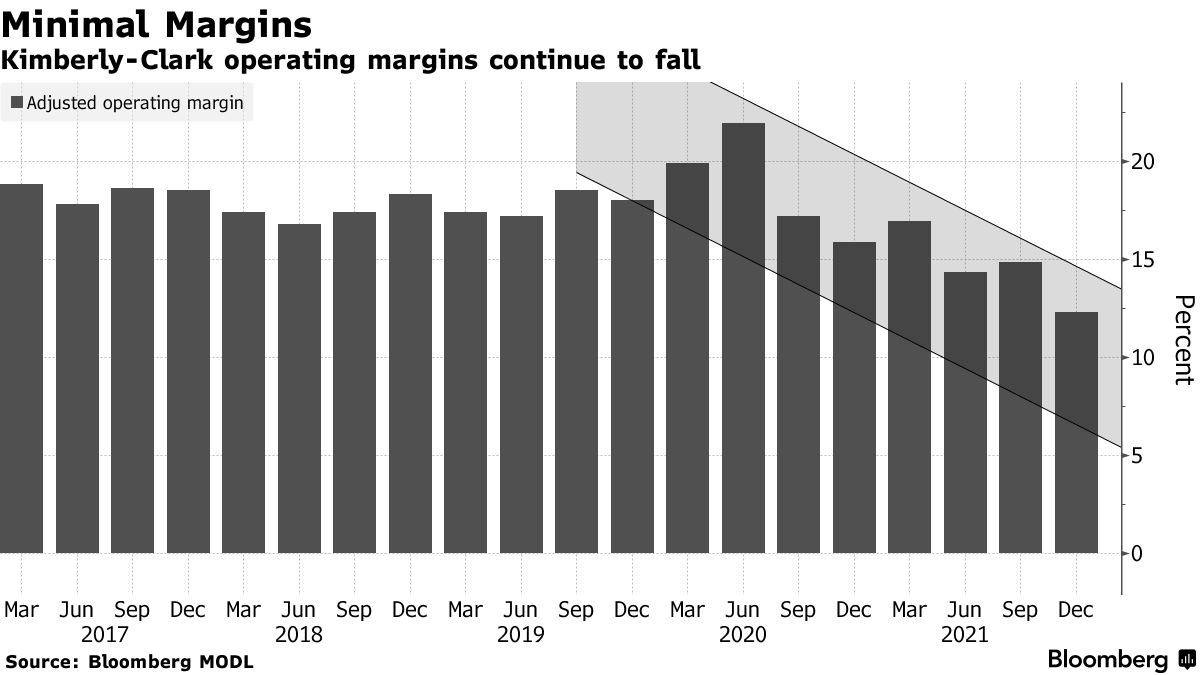
    Kimberly-Clark, the personal care giant, is facing unprecedented inflation across most aspects of its business and is struggling to maintain operating margins. “We are committed to recovering and eventually expanding our margins,” CEO Mike Hsu told investors. The company, which owns Huggies and Kleenex brands, saw a rapid decline in its operating margin since June 2020. The recovery strategy is almost singlehandedly reliant on price increases. While it could work, it also means that diaper inflation is still on the menu for 2022.

    Image via Bloomberg

    Raw material inflation is harming Kimberly-Clark 

    A mixture of supply chain bottlenecks, COVID-19, and increased demand means that almost every consumer goods company is facing unprecedented inflation right now. Kimberly-Clark is no different. The company saw input costs rise by $1.5 billion year-over-year. According to management, that’s double the previous high of 2018.

    Manufacturers like Kimberly-Clark often manage commodity purchases through yearly contracts. These contracts reset every year. With most of the inflation happening in the back half of 2021, the contracts reset to higher prices in January. Here’s how CFO Mario Henry estimated the impact of key components:

    • Fluff Pulp – UP
    • Recycled Fiber – UP
    • Nonwoven – UP
    • Super-absorbents – UP SIZABLY
    • Distribution – UP
    • Traditional Commodities – DOWN

    Based on the rising cost of these commodities, Kimberly-Clark estimates an additional increase of $750m – $900m in 2022.

    Diaper inflation is just the start

    Last year I wrote about how KMB management signaled that the company would manage inflation via targeted price increases on premium products. Well, that was wishful thinking. Last March, the company raised prices on 60% of its consumer business by mid-to-high single digits. That action continued, with the company raising prices across North America every quarter in FY2021. Hsu expects more down the line. “I would say we’re expecting our teams to be able to price to offset the majority of the inflation,” he reassured investors.

    Q1 – 2021Q2 – 2021Q3 – 2021Q4 – 2021
    2%2%5%5%
    Average KMB NA Price Increase across all SKUs (via company communications)

    Although it may just be incidental, one thing that is interesting to me is the framing. P&G announced similar price increases this month. However, management framed the increases around innovation. P&G’s strategy is based around combining new product benefits with price increases—resulting in consumers “trading up” the category.

    I haven’t seen much pretense of this in Kimberly-Clark’s management’s remarks. It’s somewhat odd because the company has a rich history of innovation—creating 5 of the major product categories it competes in today. 

    This approach seems somewhat risky, as management admits that the unprecedented times means forecasting isn’t as insightful as it once was—particularly around elasticities. “The trick of the elasticity modeling,” Hsu said, “is we’re beyond the range of estimations, So you’re kind of estimating what’s happened historically, and the price points are higher than they’ve been.”

    Instead, the company is betting on the power of its brands and existing sales and distribution network.

    Hsu concludes:

    What I can tell you though is that I’m very confident that we will take take the right actions to recover the margins of the business, whatever that looks like. So we’ve shared with you what our assumptions are for 2022 in terms of all of the moving pieces. And if it turns out to be different than that, if there turns out to be upside, that’s great for all of us. If it turns out that the environment is rougher than what we’re thinking, we’ll take the right action.

    So if inflation continues to run, we’ll continue to price. We’ll continually look at the cost structure of the business and take the right actions.

  • Operations and Pricing – What we can learn from the recent P&G price increase

    Procter & Gamble announced it would raise prices across its portfolio. P&G, which owns over 20 different billion-dollar brands, including Head & Shoulders, Crest, Pampers, and Tide, is making a bet that the power of its brands is greater than consumers’ shrinking wallets. In doing so, the Cincinnati-based consumer goods giant joins the ever-growing list of companies who plan to pass inflation onto consumers. This shouldn’t surprise many people. The announced P&G price increase is in line with what you’d expect given the company’s operations and pricing strategy.

    The relationship between pricing and operations

    The relationship between pricing and operations is straightforward. If a company’s product is a commodity, it won’t be able to demand higher prices. That means it will struggle to gain any cost advantages through branding and must achieve it through operational efficiencies. Outside of the decline of anti-trust enforcement, this was the core reason Walmart succeeded so rapidly. It flawlessly aligned an every-day-low-price approach with streamlined operations.

    TreeHouse Foods, which specializes in private label packaged foods, earns its’ profit this way. Now, faced with rising commodity and transportation costs, the company faces sparse operating margins–around 3%. Meanwhile, P&G, which faces the same headwinds but owns powerful brands, has operating margins of about 22%.

    If TreeHouse reduced operating costs by 1%, it would have a massive impact on its profitability. To achieve that same impact via increased sales revenue, it would need to increase revenue by (.01/.026) 39%. That’s not remotely realistic. Meanwhile, P&G, with its high operating margins, would need to increase revenue by (= .01/.22) about 4.5 percentage points.

    The table below shows the corresponding revenue increase needed to match a one percent decrease in operational costs across a few private label and branded CPG firms. One interesting thing to point out is that Kimberly-Clark is P&G’s biggest competitor in the disposable diaper market. It also has a significant private label presence.

    CompanyOperating MarginRevenue increase
    (per 1% decrease in operating cost)
    Clorox22.7%4.4%
    P&G22.4%4.5%
    Church and Dwight21.4%4.6%
    Kimberly-Clark13.8%7.2%
    Spectrum Brands3.2%31.3%
    TreeHouse Foods2.6%38%

    What does this mean?

    Typically, branded companies could drive increased sales through more trade promotions or marketing spend. Trade and marketing drive more volume. This of course comes with added cost.

    However, with inflation on everyone’s mind, branded firms seem to be piggybacking on inflation. For the strongest brands, they can add potentially add sales growth entirely through higher prices.

    During the investor call, P&G CEO Andre Schulten played down any operational improvement work.

    Number one, when you think about cost savings projects, they require line time, that line time is competing with the need to ship cases in a very constrained supply chain. When we think about innovation, we frequently talk about our desire to close price increases with innovation. Innovation also needs line time. So cost savings projects on the line also compete with innovation, and they compete with our desire and need to ship the business. Therefore, in a constrained environment, as you point out, our businesses make the decision to focus on innovation, focus on shipping the business, which is better for retailers better for consumers, better for us in terms of value creation, but it has an impact on cost savings. The good news is these cost savings are available to us in the future; they don’t go anywhere. But you see a little bit slower ramp-up in that context.

    The P&G price increase summed up

    Essentially, P&G is betting that the higher prices it will charge through innovation will make up for the lack of any increase in operational efficiencies.

    Now is the time to point out that P&G is estimating that organic sales revenue for FY22 will increase 4-5%, which is right in line with the simple calculation above.

  • Retail Media Networks and Slotting Fees

    In 2017, Amazon made a fateful decision. It quit being a retailer who happened to sell online and became a retail media network.

    Previously, Amazon’s retail model was simple. Users searched for what they were looking for, and its algorithm delivered the relevant results to purchase. The process was fairly neutral—derived from a straightforward algorithm based on customer reviews. A better product and solid merchandising meant more sales.

    With retail media networks, it’s different.

    Brad Stone explains in his book Amazon Unbound:

    Amazon’s search results had evolved from a straightforward, algorithmically ordered taxonomy of products into an over-merchandised display of sponsored ads, Amazon Choice endorsements, editorial recommendations from third-party websites, and the company’s own private brands. In some product categories, only two organic search results appeared on an entire page of results. Since brands and sellers could no longer count on customers finding their products the old-fashioned way, through the site’s search engine, they were even further inclined to open up their wallets and spend money on search ads.

    This transition has been incredibly lucrative, and we’ve seen Walmart, Target, Lowe’s, and Dollar General launch their own retail media networks in the last year. According to Forrester Research, the market could be worth $50 billion next year.

    What does this mean for CPG companies?

    What are Retail Media Networks?

    First things first, we need to define what Retail Media is. At its simplest, Retail Media is spending advertising dollars on retailers’ websites. A Retail Media Network is the platform that retailers build to manage that spend. It gets a bit more nuanced as some retailers, like Walmart and Target, have omnichannel capabilities. For example, manufacturers can bid on search results on Walmart.com and purchase in-store video displays through Walmart Connect. In Target’s case, CPG companies can buy advertisements on Target.com, Target in-store, and across NBC Universal media properties.

    One way to think about retail media networks are as an evolution of slotting fees.

    Traditional brick-and-mortar retailers had limited shelf space. Retailers could only hold so much physical inventory. One way to ensure management optimized revenue/square foot was to charge slotting or pay-to-stay fees. Manufacturers pay slotting fees for the right to be on the shelf. Not all retailers charge slotting fees. EDLP retailers like Costco and Walmart do not–although you could argue they just build it into the price.

    Proponents would say that retailers and manufacturers are commerce partners and that the fees offset risk within the system. The reality is retailers charge slotting and pay-to-stay fees because manufacturers have no choice but to pay them. A manufacturer is reliant on the retailer to reach consumers. It makes no money if it can’t reach consumers.

    E-commerce is in a similar situation. Online storefronts have unlimited shelf space, but the only real estate that really matters is the first page. Research suggests that first page results command around 91% of search traffic. Enter retail media. This real estate is incredibly valuable, and most retail media networks have some version of “Sponsored Products.” Manufacturers pay-per-click for targeted advertising with a chosen set of keywords.

    SlottingRetail Media Network
    Deal ManagementCentralizedCentralized
    Planning LevelCategoryKeyword (arguably PPG)
    Shelf ManagementManual – physical store shelfAutomated
    Fee TypeFixedVariable (CPC)

    What explains the rise of Retail Media Networks?

    It’s easy money for retailers.

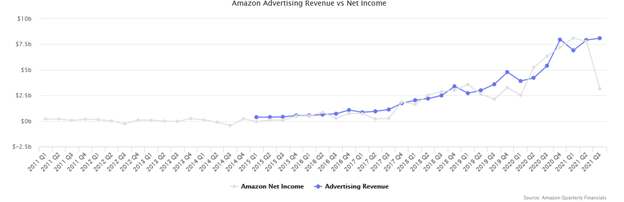
    Unlike slotting, which is also easy money, individuals don’t have to stock shelves every time a company outbids another. All this income is effectively free profit. Most retail media networks are self-service portals, and the marginal cost of adjusting product search results is effectively zero. Last year, Amazon Advertising reached $7.5 billion in revenue—all profit.

    Don’t believe me? Let’s take a look at its impact at Amazon. Here’s an amazing graph that charted Amazon Advertising Revenue and the company’s overall net income. There’s a clear correlation.

    Are Retail Media Networks a good investment for CPG Brands?

    One of the more interesting aspects of the retail media network debates is this idea, often repeated by the well-intentioned analysts, is that manufacturers are okay with paying these fees because it offers unique targeting. While this may turn out to be true in the long run, it’s certainly not backed by data today.

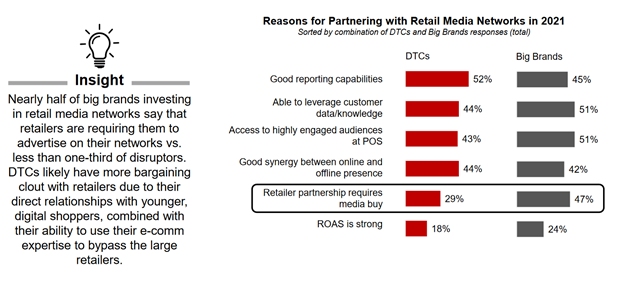
    A recent IAB survey asked CPG companies why they paid for placement in Retail Media Networks; 47% of ‘big brand’ consumer goods companies made the investments because the retailer required the media buy. Just 24% did so because of the strong return on their advertising investment.

    Via: IAB Brand Disruption 2022

    This sentiment is strikingly consistent across the e-commerce landscape.

    Again, Brad Stone explains:

    A bipartisan report by the U.S. House antitrust subcommittee would later disapprovingly conclude that Amazon “may require sellers to purchase their advertising services as a condition of making sales” on the site since consumers only tend to look at the first page of search results.

    However, I don’t think that it’s all negative.

    From a brand perspective, right now, the major advantage of retail media networks are twofold: First Mover Advantage and that they’re variable costs.

    Right now, e-commerce is still the wild-west of consumer goods retail, and due to the reliance on algorithms, e-commerce features an inherent lock-in effect for many consumers. Once a consumer buys something through Walmart.com, the product will be forever attached to the profile—potentially locking in future sales. Since these costs are variable, rather than up-front flat fees like slotting, make it ideal for new product introductions. After all, would you rather pay $200,000 to introduce an SKU in 40 physical locations without any knowledge of its popularity or run a few targeted tests online?

     What does this mean?

    I think the writing on the wall is pretty clear. Retail media networks aren’t exciting avenues for growth—but rather an electronic extension of slotting fees.

    In short, business as usual.

  • Conagra Brands Makes An Interesting E-commerce Push

    On January 6, 2022, Conagra Brands held its FY22 Q2 earnings call. Overall, the quarter was worse than expected, with inflation eating significantly into profits. Operating margin dropped to 14.6%, down from almost 20% the quarter prior. However, no one is panicking as most people assume the problems are only temporary. “We expect margins to improve in the second half of the fiscal year,” CEO Sean Connolly told investors, “as a result of the levers we pulled and continue to pull to manage the impact of inflation.” One reason for optimism is Conagra Brands’ e-commerce strategy, which, combined with management’s view on competition, makes the Chicago-based company one of the more interesting companies in the CPG space.

    That’s probably a weird sentence to read, and trust me, it was an odd sentence to write but stay with me. Conagra Brand’s biggest portfolio is frozen foods, a category under constant attack by upstarts and effectively incompatible with direct-to-consumer models. Birds Eye, a frozen brand they purchased in 2018, is effectively a commodity. Its most profitable category, snacks, goes against almost all health trends within consumer goods. Its last category, staples, has incredibly low margins. Management still focuses on efficiency, but as this article will show, are still focused on modern industry trends.

    In a way, being outside of most trends makes Conagra one of the most interesting companies, precisely because their approach will be different than ones with brands native to new trends.

    Conagra Brands’ e-commerce strategy

    Conagra Brand’s advertising and promotional (A&P) spending has changed drastically over the last decade. In the past, branded consumer products companies invested heavily in television and radio advertising to build brand awareness among consumers. This can work, but it’s also really inefficient.

    Recently, Conagra shifted this spending towards what I’d call algorithmic trade.

    Connolly explains emphasis mine

    So I would say, we made the decision a few years back to treat e-commerce as a bit of a start-up business and we said we are going to invest in it.

    So we have been, I would say, over investing relative to other areas in e-commerce because it’s far more elastic. We see the business. We get the purchases started in consumers’ basket and it’s both pure blood e-trailers and brick-and-mortar retailers who have built out their e-commerce platforms. Both of them have been very high-growth areas for us and very strong investment areas for us.

    And what we found is that, there is a good ROI on these investments in e-commerce, because once we invest to kind of getting into the getting into consumer repertoire and are part of their shopping algorithm online it that translates to a repeat purchase. So, we get them when they come back whatever the purchase cycle is for that product. So that’s been one of our key marketing shift there is to go hard after e-commerce the last few years, and we are very happy with the returns and that’s why we continue to invest there.

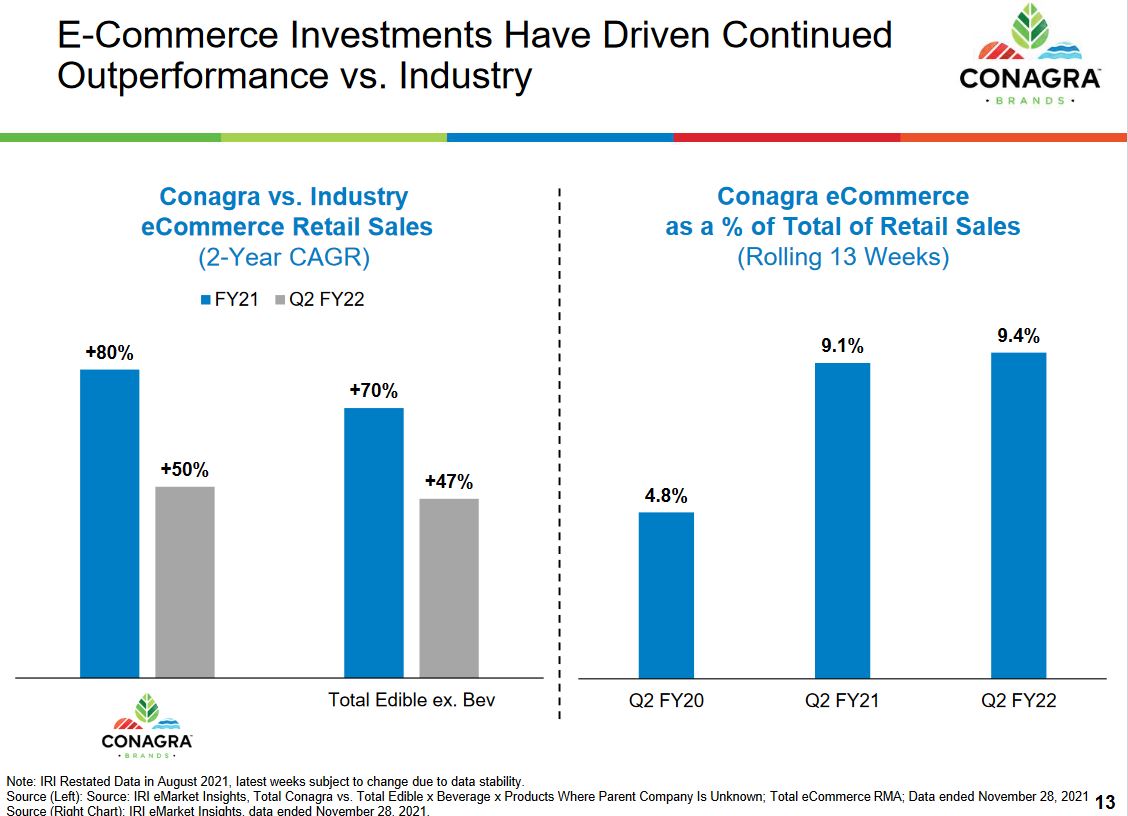
    Basically, Conagra’s e-commerce strategy involves over-investing in the initial customer acquisition with the idea that products automatically show up in users’ shopping carts. The approach is working. Conagra outpaces its’ competition in terms of e-commerce growth (note: we don’t know if this is profitable growth).

    Source: Conagra’s 2022 Q2 Presentation

    In a sense, it’s trade spend because they are spending money for presumably prime placement in search results. On the other hand, it’s not because it’s really about being looped into an algorithm’s recommendation cycle. Either way, it’s very smart, especially if you’re selling staples and frozen foods—things consumers don’t necessarily spend a whole lot of time thinking about. 

    A view on competition in packaged foods

    Earlier in the call, management was asked about price increases and if they’ve experienced any pushback. The short answer is no. The longer answer is a nice statement on how consumer goods companies need to view themselves.

    Connolly explains:

    Previously, a consumer’s comparison of choices was between close proximity items inside the grocery store. Today, due to the demographic dynamics I talked about around young consumers’ home nesting as well as the huge move to working from home. The biggest comparison taking place from a value standpoint is between away-from-home choices and at-home choices…The comparator today is we are selling a product that might have been $2.69, and it might go up to $2.89 or something like that, versus the alternative is to go away-from-home where prices have increased even faster, and it’s $14.50. 

    That’s thinking ahead of the curve. Exactly what you’d expect out of a company that sells frozen peas.

  • General Mills to use pricing power to maintain margins in 2022.

    General Mills had a fairly good quarter, continuing a string of success that most branded consumer goods companies have had over the pandemic. It had $5 billion in revenue over the last three months, 6% higher than the year before. However, profit declined 13%–caused mostly by inflation. How does the Minnesota-based company plan to get that profit back? During its’ recent investor call, General Mills made it clear it will use its pricing power.

    What is pricing power?

    There’s a lot of different technical definitions of pricing power within the consumer goods industry. It’s a high stakes game with billions of dollars at risk. At a high level, brands want to charge as much as possible for products, but not too much where it impacts the overall demand for it. This interplay between price and demand is called elasticity.

    Products whose demand doesn’t change much with price are considered inelastic. When demand for a product is heavily influenced by the price it is considered elastic. Products that feature an inelastic demand have pricing power.

    Given increased inflation, it’s a great time to have pricing power. General Mills has it. In the last few months, the company has increased prices by an average of 9% across North America. Executives don’t comment on forward-looking prices, but CEO Jeff Hermening said more increases are coming. “We have pricing already in the marketplace that we’ve already announced to our customers,” he told investors, “and so we’re confident that, that it will be higher in the second half of the year. “

    Why are higher prices coming? Quite frankly, they can, so they will. 

    Pricing, reality vs perception

    According to General Mills, price increases are due to inflation. “We’ve seen about half a billion dollars more in costs than we were expecting this year,” chief executive Jeff Harmening told investors. This is more or less standard across the consumer goods industry. But what are the costs specifically? Kofi Bruce, General Mill’s CFO explained:

    About 55% of our input costs are sitting in raw packaging materials, 30% in manufacturing and the remainder in logistics. 

    And what we really saw that kind of accelerated was our raw and packaging materials moving out to double digits, logistics which we now expect to was already in the double digits, continued to survive the loss of that base, and in fact remained in the low single digits. 

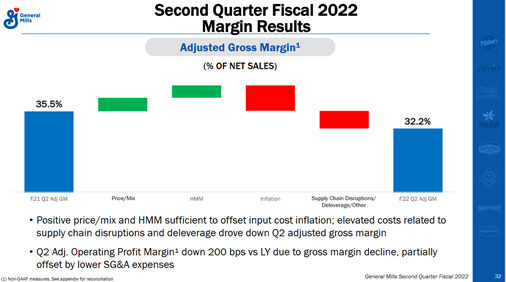
    This is certainly true. A look at General Mill’s margin waterfall shows inflation has a large impact on margins. It also shows that it’s been able to offset inflation through a mixture of pricing and HMM (holistic margin management).

    Contrast this experience to TreeHouse Foods. General Mills was able to increase prices and still maintain healthy margins of above 30%. TreeHouse, one of the largest private label food companies, has seen its’ margins drop to about 15%. Why can’t TreeHouse foods raise its prices to combat inflation? 

    Pricing Power and the Reference Price

    In How Brands Grow, Bryon Sharp explains the concept of a reference price.

    The academic research on pricing emphasizes the notion of a consumer reference price—especially the consumer’s internal reference price, which is the memory or expectation of what prices should be. 

    In the case of TreeHouse Foods, it manufactures products that compete strictly on price. Its reference price will always be of a low-cost alternative. Its demand will always be somewhat elastic. General Mills competes on quality and brand. Its products are more inelastic.

    Sharp continues:

    This expectation of price is thought to be generated by exposure to prices in the past, either by purchasing or observing communications such as ads. The idea of a reference price is that ‘past prices matter’ and if consumers encounter a price above their reference price, this dampens their propensity to buy.

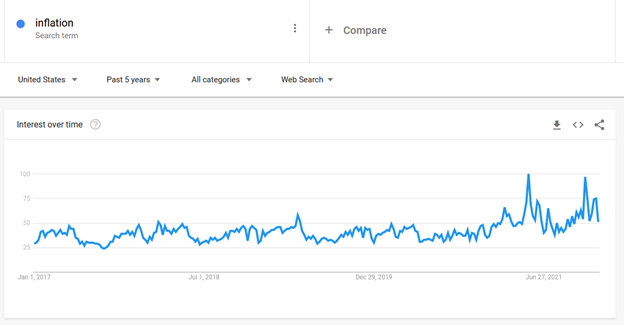
    In this case, the reference price is distorted, not through advertisements, but through media talk about inflation. The image below shows Google searches for “inflation”. As you can see, it’s skyrocketed over the last few months. People believe inflation is widespread, and so they’ve adjusted their attitudes to expect price increases. 

    Since General Mills has inealstic products with pricing power, they’re exercising it. TreeHouse Foods isn’t so lucky.

  • The Cream Cheese Shortage of 2021 (or why supplier relationships matter)

    Something weird happened this year. There was a great cream cheese shortage that occurred overnight. Seemingly without warning, cheesecake producers and bagel shops were stuck looking for a product that was a dying category a decade before. Yes, you read that right. Cream Cheese was a dying category in the recent past.

    In 2010, after years of stagnant sales, Kraft enlisted Paula Deen to boost Philadelphia Cream cheese. She was set loose on America’s morning shows promoting a cooking competition. It was a tremendous success for the legacy brand, generating a 5 percent sales increase in just two years. The competition quietly ended when Deen announced she had diabetes.

    Fast forward ten years, and cream cheese consumption is through the roof. Foodservice sales are up 35% and at-home consumption is 18% higher than 2019. The result is a cream cheese shortage for America’s bagel shops. In the last two weeks, USA Today, New York Times, and Bloomberg ran articles looking to explain the central question: why is there a cream cheese shortage?

    Why is there a cream cheese shortage?

    It depends on who you ask. Most articles have focused on three key factors: increased demand, the quick churn nature of dairy, and a cyber-attack.

    Increased Demand

    People are working from home and buying more cream cheese for their morning bagels. Combined with the holidays (which feature a lot of cream cheese in certain deserts), people are just buying more cream cheese, and manufacturers can’t keep up.

    Quick Churn

    Unlike other shelf-stable products, manufacturers can’t stockpile cream cheese for later sales because it’s dairy and has a quick expiration date. What they make goes out the door almost instantly.

    Cyber Attack

    Schreiber Foods, a privately held dairy processor in Wisconsin, was the victim of a cyber attack in late October. The company stopped production for about a week after hackers took control of its facilities. It may seem like a small event, but Schreiber is such a large cheese processor that it plunged the industry’s spot market by 17%. All of that production was off the market.

    Why Manufacturer / Retailer Relationships matter

    One thing none of this analysis touches is the power dynamics at play. Cream cheese shortages haven’t been spread equally across the market. Take this comment from Richard Galanti, Executive Vice President and CFO of Costco, in last week’s investor call:

    I mean I had — it was a little bit of a chuckle at a call just yesterday from a reporter asking about how are we doing on cream cheese. And so I checked, and we’re — there’s a cream cheese shortage out there, and the bagel shops are being challenged. We actually got — as the buyer said, it took a little extra work, but we’ve got all the cream cheese we need. So I think we’ve done a good job in merchandising.

    You may be tempted to agree with Galanti, that Costco’s buyers are just a bit better than others. I’m sure they’re talented, but a hidden issue here is power.

    Costco is a large retailer that places massive bulk orders of cream cheese. From a manufacturer’s perspective, it’s considered a Direct account. A Costco buyer works directly with the manufacturer to place an order. Costco orders enough that the manufacturer probably has an internal sales team to manage an account. Not only does Costco’s large order give it the pricing power to demand discounts, if something goes wrong with a delivery or an order, Costco can contact a person who solves the problem.

    Typical Direct Relationship

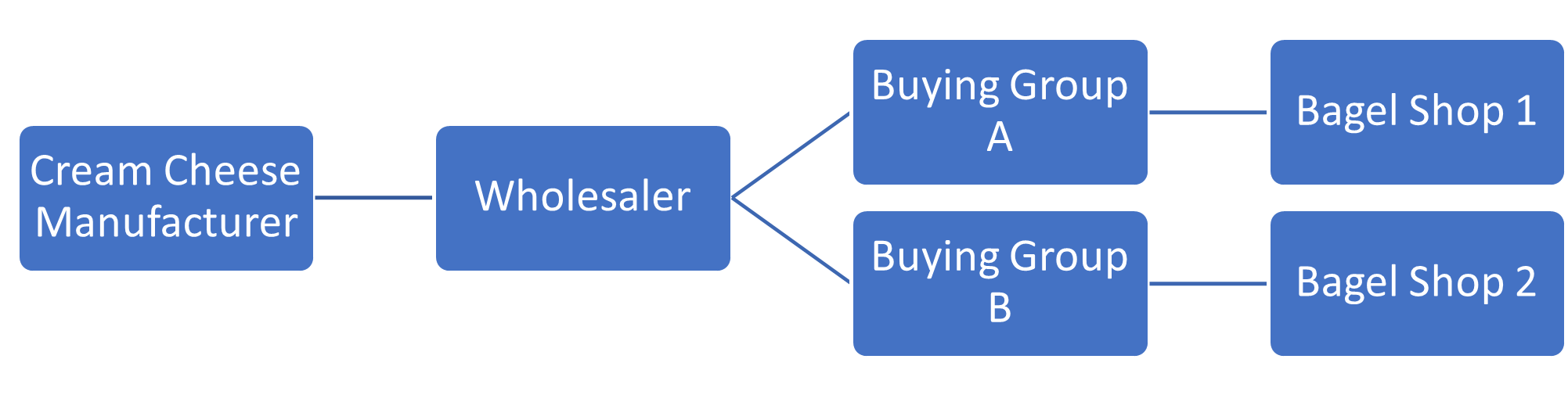
    A random bagel shop has a different experience. From a manufacturer’s perspective, they probably don’t even know that a bagel shop orders their product. Rather, the manufacturer sells products to a wholesaler (C&S, Sysco, and US Foods are major wholesalers) who then sell and deliver the cream cheese to the Bagel Shop. Within the CPG industry, wholesalers are considered indirect accounts.

    Typical indirect food service account.

    Where it gets kind of complicated is that within each wholesaler are different buying groups. Buying groups are basically price discounts that wholesalers offer customers based on volume or bundled products (e.g., get 5% off if you purchase $100,000 or more or get 3.5% off if you are buying all your dairy from the wholesaler). They’re typically one-year contracts.

    The Bagel Shop is competing for attention with shops inside and outside its buying group. If something goes wrong with an order, the Bagel Shop can’t contact the cream cheese manufacturer directly; rather, it works through the wholesaler. Complicating matters, typically, a manufacturer will outsource the management of wholesaler accounts to third-party brokers, who receive a yearly management fee based on a percentage of sales. 

    Basically, if something goes wrong with Costco, they’re a phone call away from a solution. If something goes wrong with the bagel shop? Well, it’s going to be a while. 

    Sure. I’m sure Costco has tremendous buyers, but having a direct line to the manufacturer helps explain why they’re flush with goods and others are stuck with out.

  • Keurig Dr. Peppers Strategy – Route to Market

    The recent Keurig Dr. Pepper (KDP) earnings call focused on the popular industry topics of late: Supply chain disruptions, commodity inflation, and transportation shortages. With sales up almost 7%, the company is doing a solid job managing all three. There was one point in the Q&A that I found very interesting. “We think our DSD asset is a competitive advantage,” CEO Robert Gamgort told analysts, “We’ll look for ways to continue to consolidate distribution and drive more efficiency and effectiveness through that really important asset to us.” It’s clear that to Gamgort, Keurig Dr. Pepper’s strategy is guidedby its route to market strategy. To understand its strategic importance, you need to understand KDP’s broader route to market strategy.

    What is a Route to Market strategy?

    Stated simply, a route to market strategy is how a company plans to get its product in a position where consumers can purchase it. It doesn’t really matter if a company has a phenomenal product if consumers don’t know about it or can’t find it to buy. It also doesn’t matter if it has a great product that is readily available if the cost associated with the first two are exorbitantly expensive.

    In the consumer goods world, a route to market strategy typically entails generating consumer demand through advertising and then selling goods to a customer (retailer) and delivering them via a 1. direct shipment to the retailer’s warehouse, 2. direct-store-delivery (DSD) or 3. wholesaler who acts as a mixture of 1 and 2.

    The Keurig Dr. Pepper Route to Market strategy

    From a high level, KDP’s RTM strategy doesn’t look like a strategic asset. In fact, it’s what you’d assume any beverage company would look like. Note, brands fit into each one of these strategies differently. For example, company-owned DSD is dominated by brands Snapple and Bai. In 2018, around 40% of Dr. Pepper volume was through the hospitability route.

    • Company-owned DSD: A fleet of KDP owned trucks that deliver goods directly to stores. The truck drivers act as account managers, who do everything from unloading products onto shelves to negotiating sales deals.
    • Independent DSD Partners: Like Company-owned DSD. These partners typically concentrate on territories the manufacturer lacks a footprint, or on small niche retailers.
    • Cola System: Coke and Pepsi-affiliated bottlers buy concentrate, manufacture soda, and distribute it within their areas. Dr. Pepper is the major brand here, and a National Accounts team manages it.
    • Warehouse Direct: The company ships the product directly to retailer warehouses. This is mostly smaller brands like Hawaiian Punch.
    • On-premise, Office, Hospitability: Think fountain systems and other foodservice arrangements. Unlike Coke and Pepsi, Dr. Pepper isn’t restricted by franchise agreements and can be placed in both Coke and Pepsi systems.
    • E-Commerce: Sales directly from the Keurig Dr. Pepper website. The lynchpin of this route is Keurig. It has built a rare ecosystem around a self-service machine and recently launched the Supreme Plus SMART platform—which features auto-replenishment. Overall, this category is now over 10%.

    How does Keurig-Dr. Pepper maximize each route?

    Technology basically.

    According to the KDP investor day presentation, the company has made substantial technology investments that allow it to optimize each route. Here’s an example for the Company-owned DSD-system.

    1. KDP has a platform that tracks sales to each individual retailer. Before each sales call, the system generates a recommended order based on past sales.
    2. This recommended order is fed into a customized handheld system. A recommended driving route is generated, as are different promotional options.
    3. The salesperson negotiates a deal with the customer, using recommended pricing, and promos—after driving to the retailer in the most efficient way possible.
    4. They take pictures of the shelves using the handheld—which are then analyzed by corporate.  

    An innovative Route to Market strategy

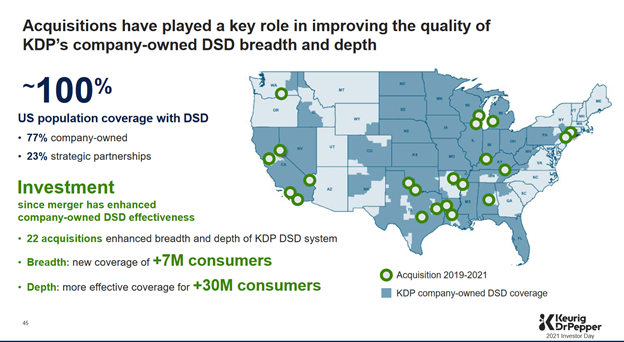
    Here’s why I think KDP’s RTM plan could be exceptional. Keurig Dr. Pepper has executed a series of strategic moves to build out the company’s DSD system. From 2019-2021 the management acquired 22 different companies, adding delivery coverage for 7 million consumers in the process. Thinking ahead, this network gives the beverage company the potential ability to bypass retailers and third-party shipping fees—delivering products directly to consumers.

    KDP's route to market
    via KDP’s 2021 Investor Day presentation

    More exciting is that KDP can sell access to this network to other manufacturers. This is exactly what the company did in 2020 when it signed a distribution agreement to double their volume in New York and New Jersey. “We’ve been putting more volume through our system,” Gamgort told investors during a recent annual meeting. This volume not only improves their return on invested capital but is a key driver of the company’s overall strategy. “We brought in more partner brands, and importantly, we’ve brought in a number of territories that have actually added volume to our existing territories.”

    It may have turned a traditional cost into a stream of revenue.