Author: Eric Gardner

  • McDonald’s corporate officers: Are they still a big strategic asset?

    McDonald’s corporate officers: Are they still a big strategic asset?

    The composition of a company’s corporate officers or board can tell you a lot about a company’s operations and culture. “If a corporation has two executives who think alike,” Ray Kroc, the man who transformed McDonald into an international juggernaut, told a bunch of college students. “One of them is unnecessary.” In the case of McDonald’s corporate officers, during Kroc’s time, the group’s diverse background was viewed as a key strategic asset.

    In Kroc’s mind, McDonald’s wasn’t building a typical company. At that time, franchise businesses made most of their money off up-front franchising fees. Kroc wanted to invert that model. Instead of charging $50,000 for a franchise fee, McDonald’s would charge just $950 upfront and 1.5% of future revenue. To ensure that 1.5% generated sustainable income, Kroc had to perfect the firm’s business operations—a first for a food service company.

    He didn’t want to hire a bunch of MBAs to manage his business because they were all trained in a specific management approach–one that prioritized upfront fees over a long term partnership. In McDonald’s: Behind the Arches author John F. Love summarized Kroc’s situation, “Even the best hotel and restaurant schools had no notion of the type of business Kroc was building.”

    McDonald’s corporate officers: Kroc’s ideal

    This ethos resulted in a preference for hiring action-orientated people over academics. College and advanced degrees weren’t needed. What McDonald’s needed was people who had common sense and were willing to work the long hours necessary to build an innovative new model.

    Love highlights the McDonald’s commitment to this ideal.

    When he joined McDonald’s personnel department in 1962, Jim Kuhn was greatly relieved to learn that McDonald’s did not require (and still does not) a college degree for managerial slots. ‘ ‘The thing that I loved at McDonald’s,” Kuhn says, “was that they just told me to go out and get the best damn people I could get and to look at them, not their credentials. We hired people that would not have gotten through the door at other companies, not because they were losers but because they were not traditional.”

    That philosophy is intact today and is reflected in the surprising lack of college degrees inside McDonald’s executive suite. Of the twenty-six executives at the senior management level of McDonald’s Corporation, fully twelve are without college degrees, including Chairman Turner. Among the company’s eighty corporate officers—from assistant vice president on up—forty-three (or 54 percent) do not have baccalaureates. For its size, McDonald’s also has relatively few MBAs (twenty-eight), and it is likely the only company in America with more than $1 1 billion in sales that does not boast a single Harvard MBA. “Our people all have real-world degrees,” Kuhn says.

    This ideal turned hiring into a core strategic asset. While its competitors focused on perfecting the now, they were building towards the future.

    Modern composition..still an asset?

    Does McDonald’s carry on this same preference for action and results over academic achievement? Well, the short answer seems to be no. Obviously, times have changed. America’s view towards college attainment has shifted tremendously. In 1960, when Kroc was laying the foundation of the McDonald’s empire, just 7.7% of Americans were college graduates. In 1986, when Behind the Arches was published, the number was around 20%. Today, that number is 35%. But still, I was surprised by the results.

    According to their website, there are 14 corporate officers. Of these McDonald’s corporate officers, all 14 have college degrees. 8 of the 14 (57%) have advanced degrees. 5 have MBAs.

    As McDonald’s heads into new and unproven areas of business, namely e-commerce, it’s easy to wonder if Kroc’s vision may be better suited.

    But on the bright side, there is now at least one Harvard MBA within the company: CEO Chris Kempczinski.

    Photo by Erik Mclean on Unsplash
  • Albertsons’ management is probably wrong about protein inflation

    In a recent investor call, Albertsons predicted that COVID-19 related shocks would generate manageable inflation in the upcoming months. “We expect the inflation to be higher as we go through the year, but we expect it still to be in the 3% to 5% range.” CEO Vivek Sankaran said. “Which, in our opinion, is extremely manageable.”

    Like most COVID-19 related inflation, the shocks aren’t uniform across categories. For the overall US economy, it is estimated that used-vehicle prices have accounted for about one-third of the overall spike in cost of living. For Albertsons, management believes that spike is can be mostly attributed to rising protein costs. “You’ll see that a big part of the inflation is proteins,” Sankaran continued, “and protein inflation tends to be more cyclical.”

    Except it may not be cyclical, but a policy choice.

    Inflation is absolutely happening within the protein industry. According to the U.S. Consumer Price Index (CPI) almost area segments are up.

    • Beef is up 6.5%
    • Poultry is up 5.3%
    • Pork is up 7.8%

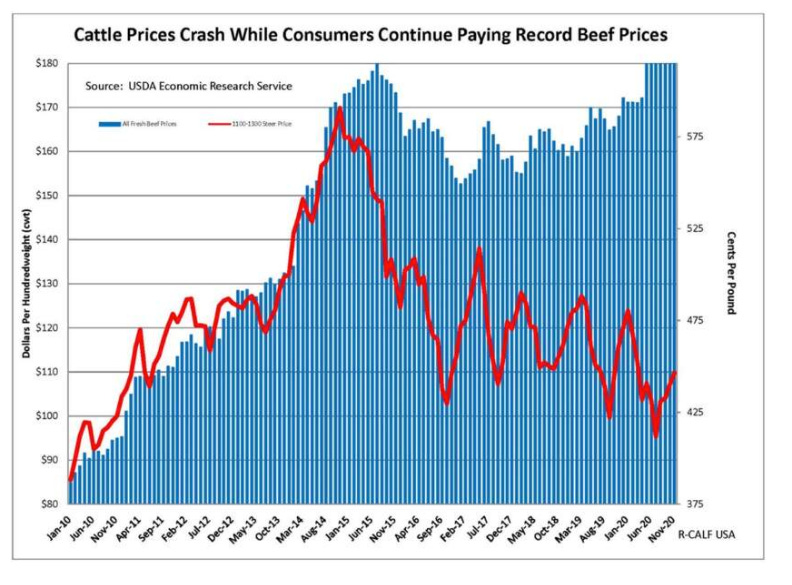
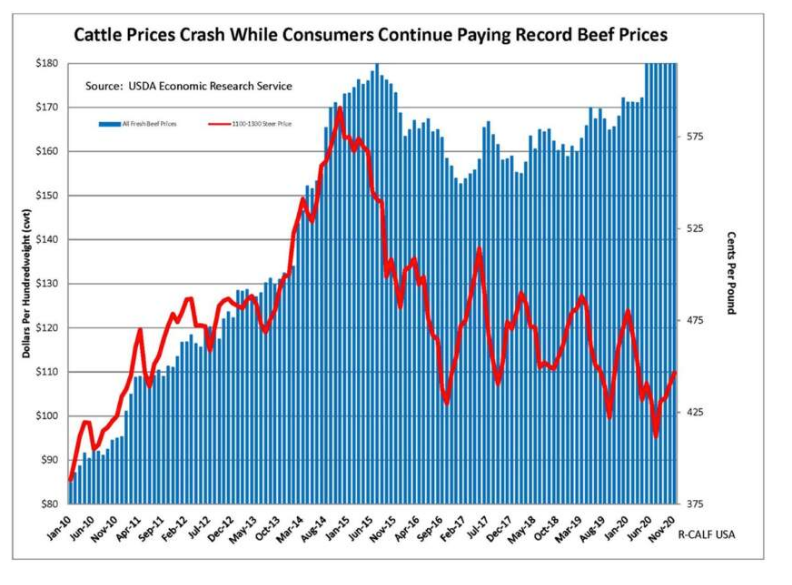
    Similar to the dairy industry, the meatpacking industry has a massive monopoly problem. For beef specifically, four firms (Cargill, Tyson, JBS SA and National Beef Packing Co.) slaughter 85% of US beef. Matt Stoller has written extensively on the topic, but the graphic below provides a quick summary of its impacts:

    Image via Matt Stoller

    Since 2014, wholesale and retail beef prices have had almost an inverse relationship. The less meatpackers pay for raw cattle, the more consumers pay for the finished good. Albertsons could of course absorb the price increase, but it has margin requirements.

    What does this mean for Albertsons? Albertsons is in the business of buying goods from processors and selling to consumers at a markup. They are unfortunately at the mercy of the meatpackers. Outside of Albertsons buying a meatpacking facility, or targeting local producers who probably can’t meet their scale, things aren’t looking good for protein inflation.

    Photo by tommao wang on Unsplash

  • Supply Chain Management: How Conagra is managing constraints

    Supply Chain Management: How Conagra is managing constraints

    Last week Conagra Brands had its 2022 Q1 earnings call. It was a solid, if unspectacular, result. Overall net sales were down one percent, driven primarily by the results of some previous divestitures. Organic net sales, a metric that strips out revenue from divestitures and acquisitions, increased by 7 percent. More good news is that despite being what I consider a legacy packaged food company, e-commerce sales now account for 9.6% of all volume. In short, Conagra Brands has done a good job of navigating COVID, especially the increased demand and accompanying stress on its supply chain, while building for the future.

    One quote jumped out at me. It could have been better. “If we had the capacity to meet all of the demand,” CEO Sean Connolly told investors, “our numbers would likely have been even more impressive.”

    So let’s break that down a bit, what could have been better, and what has Conagra Brands done to manage around the shortcomings.

    What is supply chain management?

    Like a lot of terms in business, it depends on who you ask. Personally, I tend to answer the question, “What is supply chain management?” with a simple answer: The processes and systems in place to ensure that you have enough raw commodities to manufacture the product. It seems that Conagra defines it a bit differently. When asked about the cause of their supply shortcomings, Connolly answered:

    With my earlier comments within the kind of strain, as I’ll call it within supply chain, the three buckets that I mentioned are labor, obviously, materials and ingredients and logistics. So we’re working all three of those buckets aggressively every day. 

    Let’s take a deep dive into each one of the supply chain management buckets.

    Labor

    It’s the people required to transform raw materials into finished goods. In Conagra’s case, this is a very real constraint, and it also one management has a fair amount of control over. If Conagra is struggling to attract workers, it can increase wages until it’s a competitive offer. This, of course, comes at a cost to the margin.

    Materials and Ingredients

    The goods and materials that become finished goods. For Conagra, these are the commodities that it processes: beef, poultry, wheat. The good news is that most of their raw materials are sourced from America and not subject to international disruption. That’s about it in terms of good news. The raw material market is pretty crazy right now. Goods are subject to pressure from both the demand and supply side of the equation. Food processors looking to capitalize on new COVID-based consumer demand drive up prices. Farmers face increased material costs (fertilizer) and labor costs (wages) on the supply side. Throwing another wrench in the equation are uncontrollable things, like droughts. All told, the Federal government predicts a fair amount of commodity inflation in wholesale markets. The Procurement Team (the team responsible for sourcing) has their work cut out for them.

    Transportation

    Transporting the raw materials between plants and the finished goods. Due to a strategic decision, this lever is almost completely out of Conagra’s hands. From the Annual Report:

    Substantially all of our transportation equipment and forward-positioned distribution centers containing finished goods are leased or operated by third parties. 

    It’s also a competency in near emergency circumstances. From Bloomberg:

    Trucking has emerged as one of the most acute bottlenecks in a supply chain that has all but unraveled amid the pandemic, worsening supply shortages across industries, further fanning inflation and threatening a broader economic recovery.

    Supply Chain Management – Mitigating constraints

    Supply Chain management isn’t easy. As you can see, of the three buckets, Conagra management only has complete control over one: labor. What can it do then to ease tension on its supply chain when you can’t meet demand?

    Pricing.

    When the supply chain is stressed, Conagra can try to temporarily increase prices to reduce demand—while maintaining overall net sales.

    He explains:

    When you’re in a strange supply situation, we do look at promotional reductions to keep demand in check and not exacerbate supply challenges. So it’s we work with our retailers on some of the stuff that they like to get out on the floor during the holidays, you’ve got two aspects of those holiday promotions, you’ve got the location, getting it out on the floor, and then you’ve got the amount of discount, the magnitude of the discount. 

    Certainly, we want to help our consumers to find our products during the holidays. But the magnitude of the discount does not need, we don’t need to fan the flames of supply challenges. So you make a very fair, reasonable point much how we behave during the height of the pandemic with respect to promotion.

    This holiday season you can expect a fair amount of in-store displays but minimum discounts. 

    Photo by Jacques Dillies on Unsplash

  • Foodservice Distributors and CPG – COVID, concentration, and what it means for CPG companies

    Foodservice Distributors and CPG – COVID, concentration, and what it means for CPG companies

    Foodservice is a different animal than traditional CPG retail. In traditional retail, CPG manufacturers sell goods to retailers, who then sell goods to consumers. CPG companies generate bargaining power through strong brands and horizontal acquisitions. The stronger your brand is, and the more strong brands you own, the more you can dictate pricing. 

    Foodservice is different. Since the products are inputs into a finished product (e.g., a meal), branding doesn’t matter. An end consumer does not care if the milk in their milkshake is from Deans or Organic Valley. It’s effectively a volume-based commodity business that is supplied by branded CPG companies. In this model, CPG manufacturers sell goods to foodservice distributors, who then sell goods to restaurants/hotels/schools, who use the goods to make products that consumers buy. 

    It’s all about pricing, which is why foodservice distributors are the major power player and gatekeepers in the industry.

    Foodservice Distributors in the USA

    Before I get into the upcoming platform wars, it’s important to take a step back and define foodservice distributors. From an overall market perspective, most analysts consider foodservice distribution in America a highly fragmented market. The latest estimates place the number of food distributors at 16,500 and value the market at $268 billion a year. Personally, I view that as slightly misleading. Based on 2019 data, the top 6 distributors capture around 50 percent of the market’s revenue.

    Company, Region, Tractors, Distribution Centers

    Company# of Trailers# of Distribution CentersRevenue
    Sysco8,577236$60B
    US Foods5,336168$26B
    Performance2,04725$19B
    McLane2,17880$16B*
    Gordon Foodservice3,00012$13B
    Reinhart1,3799$6B
    McLane does not break out foodservice revenue. Estimation based on proportion.

    Distributors are typically drawn from three categories: broadline, system, and specialty.

    • Broadline: Offer a wide variety or “broadline” of products and services.
    • System: Provide goods for specific large chains.
    • Specialty: Concentrate on a niche segment (e.g., cheese, fresh fish).

    The major players dominate the broadline and system categories, and as you can imagine, the major distributors are becoming bigger and bigger. Since the early 2010s, Sysco and US Foods have completed over 30 acquisitions—increasing their revenue by $12 and $4 billion

    How do foodservice distributors make money?

    In simplest terms, foodservice distributors buy products from manufacturers, hold products in warehouses, sell products to restaurants/venues, and deliver the products once sold. The goal for a foodservice distributor is basically that of a Vegas sport’s book. Just as Westgate sets a betting line to get equal money on both sides, foodservice distributors are trying to balance inbound products and outbound orders. Buy too much product, and the distributors have to pay for unnecessary storage and transportation. Buy too little, and customers jump ship because they aren’t meeting their needs.

    The key business assets are the physical distribution centers, trucking network and sales network. The distribution and trucking network are huge capital expenditures—reducing the threat of new entrants into the industry. Amazon is often praised for its 100+ distribution facilities across America. Sysco has 236 locations. US Foods has 168. Unlike Amazon warehouses, they are refrigerated. Allowing both to service effectively every single place in America that sells food. (Note. In 2020, Amazon made a huge investment in food wholesaler Spartan Nash. Food wholesalers aren’t exactly foodservice distributors, but it’s an adjacent market.)

    The sales network is a little less concrete but just as important. Independent restaurants figured out that they can gain more pricing leverage against the industry if they join together in what is commonly called buying groups. Buying groups often sign short-term agreements with food distributors around negotiated prices. It’s not uncommon for a buying group to switch their distributor every year. That means that distributors routinely ask for massive price discounts from manufacturers. If manufacturers don’t agree, a food distributor can drop the entire SKU from the buying group and the larger catalog. 

    COVID – 10 years of foodservice evolution in 10 months

    COVID crated the foodservice industry in America. McKinsey estimates that restaurant sales dropped by 40-50 percent

    A McKinsey analysis explains what happened next:

    Immediately after coronavirus-related shutdowns, outbound orders suddenly stopped because of government-mandated closures of restaurants, even though inbound orders of food kept coming in from farmers, foodservice producers, and processors. That led to logistical bottlenecks and storage-space shortages as distributors worked to cancel incoming shipments of inventory from farmers.

    Large companies could use their scale to absorb the shock—small and medium operators were left with unsold inventory—often perishable. Perhaps even more strategically important, larger operators used the downtime to focus on sales.

    Kevin Hourican, Sysco CEO, explained:

    Our sales teams are actively engaged with new customers and helping existing customers maximize their business during this recovery period. We continue to win business at the national and contract sales level. We have now posted over $1.8 billion of net new wins since the start of the pandemic with another strong quarter of new contracts signed. I’ve said on prior calls, the contracts we are writing are at historic profit margins. 

    Here’s Pietro Satriano, US Food’s CEO, saying the same thing:

    For nationally managed customers, which, remember, includes national chains, healthcare, and hospitality, you will remember that in 2020 we added $800 million of new customer wins, which is driving some of the increases we are seeing. In the first quarter of 2021, we added $200 million of new customer wins, and our pipeline for the balance of the year is very healthy.

    To restate: it’s estimated that restaurant sales dropped by 40-50 percent and the large players are adding billions of dollars of high profit margin business. 

    Translation: That margin isn’t coming from restaurants. CPG manufacturers are going to be squeezed. 

    With a handful of distributors controlling 50% of the market, distributors are going to increasingly demand price concessions–putting branded CPG firms in an uncomfortable position. 

    Photo by Vance Osterhout on Unsplash

  • Beyond Meat News: big partnerships, but is it sustainable?

    Beyond Meat News: big partnerships, but is it sustainable?

    In Beyond Meat news, the California-based manufacturer of plant-based meat substitutes announced it signed deals with McDonald’s and Yum Brands to provide flagship menu offerings with the fast-food giants in the future. “It is my strong belief,” CEO Ethan Brown told investors, “that partnerships of this nature with partners of this caliber are required to accelerate our flywheel of availability and scale-driven cost reduction.” Taking a step back, there are equal reasons to be excited about Beyond Meat’s future, as there are to be pessimistic.

    Why the Beyond Meat news should excite the packaged food industry

    In simplest terms, deals with McDonald’s and Yum Brands! all but guarantee a steady stream of volume for plant-based meat substitutes—a new category. That is exciting! The details are still scarce, but Beyond Meat will develop new plant-based items for KFC, Pizza Hut, and Taco Bell under the announced terms. Meanwhile, it is the “preferred supplier” for a plant-based burger for the golden arches—presumably meaning it will develop the burger from a McDonald’s recipe.

    From an organizational point of view, Beyond Meat is built around regions and then distribution channels. There are a US and International business that includes retail and foodservice segments. Retail encompasses grocery sales; foodservice includes anything sold from restaurants and other institutional settings. Using 2019 as a baseline (because COVID-19 destroyed “normal”), The US business had about a 65/35 split favoring retail. Meanwhile, in international, the ratio was reversed—it was 84/16 leaning foodservice.

    In most companies that I’ve advised, foodservice is often viewed as the simpler business. Unlike retail, which mostly operates on a high-low promotion-based strategy, foodservice is driven largely by volume and price, but that doesn’t mean that it can’t transform a business. Just ask Tyson, one of Beyond Meat’s major category competitors.

    How McDonald’s transformed Tyson Foods

    Before the rise of Tyson Foods, the chicken industry was not particularly profitable. Like most agricultural commodities, it was subject to boom and bust cycles. Good times would yield large returns, signaling for other farmers to get in on the chicken business. This would inevitably flood the market with chicken—resulting in a bust. One of Tyson’s most profitable realizations was understanding that it’s better to own the slaughterhouse than the farm. By the mid-1940s, the company was entirely reliant on contract farmers—who raised chickens based on Tyson’s specifications—and took on the brunt of the boom/bust risk.

    That doesn’t mean that processing was a free ride. Unlike grain or oil, chicken has a short shelf life. In boom years, Tyson had a dilemma—flood the market and destroy operating margins or see inventory rot in a warehouse. A bust cycle meant idle factories, with downed production lines and lost profits. Each era had its own level of uncertainty. Don Tyson, the founder’s son, had an answer.

    By the late 1960s, Don Tyson saw that America was changing. With the rise of car culture and fast food, Americans were now on the go. They weren’t looking to sit down at the dinner table for a chicken dinner. They wanted something easy and cheap. They wanted convenience. He realized that a future path to profits was in the drive through.

    In The Meat Racket, an indispensable history of the company, Chris Leonard explains what happened next.

    The future had just one problem, in Don’s estimation: Chicken wasn’t on the menu. The fast-food industry was built squarely on the hamburger, and for good reason. Hamburger was a malleable meat, easy to shape into patties of various sizes, and to ship and speed-cook in cramped kitchens. Chicken, on the other hand, was still sold by the drumstick and the breast.

    If Tyson could solve this problem, it would not only open up new sales volume but allow his company to escape commodity pricing. In the 1970s, the retail price of chicken declined by 11 percent.

    Don Tyson hit the road and started pitching any and every fast-food joint in the nation. According to Leonard, “He became an evangelist for chicken and it’s potential as a cornerstone of the fast-food menu.”

    Leonard continued:

    He also made it clear that Tyson, and only Tyson, could deliver millions of pounds of meat to a national food chain with an around-the-clock distribution system. His pitch was simple: — Look, we’ll dedicate a whole plant to your production. We’ll cost it out, where you give us a reasonable margin. And we’ll just run your product. We can do this cheaper for you. And because it’s a dedicated plant, you can look over our shoulder on quality control all the time.

    After 14 years of pitches, McDonald’s agreed. Their food scientists figured out a way to grind chicken and encase it in bite-sized breading. The McNugget was the perfect food for a person on the go.

    As Don Tyson promised, his company retrofitted a plant in Nashville, Arkansas, to make nothing but the McNugget. By 1983 Tyson was supplying the McNugget to McDonald’s stores around the country. Don Tyson had finally found a chicken product whose price didn’t fluctuate with the wholesale market for fresh chicken. It freed Tyson, at least in part, from the vicious commodity price cycle that tortured the industry.

    As Don Tyson had envisioned, chicken products slowly began to creep onto menus across the country. Eventually, chicken would overtake beef and pork as the most-consumed meat in America.

    Within a decade, Tyson was making chicken for both McDonald’s and Burger King. Shortly later it became the most consumed meat in America.

    What me, Skeptic?

    It’s easy to see why Beyond Meat is excited about the partnership news. The rationale is obvious. Having Beyond Meat products at two of the nation’s most famous fast-food companies makes its products accessible to almost every consumer in the country. Instead of converting people through grocery stores, they’re effectively offering prepared samples across the nation. The mass of orders means that the company should be able to start taking advantage of economies of scale—driving down production costs. Given the optimism, there’s still one big elephant in the room.

    Do people like Beyond Meat’s plant-based meat substitutes?

    Most analysis I’ve seen on the question points to larger trends in the category. Morning Star’s recent report is a good stand-in:

    We expect the global PBM market will grow from $12 billion in 2019 to $74 billion by 2029 (a 19% CAGR), as PBMs grow from 2.5% of the ground meat market to 12%. We model Beyond’s market share increasing from 2.5% in 2019 to nearly 9% in 2029, as PBMs gain a larger share of the overall meat category, and as Beyond’s brand continues to win with consumers, given its strong performance in taste tests and ongoing R&D investments.

    What’s driving this growth?

    We expect a primary growth driver to be the 20% of consumers willing to adjust their habits to benefit the environment, as Beyond’s products emit 90% less greenhouse gases, require 93% less land, 99% less water, and 46% less energy to produce than their meat equivalents

    So it seems to me, that a lot of this overall optimism is built around the assumption that a critical mass of consumers will adjust their consumption habits based on environmental concerns. That logic seems to go against almost all of our lived reality. Tyson leveraged food service contracts to standardize a category that people loved. Beyond Meat is betting on this in a category that no consumers really asked for.

    I think the hard reality is that unless Beyond Meat offers a cheaper and healthier product than traditional meat, it will be little more than a curiosity.

    Image via Flickr

  • Is the Nestlé e-commerce strategy the future of CPG?

    Is the Nestlé e-commerce strategy the future of CPG?

    Last week Nestlé, the world’s largest packaged food company, posted solid earnings as consumers continued to pivot towards grocery stores amid the pandemic. Overall, the company saw organic growth rise by 3.6%, putting it in between rivals Kraft Heinz (6.3%) and Unilever (1.9%). Much of this growth is due to smart acquisitions and divestitures, recently headlined by its $4.3 billion sale of its North American bottled water business to private equity firm One Rock Capital Partners.  What I find interesting is what these acquisitions mean about the Nestlé e-commerce strategy and how it might just be the future of the CPG industry.

    The Nestlé M&A approach

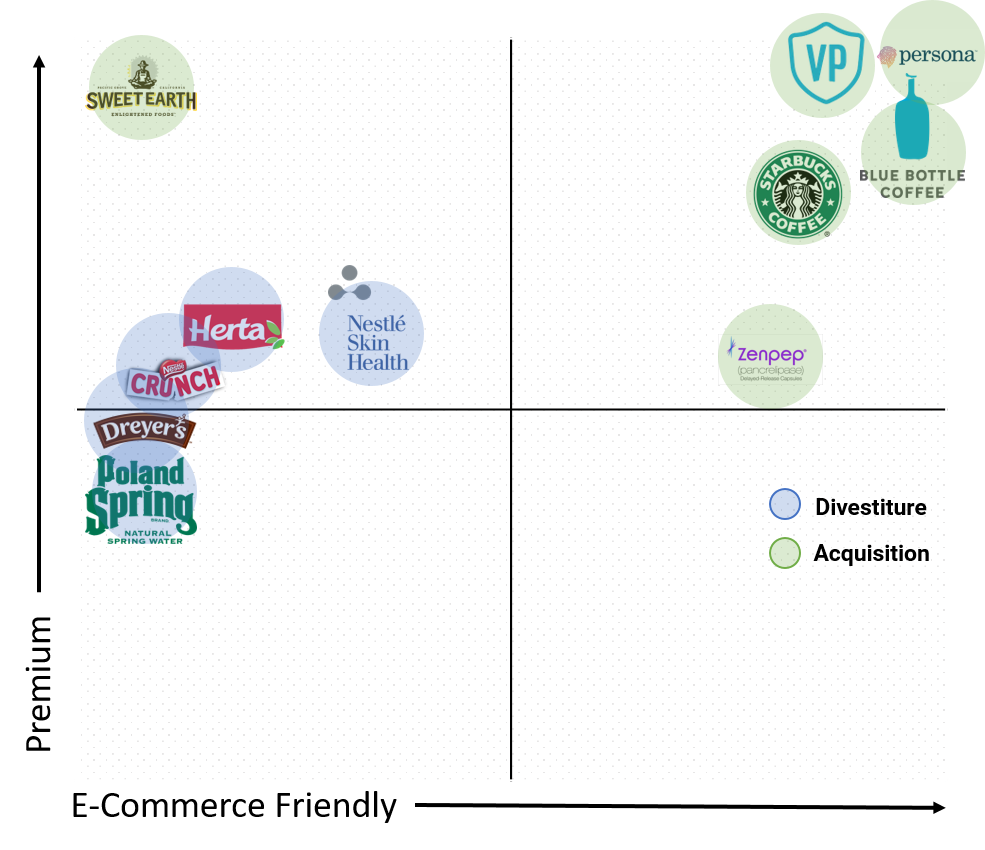
    In 2017 Nestlé missed earnings estimates and found itself struggling to compete in the U.S. market. Since then, the company has completely revamped its offerings. It sold off non-core assets like Gerber Life insurance for $1.5 billion. Its CPG catalog divested from bottled water, Nestlé skin health, U.S. candy businessU.S. ice cream, and packaged meats. The company entered 75 separate transactions—turning over about 18% of the company’s sales. As the below graphic shows, the major strategy can be summed up as: Get Premium and Get E-commerce.

    I went ahead and categorized the company’s recent major transactions across two measures: Premium and E-Commerce Friendly.

    You’ll see the Y-axis is labeled Premium. That effectively means, can Nestlé charge a premium price for the product? The answer for almost all the divestitures is “no”. Poland Spring is a budget brand; Herta will always be a convenience option to freshly sliced meats. 

    The X-axis, E-commerce Friendly, is a bit more nebulous. Essentially, does the product and brand lend themselves to e-commerce? When thinking about e-commerce, ask yourself:

    1. Can it be easily stored in a non-climate-controlled warehouse? 
    2. Does it lend itself to bulk pack sizes? 
    3. Can buying be personalized via a website? 

    The answer for almost all the divestitures is no. Dreyer’s is not only a mid-tier ice cream brand—unable to compete against high-end gelato and healthy options like Halo Top—but it’s also a category dependent on in-store distribution. Ice cream requires refrigeration, which does not lend itself to easy e-commerce sales. U.S. candy is almost entirely single-serve, impulse-driven, and often involves refrigeration during transit (prevent melting), making it a tougher sell online.

    Meanwhile, nearly all the acquisitions are premium products and/or native to e-commerce. Like Dreyer’s, Sweet Earth is dependent on refrigeration. Unlike Dreyer’s, it offers premium vegetarian offerings priced a dollar or two higher than the competition. Persona offers personalized vitamins through a digitally native sales experience. Starbucks was the first premium coffee brand in America, and Blue Bottle Coffee takes it to another level. Both have product offerings that are easily shipped and sold over the internet. 

    I should point out that my graph doesn’t include Freshly and Mindful Chef, two digitally native meal prep companies Nestlé acquired.

    It also says nothing about PetCare, a category ripe for e-commerce that Nestlé is positioned to conquer. 

    The Nestlé e-commerce strategy

    Mark Schnieider, CEO of Nestlé, talked about its evolution in e-commerce—with an eye towards pet care.

    I think the best area to exemplify that is PetCare where, clearly, we’ve been for years patiently building up what I call a PetCare ecosystem when it comes to the total advice around pet ownership, and nutrition, of course, being a big part of that. Then increasingly bundling in e-commerce opportunities including bespoke, such as Tails.com and Just Right in the U.S. So I think this is a major opportunity. PetCare being one example. 

    I think you’re seeing similar opportunities in other major categories, but PetCare does stand out. So I agree with you that this is a key area of focus for us going forward.

    Most CPG companies talk about using technology to build ecosystems or platforms. Honestly, a lot of it is nonsense marketing speak, but Nestlé is actually doing it in pet food. Many manufacturers are selling the same exact products (they may change the pack size) but through Amazon or Walmart.com. When you go to Just Right, you fill out a quick survey about your dog, and moments later, you have a completely custom food blend—priced at a premium, of course—ready to be delivered to your door. It’s the type of product that can’t be sold in traditional retail but perfect for online.  

    This begs the question, “How much of this infrastructure should Nestlé build and how much should it create through partnership?”

    In terms then of acquisitions, I mean, when it comes to just digital enablers, I feel more often, this is about partnerships and it’s about licensing. When it comes to business models, yes, and take as an example our investment in Freshly, where clearly, you have a business model and there’s a strong digital component to it. Or take our acquisition of majority stake several years ago in Tails.com, where you have bespoke pet food, and clearly digital is the way to order pet food and to get into those subscriptions. So,this is where I would see the sweet spot. So,we have a digital model with the business model combined. Just digital tools alone, frankly, I’m not sure we should be the only owner of that. I think there, it’s better to license in or to partner.

    Translated — if the core business model is reliant on technology, it could make sense to own–if not, partner.

    Later, he described the results.

    Let me highlight on top that for a category like pet food that indexes very well in e-commerce; there is frequency of consumption and shopping, it’s bulky, so that’s prone to subscription models. There we grew, in the U.S. last year, 65%, and it is close now to 20% of sales.

    Potentially 20% of sales!

    It sounds like a winner. It sounds like the future of CPG.

    Photo by inma · santiago on Unsplash

  • Kraft Heinz: Earnings boost and a smart sale of Planters

    Kraft Heinz: Earnings boost and a smart sale of Planters

    Thursday’s Kraft Heinz earnings call was a quick 31 minutes, but it revealed a lot about the future of the recently beleaguered company. Barron’s Teresa Rivas summed it up best: “What a difference a year makes.” Led by rising sales across all its platforms, the company reported a solid 6% growth from the previous year. The Tase Elevation platform, which features its Ketchup and Mayonnaise brands, saw an increase of 14% in its non-foodservice accounts. “We couldn’t be more optimistic and positive about the momentum that we have in the company right now,” CEO Miguel Patricio told investors, “We have today a very different company that we had just 12 months ago.”

    What happened?

    Destroying a brand by cuts

    Kraft Heinz was formed in 2015 when Brazilian-based private equity giant 3G took ownership of both companies in two deals worth over $74 billion. To drive efficiency and meet its newfound debt obligations management immediately adopted a zero-based budgeting approach.

    Here’s how I described the process:

    Traditional corporate budgets are derived from historical information. Imagine that you’re in charge of in-store marketing at Kraft. Last year, you spent $15 million on a variety of in-store marketing events. After analyzing inflation, competitor data, and new item distributions, you estimate you’ll need an additional $500,000 in funding to support the business. Your boss agrees, so you get the budget.

    Zero-based budgeting doesn’t work that way. In zero-based budgeting, every single company expense (from in-store food samples to pencils) is classified into a specific category. Each category is assigned a manager who builds a budget from scratch, justifying every single expense. Budgets are analyzed and awarded a cap. Managers are then incentivized based on how much they spend under the cap.

    This program resulted in a $1.7 billion reduction in annual spend. Some of it, like private jets, were justified. Others, like promotional and marketing spend, kept the company relevant.

    In year one, a cut in marketing and promotional spending may not impact much. Change doesn’t happen overnight. The initial success means the cuts are repeated for three straight years — because why not? The manager is incentivized to cut. Everything is fine until reality catches up. A legacy brand with reduced promotional support in an ever-changing category is a recipe for disaster.

    In 2019 Kraft Heinz had to write down the value of two of its biggest brands by $15 billion. That same year it brought in Miguel Patricio as CEO. “Cost-cutting should be a priority for any company.” he told Reuters, “However, you cannot cut costs every year.”

    Kraft Heinz reorganized in 2020

    PlatformAnnual Revenue
    Taste Elevation$7B
    Easy meals Made Better$4.3B
    Real Food Snacking$2.2B
    Fast Fresh Meals$5.9B
    Easy Indulgent Deserts$.9B
    Flavorful Hydration$1.5B

    A new CEO meant a lot of things. It meant new leadership–Patricio replaced 7 out of 10 Senior Executives. It meant new priorities; Patricio announced a goal of increasing marketing spend by 30%. It also meant a new company structure. Prior to Patricio the company was built around 55 different food categories. That means that Ketchup, Mustard and BBQ Sauce were separate portfolios—with competing promotional and marketing budgets. Now products are reorganized into six “platforms” where Kraft Heinz will jointly plan and manage the products in each region. The terms jointly plan and manage includes all core functions of a CPG firm—which is why the Planters sale makes a whole lot of sense.

    Kraft Heinz earnings were boosted by the Real Food Snacking Transformation

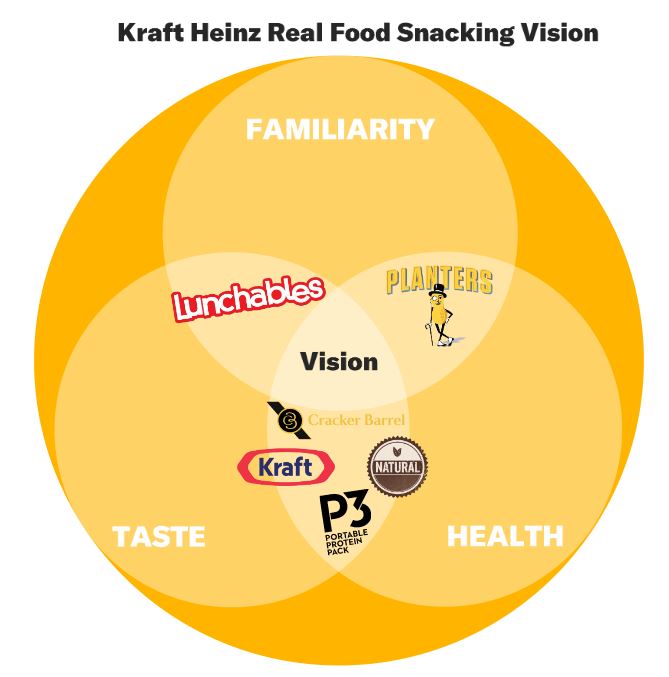
    According to the official strategy, Kraft Heinz’s Real Food Snacking platform is centered on the idea of unifying the company’s offerings to “leverage insights, drive innovation and meet demand for nutritionally dense, tasty and convenient snacks.” Reading between the lines, it’s clear Kraft Heinz is looking to revitalizing its snacking products through a mixture of healthier options that share production resources.

    Lunchables will underpin the platform, which is ironic given its origins. Lunchables were created in the early 1990s to sell excess bologna and processed cheese to a populace that wasn’t interested in either. “People were falling out of love with bologna.” Michael Ross wrote in Salt Sugar Fat, “What it needed was a new vehicle, something other than bread and mustard to draw people’s interest—something with enough pizzazz to overcome the growing hesitancy about the fat in red meat.”

    Kraft found it in Lunchables.

    Moss continues:

    They would help turn the trays into a processed food colossus, one that would break industry records by soaring to nearly $1 billion in annual sales…The trays created an entirely new category of food, one that exposed Americans, especially young kids, to the thrills of fast food that heretofore were the purview of restaurant chains like McDonald’s and Burger King. Back in the late 1980s, when Lunchables were first introduced, food manufacturers—despite their push for more convenient foods and their heavy reliance on salt, sugar, and fat—had not yet realized that they could mimic the fast food chains by making whole meals that were ready to eat at school, on the go.

    Basically, it was a new innovative way to sell processed red meat—almost opposite of Kraft Heinz’s current goal of selling “real” snacks.

    Today, Kraft Heinz is looking to use the same trays, but to replace bologna with lean protein and other “better for you” options like dried fruit. Lunchables will continue to target children, while P3 will target adults. Combined, this allows Kraft Heinz to drive massive efficiencies across the board.

    Planters did not fit into the Real Foods Snacking

    The Planters brand did not fit into this paradigm. P3 and Lunchables share common ingredients and packaging–if a new flavor combination takes off in one brand it can easily export to another. Both Lunchables and P3 also face limited private-label competition.

    On the other hand, Planters faces intense private label competition and can’t piggyback off of product, packaging and pricing innovations.

    Miguel Patricio summed it up:

    Look, Planters is a very iconic very strong brand. So this is not something that we took lightly. But to improve our portfolio, we must focus on areas where we see the greatest competitive advantage, the greatest potential and returns. And when I — we look at Planters, Planters is one of the brands that is most affected by private label in our portfolio, it’s also of course affected as a commodity. And so when we looked at that, in order to have more flexibility toward the future on building a portfolio, I think that, we made that choice and we are very happy with that.

    Image via Flickr

  • Clorox earnings call reveals a targeted approach to international growth

    The Q2 2021 Clorox earnings call revealed more good news for the Oakland based consumer packaged goods company. Overall, organic sales increased by 26%, fueled primarily by 42% growth in the company’s health and wellness division, which includes the namesake cleaning brand.  “We’re continuing to see increases in household penetration and repeat rates among existing and new users,” Lisah Burhan, VP of Investor Relations told the group. According to Clorox, COVID and strategic investments were the primary drivers.

    Clorox is a deceptively big company with a smart strategy. The company boasts annual revenues of over $6 billion, which puts them between Church and Dwight and Swedish giant Essity. However, it competes in smaller categories—meaning it doesn’t have a whole lot of head on competition and can focus on delivering value through innovation. For example, it its Food Products portfolio contains one major brand, Hidden Valley. Hidden Valley is the clear number one salad dressing in America, but it’s a category that isn’t particularly valuable.

    According to IBISWorld, the US Salad Dressing market is about $3.3 billion. By comparison, the ice cream market is about $8 billion, and the overall seasoning, sauce, and condiment market is around $23 billion. The result is a big, advanced fish, competing in smaller ponds.

    Now obviously, COVID benefited the company, but its plans for expansion are what I found interesting.

    Clorox earnings reveal a targeted international expansion plan

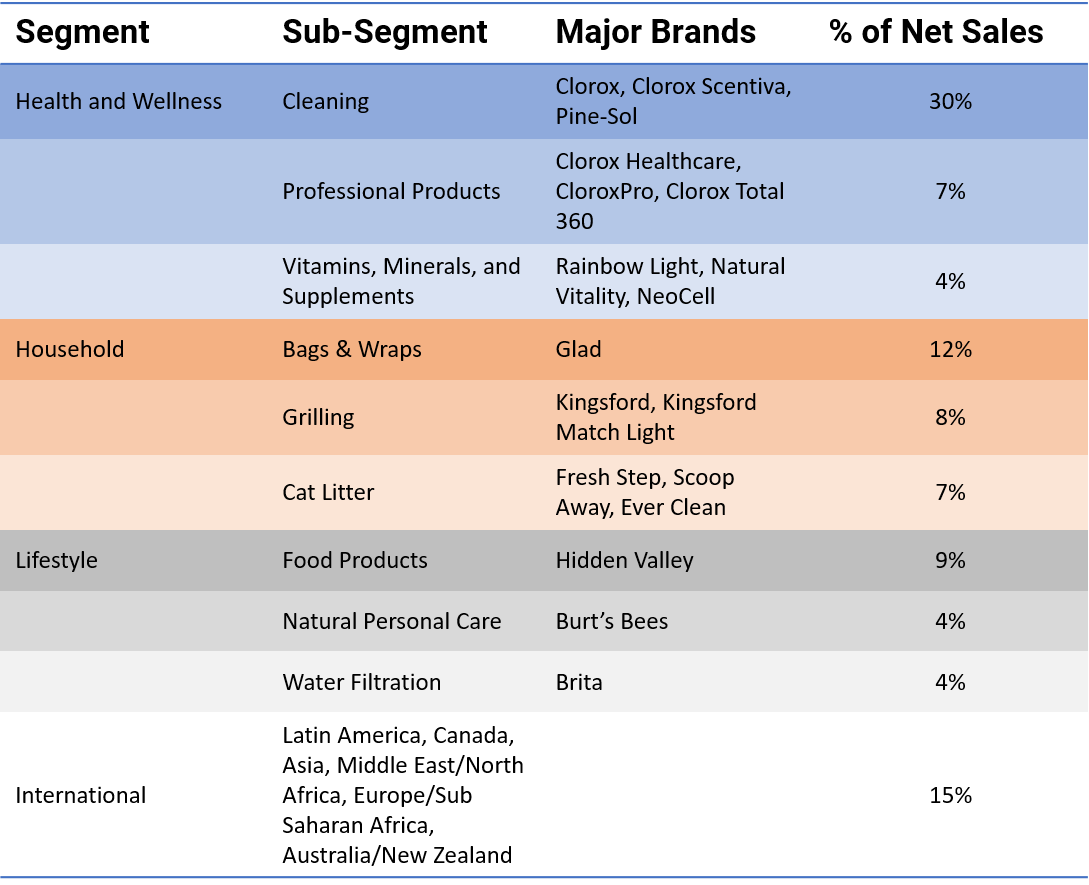
    Clorox is organized into 4 operating segments: Health & Wellness, Household, Life Style, and International. International is the smallest segment, but it’s also arguably the largest growth opportunity.

    This is common for many CPG companies. Most only start targeting international expansion once they’ve saturated the home market. The reason for this are obvious, but perhaps the most important is that international expansion really hard to do. Today, more than half of P&G’s $71 billion in revenue comes from abroad, but it wasn’t always that way.

    Here’s how Alecia Swasy described P&G’s foray into international markets in her book Soap Opera.

    P&G’s international business took decades to develop. Its first venture outside the States was a plant in Canada in 1915 and the purchase of a small English soap company in 1930. Five years later P&G bought a company in the Philippines, a source of raw materials for its oil business. After World War II it moved into Mexico, Venezuela, France, and Belgium, among other countries.

    Despite spending millions, international expansion wasn’t viewed as a priority inside the company. Here she describes future CEO Ed Artzt’s view when he was asked to oversee the company’s European operations.

    Those who worked with him recall that he had mixed feelings about the assignment. International posts were the equivalent of getting sent to Siberia. “He wasn’t sure he wanted international,” Bart Cummings said. “It was out of the mainstream.” But Artzt said he took the job willingly because he knew that the company’s long-term growth would come from distant shores.

    Part of the management difficulty was political. At that time there was a high amount of regulation around import/exports within Europe. Every country was basically post-Brexit UK. The other part was the technological and business process. They were attempting to stand up new brands without a ton of data on what local consumers did and did not want. That data would feed a supply and sales chain. If it wasn’t correct the money was wasted.

    Today, with the benefit of e-commerce, Clorox is going a different direction.

    Clorox CEO Linda Rendle explained:

    And then as we think about more broadly, the avenues that we have to introduce our brands to consumers have expanded. E-com is now a way that you can enter into a market, learn more about the consumer in a low-cost way. That allows us to get early insights and decide if we want to build more of an infrastructure behind an International business to expand.

    Basically, instead of setting up an entire sales, marketing, and supply apparatus, Clorox is going to selectively piggyback off an existing e-commerce platform and build a case to move into brick-and-mortar. Once they identify the winners, they’ll build up a network and sell them in.

  • CPG and E-Commerce. What company is winning?

    CPG and E-Commerce. What company is winning?

    For nearly a decade, CPG and e-commerce was a strategic priority for most firms. For years managers investigated the possibility of an entirely new channel—one with potentially higher margins than traditional brick-and-mortar retail. There were plenty of unknowns: How would this impact our main distribution channels? What about pack counts? How can you stimulate impulse purchases? How do you drive conversion without paying an arm and a leg for customer acquisition? 

    Consumer packaged goods companies invested millions of dollars on theoretical scenarios. Then overnight, things changed. CPG e-commerce was no longer a mythical goal; it was a revolution in real-time. The catalyst wasn’t a killer app or a perfectly designed marketing campaign. Rather, a global pandemic that upended life as we know it. Almost overnight, consumers gave up in-person shopping—replacing it with a mixture of online delivery or omnichannel. The pandemic fueled CPG e-commerce stats are pretty staggering.

    From Boston Consulting Group:

    The numbers reflecting the shift to e-commerce are dramatic: the use of online grocery services (across all fulfillment models) more than doubled from February to March 2020, from 13% to greater than 30% of US consumers, according to Brick Meets Click. And BCG analysis reveals that about 40% of these consumers are trying online grocery for the very first time. Perhaps the more important finding is that approximately 35% of US shoppers new to e-commerce in March plan to continue making grocery purchases online after COVID-19 restrictions are over. 

    It begs the question, what CPG companies are excelling in e-commerce?

    CPG e-Commerce Leaders

    If you’re going to declare any CPG firm a leader in any category, there needs to be some sales data behind it. Unfortunately, there isn’t an open-source data repository for e-commerce sales. There’s a reason for that. It’s valuable. Almost all the specific data is either proprietary or behind heavily guarded paywalls. 

    That was until I spent a few hours reviewing investor calls and annual reports. Some firms (P&G and Unilever) are incredibly open about their e-commerce success and call it out their website or annual report. Others, like Church & Dwight and Kellogg, let it slip in investor calls or media features. 

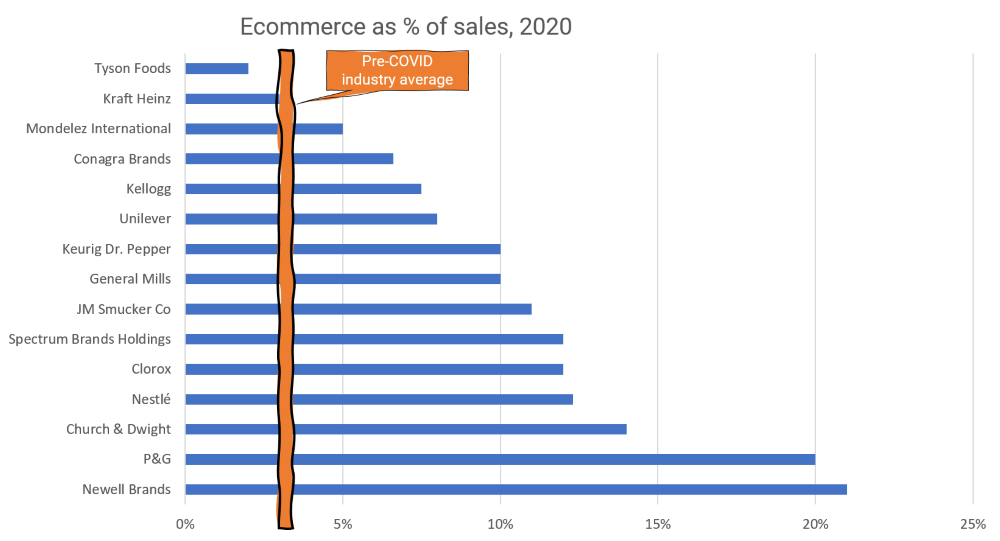
    The result is the following graphic, which I’ll periodically update. 

    Newell Brands and P&G are clear leaders in cpg e-commerce. The reason is clear–they’re selling mostly home goods that are easily shipped and distributed through the mail. I’m fairly blown away by JM Smucker and Nestlé, the two food companies with more than 10 percent of sales coming from online. 

    Photo by Joshua Golde on Unsplash

  • Kimberly-Clark looks to revenue growth management to combat commodity costs

    Kimberly-Clark looks to revenue growth management to combat commodity costs

    With its 4Q earnings report, Kimberly-Clark showed that brands still matter—even in categories with intense private label pressure. The Texas-based personal care company, which manufactures various paper products, saw organic sales increase 6 percent for the full fiscal year. “Overall, our results were strong,” CEO Michael Hsu told investors, “and I’m encouraged by the way we executed in 2020.”

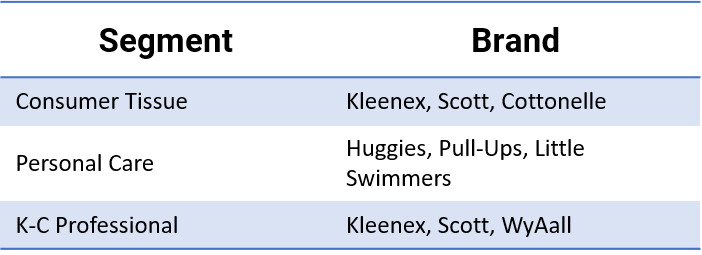
    One thing that COVID-19 taught us is that in times of crisis, consumers flock to trusted brands. Led by Kleenex, K-C’s Consumer Tissue segment saw organic growth of 13%. Personal Care, headlined by Huggies, followed with an impressive 6%. Meanwhile, the professional segment, which primarily services paper products to offices, struggled, dropping 7%. The year’s success comes with a new set of problems. They’re good problems to have but need to be managed.

    Kimberly-Clark is expecting a level of commodity inflation in 2021

    Most consumer product companies take simple raw materials and process them into finished goods. The value of the processing is reflected in the overall brand and price premium it can command. However, no matter how great the company is at engineering and branding, at the end of the day, the profitability of Kimberly-Clark is somewhat dependent on raw material prices. This year’s success reduced the amount of raw material available for next year—which could decrease its margins.

    Michael Hsu outlined some of the company’s expectations:

    So, if I tick through a few things, virgin pulp, we’re expecting inflation, and that follows a year and a half of very low pricing. So virgin pulp, we’re looking for it to be up high-single digits on average. Polymer resin, we’re expecting to be up significantly, 30% or maybe even higher in North America. Nonwovens and superabsorbent will follow that but to a lesser degree. Those dynamics are largely supply driven at this point. Recycled fiber, we’re expecting to be up mid-teens; distribution costs, we’re expecting to remain inflationary, and that’s mostly due to industry’s supply constraints. And other materials such as third-party purchased safety gloves and PPE and KCP are facing significant increases if you — if you look at what’s happening in those markets. So that’s — that’s the assumption for 2021.

    How CPG companies have typically handled price increases

    One of the easiest ways to handle commodity inflation in consumer goods is to pass the cost onto consumers. However, this isn’t as simple as increasing prices a few percentage points across the board. Manufacturers don’t set the price of their finished goods on shelves—retailers do. Retailers are more apt to pass a price increase along than a price decrease, but they also have category margin expectations. Suppose Kimberly Clark wants to raise prices by 3 percent. In that case, a retailer can maintain their own profitability goals by substituting a portion of K-C’s shelf space to competitors or private label who isn’t raising prices. For seemingly this reason, Hsu explicitly ruled out broad-based list price increases.

    Another option is to adjust pack size. If a standard Huggies box contains 124 diapers, K-C could maintain the price, but reduce the count to 96—allowing them to charge more for less. However, this decision has big long-term impacts. Not only from a consumer perspective, but a production and sales. Paying more for less is never a consumer preference, but perhaps equally important is that production lines and sales plans are optimized for the current pack-counts. Determining the specific SKU to adjust is a big undertaking.

    Luckily for K-C, there’s a discipline determined to help them understand where to target.

    Kimberly-Clark plans to use Revenue Growth Management to manage inflation

    Revenue Growth Management (RGM) is a popular topic in the consumer goods world. It’s popular because it’s a proven way to target specific profit areas.

    Here’s how I described it last year:

    Basically, it’s the ability to analyze consumer consumption data against retailer activity to identify better opportunities for trade spend to “grab those opportunities and to drive your revenues and your profits.” It may sound simple, but it is incredibly complex. Coca-Cola sells to hundreds of thousands of retailers across the globe—each with a different product assortment and level of data sophistication. Coke must not only identify the opportunities but create the right mechanisms to ensure the company executes them with the retailer.

    Kimberly-Clark is looking to leverage these same insights. RGM will bring in reams of data that will allow them to understand opportunities. Currently, a 32 pack of Huggies is $8.29 at Target online. Given the current level of online competition, it seems unlikely that the company could increase this SKU price.

    However, done right, RGM will allow K-C to understand the true cost of selling at each customer—by SKU. RGM uses a variety of COGS, Transportation, and Trade data to reveal profitability. Maybe they can increase the base cost of a less popular item by 25%, but make up the lost volume with a promotional coupon on the 32 pack.

    Hsu explains:

    With regard to the pricing, again, we do expect some significant cost inflation in the year. It’s in our plans, and that’s going to affect both the Consumer Tissue side and the Personal Care side. We’re going to take appropriate actions, and certainly that’s going to — we’re going to pull all the levers — and I’ve mentioned already certainly around cost management. But, in addition to that, it’s one of the reasons we’re very pleased that we’ve got a robust revenue growth management capability up and running globally across our regions. And the levers that we are working, I mentioned, Olivia, will be selective count changes, some selective price list price increases and then a lot of work around trade efficiency and managing through promotions.

    Kimberly Clark is hoping that RGM will help them understand what leverage they have at the SKU level and bring the results to retailers—to create a more worthwhile partnership.

    It will be interesting to see how it works out.  

    Image via Flickr