Category: Reading

  • Ranking the 23 books I read in 2022

    Ranking the 23 books I read in 2022

    It’s the eight installment (wow) of my annual year in reading. You can see past lists here.

    23. God Bless you, Mr. Rosewater – Kurt Vonnegut Jr.

    It’s pretentious and doesn’t have much of a plot. Read Cat’s Cradle or Slaughterhouse Five instead. Wikipedia

    22. Cold Mountain – Charles Fraiser

    Struggled to finish this novel about returning home after the Civil War. Surprised it’s considered a modern classic. Wikipedia

    21. Thinking Basketball – Ben Taylor

    Ben Taylor is an incredible basketball writer. His writing taught me an incredible amount about not only analytics, but strategy. I didn’t love the book, but that’s because it’s aimed at a more general audience. If you feel comfortable talking about usage rates and efficiency ratings, skip the book and head over to his wonderful website.

    20. The Money Culture – Michael Lewis

    A collection of Lewis op-eds and articles from the 1980s-1990s. Thriftbooks

    19. Financial Literacy for Managers: Finance and Accounting for Better Decision-Making – Richard Labert

    Good basic book on understanding corporate finance. Website

    18. Operations Rules: Delivering Customer Value Through Flexible Operations – David Simchi-Levi

    High level overview on building an agile organization. MIT Press

    17. Bloodchild and Other Stories – Octavia Butler

    Short story collection from one of America’s best science fiction writers. Wikipedia

    16. How the World Really Works: A Scientist’s Guide to Our Past, Present and Future – Vackav Smil

    A “realist” look at societies impending transition to a green economy. Smil frames the book around a handful of different commodities (concrete, fertilizer) and essentially argues that it’s going to be a lot harder to transition to green energy than promoters will admit. My general complaint is that it suffers from a lack of imagination. He devotes a chapter to the production of industrial fertilizer, which is an important commodity and required for America’s industrial food system. However, he never stops to ask if an industrial agricultural system is the one we should have. Website

    15. The Dawn of Everything: A New History of Humanity – David Graeber

    One of the bigger “big picture” books of last year. It’s fine. I just get tired of reconsidering the past. Website

    14. The Nineties – Chuck Klosterman

    One of America’s foremost cultural critics examines the last era of monoculture. Website

    13. The Kelloggs: The Battling Brothers of Battle Creek – Howard Market

    The story of how a celebrity doctor and his brother revolutionized America’s breakfast. It’s surreal how primitive society’s understanding of nutrition was 100 years ago. Impossible to consider how our modern system will look 100 years from now. Bookshop

    12. Financial Statement Analysis: A Practitioner’s Guide – Martin Fridson

    A fairly detailed look at understanding specific nuances around financial statements. As is all business analysis, industry context and expertise matters. Website

    11. The Goal – Eliyahu Goldratt

    There’s a reason this book is on every single operation’s person’s reading list. A wonderful fictional tale about how to optimize a manufacturing plant. Wikipedia

    10. The Lords of Strategy: The Secret Intellectual History of the New Corporate World – Walter Kiechel

    A thorough and detailed look at the rise of management consulting and its impact on the corporate world. Who would of thought that the industry took off because they were the only ones who knew how to calculate detailed profitability for far-reaching conglomerates? Harvard Business Review

    9. Blood, Sweat & Chrome: The Wild and True Story of Mad Max: Fury Road – Kyle Buchanan

    Oral history of the best modern action movie. Website

    8. The Thousand Autumns of Jacob de Zoet – David Mitchell

    I picked this up because Cloud Atlas, the science fiction novel that redefined a genre, is one of my favorite books. Turns out Thousand Autumns of Jacob de Zoet is historical fiction. The first third is slow, the second third is fine. The last third of the book is great. Wikipedia

    7. Merchants of Grain – Dan Morgan

    Food is inherently political. In America, affordable food is taken for granted, but a lack of it can destabilize governments and topple regimes. Dan Morgan investigates how five private companies control what the world eats, and what people pay. The book is dated (first published in 1979) but timeless in its analysis. Amazon

    6. Gangsters of Capitalism: Smedley Butler, the Marines, and the Making and Breaking of America’s Empire – Jonathan Katz

    Explores the origins of modern American imperialism through the lens of one of America’s most decorated Marines—Smedley Butler. Website

    5. The Money Machine: How KKR Manufactured Power and Profits – Sarah Bartlett

    The mechanics behind private equity are simple, but the industry spent decades and billions of dollars convincing people that it’s somewhat mystical. Financers aren’t simply stripping American industry for profit—they’re financial engineering! Written in the early 1990s, before the ensuing PR blitz to rebrand the industry, Bartlett examines the rise of one of America’s most notorious and profitable leveraged buyout firms—KKR. Abe Books

    4. Narrative and Numbers: The Value of Stories in Business – Aswath Damodaran

    If you’re starting out in finance, I highly recommend checking out the work of Professor Damodarn. Here he’s produced a book on the importance of crafting stories out of finance. Columbia University Press

    3. The Night the Lights Went Out: A Memoir of Life After Brain Damage – Drew Magary

    A suspenseful and empathetic book about surviving a brain hemorrhage. Website

    2. A Memory Called Empire – Arkady Martine

    A mystery science fiction novel that is both gripping and thought-provoking. Martine delves into the nature of consciousness while simultaneously examining colonialism. It deservedly won the 2020 Hugo Award for Best Novel. Wikipedia

    1. The Lords of Easy Money: How the Federal Reserve Broke the American Economy – Christopher Leonard

    For my money, Christopher Leonard is one of the best business writers working in America. Here, he takes a look at qualitative easing and its spiraling effects on the economy. Very modern business writers understand monetary policy. Leonard is one of them, and he explains it brilliantly. Website

    Photo by Alexander Grey on Unsplash

  • Ranking the 27 books I read in 2021

    Another year, another reading list. Honestly, this year might have been my worst year reading in the sense that I read a lot of bad books. 27-23 were startlingly bad. I’d go so far as to say that Guy Raz’s book is the worst book I’ve read since I started making these lists.

    But without further ado…

    27. How I Built This: The Unexpected Paths to Success from the World’s Most Inspiring Entrepreneurs – Guy Raz

    Superficial business advice for people more interested in talking about the glory of entrepreneurship than building actual companies. 90% of the “success” stories involve a version of the following line: “he encountered cash flow issues and had to ask his mother-in-law for a $50,000 loan.”

    26. Blue Ocean Strategy – W. Chan Kim

    Blue Ocean Strategy is typically viewed as a keystone business book. It’s often brought up with the same reverence of Christenson, Porter, or Drucker. I don’t understand how this book is revered by anyone. The core thesis of the book is that instead of competing in markets with many other options (red oceans), businesses should strive to play in areas without much competition (blue oceans). Really groundbreaking stuff.

    Blue Ocean Strategy is poorly researched and dependent on a variety of “gut” assumptions. One of the book’s keystone case studies is Cirque du Soleil. Now clearly, Cirque du Soleil was/is an innovative company that deserves admiration and study, but the author’s analysis of the situation is amateurish.

    They write:

    Whereas other circuses focused on offering animal shows, hiring star performers, presenting multiple show arenas in the form of three rings, and pushing aisle concession sales, Cirque du Soleil did away with all those factors…Similarly, while the circus industry focused on featuring stars, in the mind of the public, the so-called stars of the circus were trivial next to movie stars or famous singers. Again, they were a high-cost component carrying little sway with spectators.

    The authors provide no evidence that labor costs weighed down the companies. No 10-K, no newspaper article citing a record-breaking talent deal. Instead, the idea that Cirque du Soleil transformed the industry by turning to commoditized labor is thrown out there as fact. I have a hard time believing that when circus attendance was declining, an Executive at Ringling Brothers got management into a room and was like, “Here’s the solution to our problem. We’re spending ten million dollars to sign SQUIGGLES the clown.”

    25. The Deadline Effect: How to Work Likes It’s the Last Minute—Before the Last Minute – Christopher Cox

    You know a book is going to be out-of-touch with limited insights when an author’s main credential is they went to Harvard.

    24. How to Watch Basketball Like a Genius – Nick Greene

    I love basketball, and I struggled to get through this book. Imagine the general framework of Malcolm Gladwell, but without the writing talent.

    23. Power: Why Some People Have it and Others Don’t – Jeffrey Pfelfer

    A professor at a prestigious university summarizes academic research on career advancement. Most of the research was done with prestigious university graduates–meaning most of the advice is generic and useless unless you went to Stanford.

    22. Sam Walton, Made in America – Sam Walton

    300 pages of faux-folksy anecdotes without any real insight into the creation of Walmart. It’s genuinely weird to me how this book is on a variety of “best business books ever” lists. It’s also weirdly political. A good 25% of the book is reserved for Walton’s libertarian beliefs, while another 10% is taking shots at cities.

    21. VC: An American History – Tom Nicholas

    It’s a dense book on the history of venture capital in America. Not particularly readable, but meticulously researched and thought out.

    20. The New Tycoons: Inside the Trillion Dollar Private Equity Industry That Owns Everything – Jason Kelly

    The more I learn about private equity, the more I realize that it’s just a whole bunch of fancy words to describe a relatively simple financial model. This book paints a clear picture of the major private equity figures but sometimes trends more towards a press release than critical reporting.

    Seven books that I liked but didn’t provide any crazy insight or anything.

    19. Afterlife – Marcus Sakey

    18. The Big Sleep – Raymond Chandler

    17. The Chapo Guide to Revolution: A Manifesto Against Logic, Facts, and Reason – Chapo Trap House

    16. Someone Could Get Hurt – Drew Magary

    15. Just Like You – Nick Hornby

    14. Herbie – Rich Cohen

    13. The Empire of Gold – S.S. Chakraborty

    12. Innovation Delusion: How Our Obsession with the New has Disrupted the Work that Matters Most – Lee Vinsel

    The general premise of this book is that instead of innovation, we should really concentrate on maintaining and upgrading our existing public and corporate structures. Given that I write an operations-focused blog, you can assume I agree with this theory.

    11. First in Thirst: How Gatorade Turned the Science of Sweat Into a Cultural Phenomenon – Darren Rovell

    Rovell is one of the most-dunkable people on the internet, but his first book is an interesting read on the rise of Gatorade. It’s a fairly interesting story on how to commercialize a scientific product.

    10. Den of Thieves – James B. Stewart

    A look at the insider trading scandals of the 1980s that laid the foundation for modern finance.

    9. The Brothers Karamazov – Fyodor Dostoevsky

    I don’t have much to add for what is rightly considered one of the greatest books ever written in any language. There is much to admire, but superficially I couldn’t help but draw an intellectual line from Dostoevsky to Jordan Peterson. I don’t mean that as a compliment. I did a bit of googling, and it turns out that Peterson is a big fan. Why did I draw this connection? Every female character in Brothers is a hysterical insane person, which pairs perfectly with Peterson’s ridiculous disorder/order theory. It’s darkly hilarious and fitting that one of the biggest self-help influencers of the last 10 years read classic literature and his major takeaway wasn’t about the human condition but rather that women are crazy.

    8. Lights Out: Pride, Delusion, and the Fall of General Electric – Thomas Gryta

    It’s not as insightful and deeply reported as a few other recent corporate biographies, but Gryta does a nice job tracing the downfall of one of capitalism’s most important companies. The verdict: General Electric could overcome fraudulent accounting and bad acquisitions, but it couldn’t overcome both.

    7. Giannis: The Improbable Rise of an NBA MVP – Mirin Fader

    At this point, it’s surprising that Giannis is a real person. His story is one of a Greek Myth.

    6. The Secret Life of Groceries: The Dark Miracle of the American Supermarket – Benjamin Lorr

    Every few years, a book comes out that breaks down the grocery industry. Each one promises a big new insight into a thousand-year industry. There isn’t one here, but it’s still a well-written and interesting look at the modern grocery industry.

    5. The Box: How the Shipping Container Made the World Smaller and the World Economy Bigger – Marc Levinson

    A deeply reported and nuanced look at how the shipping container transformed commerce. Levinson meticulously looks at the revolution from all angles: commerce, labor, city planning, legal, socio-economic. One of the biggest takeaways was how dependent the industry’s evolution was on regulation. It’s almost as if politics plays a huge role in commerce.

    4. Amazon Unbound: Jeff Bezos and the Invention of a Global Empire – Brad Stone

    Both of Stone’s Amazon books are must-reads for anyone who lives in America. I’d argue that they’re required reading for anyone who works in the retail industry. The first book looks at how Amazon amassed the power it has. The sequel looks at what Bezos did with all that power. One very interesting dynamic here is the rise of advertising within Amazon. It’s a more powerful and efficient AWS.

    3. The Devil’s Playbook: Big Tobacco, Juul, and the Addiction of a New Generation – Lauren Etter

    It’s hard to imagine that there could be a story written about big tobacco where big tobacco isn’t the villain, but the one saying, “hold on, this might be dangerous.” But that’s exactly what happened in the case of Juul. For those that don’t know, according to its founders, Juul was created to help smokers switch from harmful cigarettes to less harmful vapes. (Note: I find this origin story preposterous) Juul then applied some Silicon Valley moxy to the industry. Juul’s version of moving fast and breaking things was explicitly advertising nicotine to children. In the end, a smoking substitute ended up ensnaring a new generation.

    2. Never Let Me Go – Kazuo Ishiguro

    A beautiful and touching book about class, cloaked in a science fiction novel.

    1. McDonald’s Behind the Arches – John Love

    Every so often, business books come along that not only tell a company’s story but reveal how it happened. It’s one thing to say that a company looks to delight customers. It’s another to define “delight” and then describe how a company defined a qualitative idea at scale. Behind the Arches is one of those books. It not only tells the story of McDonald’s evolution, from a small California drive-in to an international corporation, but it describes in painstaking detail how it did so.

    At times the book turns into deification, but honestly, it’s kind of understandable. Prior to McDonald’s, there were very few successful chain restaurants. The biggest was probably Howard Johnson, which was a sister company to a hotel chain. The reason was, how do you operationalize and scale food service? It’s one thing to produce an item at scale; it’s another to produce a service.

    Love details how it happened.

  • Ranking the 40 books I read in 2020

    Ranking the 40 books I read in 2020

    I read 37 books this year, which I think is a new record. What can I say, I had a bit more free time with quarantine. You’ll see a pretty diverse set of books: from thrillers to business profiles.

    40. Tides of War – Steven Pressfield

    I once heard Trump described as “What a dumb person thinks as smart, a poor person thinks as rich, and a weak person thinks as powerful.” Tides of War is that but in book form. A cool concept (the retelling of the Peloponnesian War) but done in the most stereotypical and contrived way possible.

    39. The Green Mile – Stephen King

    I’ve never seen the movie and generally enjoy Stephen King. When I saw it on sale for $2 at a used book store, I grabbed it. The story is well told but hard to enjoy since the entire plot is a racist trope.

    38. Motherless Brooklyn – Jonathan Lethem

    A murder mystery with incredibly low stakes.

    37. The Girl on the Train – Paula Hawkins

    I looked for Gone Girl 2.0 and ended up with a mystery where the ending was obvious. All the characters were irredeemable.

    36. Dream Big – Cristiane Correa

    Correa’s profile of 3G Capital, the private equity group that upended the CPG industry with leveraged buyouts, is effectively propaganda. I went in looking for an honest assessment of the firm’s business strategy and structure. What I got was something that could have been written by the founder’s itself. 3G’s rise is incredible. In under twenty years, 3G went from an unheard-of Brazilian firm to owning two iconic American brands: Budweiser and Kraft. According to Correa, it was all due to their guts and courage. Complete nonsense.

    35. Billion-Dollar Brand Club – Lawrence Ingrassia

    200 pages on how the direct-to-consumer model is upending consumer products, when it’s not clear the author understands the CPG industry’s basic economics. The one good insight was that successful D2C companies undercut high priced competitors by offering “just-good-enough” products. The rest is a few hundred pages of repackaged buzzwords and press releases.

    34. The Border – Don Winslow

    Overall, Winslow’s Power of the Dog series has moments of pure beauty. He has the rare ability to put huge and overarching themes into genre writing. It’s a large part of why I rated the series’ second book one of my favorites of 2015. He is also a huge part of #resistance. I’m not a fan of Donald Trump, but I also have no interest in reading someone’s fan-fiction about throwing a Trump doppelganger in jail—which describes about 1/3 of the book.

    33. Raised in Captivity: Fictional Nonfiction – Chuck Klosterman

    A collection of short stories by one of my favorite essayists. I don’t remember a single story a year later, so I went ahead and downgraded it.

    32. Dethroning the King – Julie MacIntosh

    In 2008, 3G Capital purchased Budweiser for $52 billion. Overnight, a company that branded itself as America was now under foreign control. MacIntosh traces the rise of Budweiser from a regional brand to one that controlled over 50% of the American beer market. She outlines the operations that fueled the increase: Marketing, Marketing, and Marketing and how egos and greed led to a hostile takeover. A bit of it falls into the worship of 3G-Capital and the top-heavy management style it forces on its targets, but overall I’d say it was a decent read.

    31. Secondhand – Adam Minter

    An informed and well researched look at the secondhand goods and waste market.

    30. Applied AI – Mariya Yao

    A book on AI, written by an AI consulting firm. The book is marketing material at its core, but it’s an easy read and cuts a lot of the fat out of the conversation.

    29. Mindset – Carol Dweck

    28. Getting Things Done – David Allen

    27. Executive Presence – Sylvia Ann Hewlett

    My general view on self help books is that they’re good if you take 2-3 points form each. That explains each of these.

    26. Point B – Drew Magary

    In the future, the invention of teleportation solves climate change. Teleportation eliminates the need to drive anywhere and thus all carbon emissions. It also removes any sense of privacy as people can teleport anywhere they want—including a stranger’s bedroom. The wealthy can afford protection, while the poor are left to live in constant fear. I loved the premise, but the execution is somewhat limited—a fun book to read on vacation.

    25. The Obelisk Gate – N.K. Jemisin

    The second book in N. K. Jemisin’s Broken Earth Trilogy. I really enjoyed her short story collection, but I haven’t been gripped yet.

    24. True Grit – Charles Portis

    Rightly viewed as a modern American classic. A deadpan look at the old-west, including the misogamy and racism inherent in its founding.

    23. Store Wars – Greg Thain

    I’d highly recommend reading this book if you’re new to the CPG world. Consider it a collection of case studies of the Western retail market.

    22. Rising Tide – Davis Dyer

    Harvard Business Review paid a history professor to write a history of Procter & Gamble. The company granted him immense access to its archives and resources. It’s incredibly well done, but don’t read this is if you’re looking for a complete company narrative. View it as a comprehensive look at one of the most successful companies in American history—written by the company itself.

    21. Soap Opera: The Inside Story of Procter and Gamble – Alecia Sway

    The inverse of Rising Tide. Alecia Sway, a reporter at the Wall Street Journal, spent a career reporting on the Cincinnati consumer goods company. The result is this book, Soap Opera, which she claims led to the company spying on her. The book acts as an examination of P&G’s business culture and values. Unlike Rising Tide, which portrays P&G as a beacon of American industry, Soap Opera paints a much darker picture. For example, in the 1970s, P&G released Rely Tampons. The tampons led to toxic shock and the death of at least one person. According to Rising Tide is was an unfortunate unknowable mistake that the company rectified via recall. According to Sway, it was a preventable problem known by the design team whose warnings were ignored by the financial people. Once the mistake was made public, the company then went on a scorched earth campaign to bankrupt its accusers and cover up the misdeeds.

    Overall, I found it a very interesting read. Part of her criticisms were presented as unique to P&G, while I think they’re applicable to the industry at large. The end of the book did not age well. Published in 1994, it all but predicts the company’s demise.

    20. Secret Formula – Frederick Allen

    A look at the rise and continued rise of the Coca-Cola company. Allen did a nice job connecting Coke’s marketing and sales innovations. I thought it was the happy medium between Soap Opera’s contrarian view and Rising Tide’s mythmaking

    19. The Club – Josh Robinson

    In the last twenty years, English soccer went from locally owned organizations to being backed by billionaire oil despots. This book explains how and why it happened.

    18. Antifragile – Nassim Taleb

    It’s the third and most important book (according to Taleb) in his Incerto series. It essentially argues that we’ve over-engineered our society. Here is a more useful review from noted economist Branko Milanovicv.

    17. No Encore for the Donkey – Doug Stanhope

    The first few chapters of the book are typical Stanhope: cynical, funny, and a disdain for ‘normal’. But then it changes. It turns into one of the more heartfelt books I’ve read in recent memory. It’s a book about love and loss. About building your own family and sharing it with those you choose-not those you’re related through. It’s also about death, mortality, and rebuilding. Honestly, it is fantastic. One of the things I love most about Stanhope is how much his comedy has evolved. Stanhope is one of a handful of artists who have gotten more progressive and thoughtful with age.

    16. Medium Raw – Anthony Bourdain

    I listened to the audiobook, so it was basically 8 hours of your close friend talking about food.

    15. The Sympathizer – Viet Thanh Nguyen

    After the fall of Saigon, an American education North Vietnamese Captain is sent to live in America. Here he plots the eventual return of communism to his home country. It’s part spy novel, part assimilation story, while analyzing the history of the Vietnam war in American culture.

    14. A Gentleman in Moscow – Amor Towles

    After the communist revolution, a wealthy landowner is sentenced to house arrest in a Moscow hotel. The book chronicles the remaining decades of his life. It’s a fun novel with an unexpected ending.

    13. Deep Work – Cal Newport

    It’s a self-help book, but I got more than 3 things from it. Basically, schedule “creative” time every day.

    12. The End is Always Near – Dan Carlin

    The first book from the genre-defining history podcaster. It’s more of a collection of mini-podcast episodes than a coherent narrative. However, each one is centered on the idea of how past eras viewed the end of the world.

    11. Break ‘Em Up – Zephyr Teachout

    I wrote a larger review here. Anti-monopoly is one of the most important movement in American society and will have huge impacts across both the CPG and retail world.

    10. Salt Sugar Fat – Michael Moss

    Salt, Sugar, Fat takes a critical but balanced look at the packaged food industry. It’s built around an interesting structure: how food companies evolved to use Salt, Sugar and Far to hook consumers. I’d highly recommended it to both CPG professionals and the broader population.

    9. The Buyout of America – Josh Kosman

    In 2020, I spent a fair portion of my free time learning about private equity. It’s a huge portion of our economy, and yet few people know much about it. Kosman, who writes an influential private equity newsletter, provides an thorough look at the business structure and social impacts of the industry.

    8. The Year without Pants – Scott Berkun

    A quick and easy read on managing remote teams.

    7. Do the KIND Thing – Daniel Lubetzky

    It’s not hyperbole that Lubetzky revolutionized the packaged food industry with KIND. KIND is a premium snack, with straight forward ingredients, marketed as openly as possible. Lubetzky provides dozens of great case studies and tactical advice on building CPG brands in a new era.

    6. Empire of the Summer Moon – S.C. Gwynne

    Gwynne frames the story as a biography of Quanah, one of the last great Comanche leaders, but it’s really a holistic look at the America’s Western expansion. At one time, the powerful Comanche tribe controlled territory from Colorado to the modern-day US/Mexican border. Today, the nation resides on a tiny reservation in Oklahoma. Gwynne provides a deeply researched and brilliantly told story on how it happened—tying in technology and politics. Did you know that the Texas Rangers had their roots as a genocidal militia? Neither did I. Gwynne explains how everything intertwines.

    5. The Meat Racket – Christopher Leonard

    Koshland was my second favorite book in 2019, so of course I had to read Leonard’s previous work. It’s a brilliantly researched and argued look at the rise of Tyson Foods. A chicken company that revolutionized American’s food system, while simultaneously destroying small-town America.

    5. The City of Brass – SA Chakraborty

    4. The Kingdom of Copper – SA Chakraborty

    Typical fantasy novels are modeled after the European middle ages. Chakraborty sets her Daveabad Trilogy in an Arabic fantasy land. The best way I’d describe it is a more accessible, but less detailed and sprawling, Game of Thrones.

    3. Goliath – Matt Stoller

    Goliath is a comprehensive and readable history of America’s anti-monopoly movement. It starts by telling the historical precedence for framing anti-trust policies as bulwarks against fascism and ends by detailing its fall.

    2. The Nickel Boys – Colston Whitehead

    A young black boy is sentenced to reform school for essentially no reason. From there, the system destroys an innocent person. Based on a true story, but a fictional narrative, the Nickel Boys is a beautiful novel about race and America.

    1. The Master Switch – Tim Wu

    I’ve spent a fair amount of time this year thinking about anti-monopoly policy and history. The thing that I keep coming back to is that none of this is new! We’ve faced the exact same problems before, but we knew how to manage them! Wu gives a comprehensive look at networked technologies and details how they’ve been managed throughout our nations’ history. Many commentators talk about information technology as if it is magic, cure-all not bound by typical business restraints. They’re lying or being paid to have the opinion. 

    The 20th century was defined by industrial-scale—electricity, telephone, television, radio. Today we have the same thing, except the vessel, for it isn’t in our homes but our pockets. Facebook, Twitter, podcasts—all of which are just reimaginings of past inventions.

    Most of these technologies create nature monopolies, which have universally disastrous results if unregulated. Wu provides a new way to think about modern technology and shows us how to regulate it.

  • Books about the impact of technology on society

    Books about the impact of technology on society

    If you’re looking to learn more about why society is changing so fast and what to expect in the future you’ve come to the right place. The following is a list of the five best books about the impact of technology on society. I have a fairly loose definition of technology. In my opinion, it can be both the traditional view (the internet) or policy (free trade legislation). There’s not a whole lot of rhyme or reason to the list’s order.

    Brave New War: The Next Stage of Terrorism and the End of Globalization

    “I keep coming back to the way terrorism and guerrilla warfare is rapidly evolving,” John Robb writes in the preface of the paperback version, “to allow nonstate networks to challenge the structure and order of nation-states.” Brave New War is a book about terrorism but defines the structure of an interconnected world in regards to war, politics, and business. He argues that for the first time in modern history an outsider can not only fight a modern war–but win. This leaves established organizations (corporations and governments) in a tenuous position. Recent memory has shown that Robb’s final thesis was right; companies that embrace lean tactics flourish, while others fade away. “We have two choices: we can enable its emergence, or we can delay it until it evolves on its own out of necessity.“

    The Starfish and the Spider: The Unstoppable Power of Leaderless Organizations

    You know a book is great when it is published as a libertarian manifesto and becomes required reading for political organizers of all persuasions.  Brafman and Beckstrom argue that organizations that become leaderless become unstoppable because they can’t be logically attacked. If you cut off one source of power a new one simply reemerges. The book belongs in the same category as Rules for Radicals, but as I’ve gotten older and gained experience working with Fortune 100 management I’ve began to question to the viability of scaling a leaderless organization. Nevertheless it remains an important work.

    Men Who Stare at Goats

    Jon Ronson is an expert of drilling down into a seemingly ridiculous/hilarious idea and revealing the terrifying fragment of truth behind it. Men Who Stare at Goats is an investigation of a rumored US Army program to train a group of top-secret soldiers to become so powerful they could kill a goat by staring at it. He investigates the seemingly insane rumor and stumbles upon something true and perhaps even more frightening: the institutionalized use of psychological warfare in modern society.

    American Kingpin

    American Kingpin tells the remarkable true story about how one man built an Amazon for drugs and weapons. At its peak, it processed hundreds of millions of dollars a day in illicit substances. It then came crashing down due to the work of a handful of dedicated US agents. It took Sam Walton 30 years to conquer retail. Jeff Bezos 15. All of this happened in a few years.

    How Not to Network a Nation

    In the thirty some years since the fall of the Soviet Union, most analysis is reduced to one sentiment: communism failed because capitalism is superior. They bring up the work of Hayek, stories about full grocery aisles, or simply argue that people are too self-interested for mass collectivism to work. And yes, I understand and even agree with many of these arguments, but it’s also lazy. It’s like analyzing the most recent Super Bowl and concluding that the New England Patriots won because they wanted it more. In How Not To Network a Nation Benjamin Peters provides an exhaustive look at one of the functional problems that plagued the Soviet experiment: information. Peters concludes that “American APRANET initially took shape thanks to well-managed state subsidies and collaborative research environments. The comparable Soviet network project stumbled due to widespread unregulated competition among self-interested institutions, bureaucrats, and other key actors.”

    Basically, the socialists acted like capitalists and the capitalists acted like socialists.

    Photo by freestocks.org from Pexels

  • Book Review: Break ‘Em Up by Zephyr Teachout

    Book Review: Break ‘Em Up by Zephyr Teachout

    Early in her newest book, Break ‘Em Up, Zephyr Teachout retells the story of an Amazon air hockey seller. The seller, whose air hockey table was one of the top-3 search results until Amazon introduced sponsored ads. Coincidently, despite years of sales and popular reviews, the product dropped off the search charts with their arrival—even the free organic results. Potential buyers in the America’s largest online market could no longer find the product. In a desperate act to regain volume, the seller decided to spend $5,000-$10,000 a month on Amazon sponsored advertisements. As if magic, a product that mysteriously dropped off Amazon’s organic search results, found its way back to the top after it bought thousands of dollars of advertisements.

    Zephyr Teachout explains:

    The resulting system is the opposite of a competitive market — it’s a kickback regime. Amazon sets up an allegedly neutral system , and then charges fees to game that system, calling those fees “ advertisements. ” Sellers compete over how much they can pay Amazon to get access to consumers.

    This example speaks to the heart of Break ‘Em Up. Teachout argues that large private monopolies are forms of tyranny that destroy our economy and democracy. The small air hockey seller is not free to conduct business if they’re forced to purchase thousands of dollars of advertisements from the only online market that matters. According to Teachout, the only way to combat the tyranny is to target the heart of the issue: the business model itself.

    About Zephyr Teachout

    In my opinion, Zephyr Teachout is one of the most important figures within the modern progressive movement. She’s a lawyer, law professor, author, and multiple time candidate for public office. Unlike a lot of her contemporaries, her arguments and solutions aren’t driven solely from a moral standpoint. Instead, she provides a moral vision with a fierce defense of competitive markets and cost-savings—something every business minded person should hold dear to their heart. Take the popular progressive position of Medicare (universal health care). Zephyr supports it, but wants to move past the discussion of universal coverage and into the structural issues driving health care cost: private monopolies.

    Here’s the rub: driving down prices is much harder when the government is negotiating with a powerful monopoly than when it is negotiating in a competitive market. Healthcare expert Phillip Longman has written several persuasive articles about consolidation in the drug market, and the healthcare industry more generally, and the risk that this consolidation poses to nationalizing plans. If a single payer plan was enacted without additionally addressing the monopoly problem, he argues, government could end up effectively subsidizing big pharma, and big hospitals, and keep paying enormously high prices. Those costs would shift back to the public—in the form of taxes.

    Single payer care is necessary for humane reasons, and for the extraordinary reduction in administrative costs. But why not demand both single payer and breaking up drug monopolies?

    Basically, Zephyr Teachout has the courage and the moral conviction of Ralph Nader, but the vision to see the structural issues driving our society.

    Private Taxes

    Break ‘Em Up is structured into two parts. The first argues that private monopolies have destroyed a lot of what we consider society. The second is what to do about it. One of my favorite things about this book is how she frames business taxes. The earlier $5,000 to $10,000 ‘advertising’ fee that the small business pays every month isn’t advertising. It’s a private tax, imposed by Amazon in order to access the market. Unlike public taxes, which go to fund roads and schools, this goes straight into the pocket of Jeff Bezos—who is current worth around $200 billion.

    She walks us through a variety of industries and the monopolies that impose private destructive taxes on each: Tyson and Farming, Facebook and Journalism, Amazon and Retail. The stats are particularly damning in farming. In 1985 farmers were paid about 40 cents for every dollar Americans spent on food. Today, that number is down to 15 cents. The money has shifted from small producers, to large manufacturers and retailers.

    The first part of the book is well written, but unless you’re new to the anti-monopoly thought, it isn’t particularly groundbreaking. In my opinion, The Curse of Bigness by Tim Wu (who she ran for governor with) and Matt Stoller’s Goliath do a little bit better job explaining the evolution, history, and impact of the rise of private monopolies. Where Break ‘Em Up really shines is in the second part—what to do about it.

    Break ‘Em Up!

    If you regularly read this blog, you know that I write and work at the intersection of politics, technology and consumer products. I’m generally partial to the plight of consumer products companies—this isn’t to say they’re blameless—but most are effectively powerless against large retailers. The reason for this is quite simple–we quit enforcing free trade laws.

    For most CPG companies, two retailers (Walmart and Kroger) constitute 30-35% of sales. If one of them says an item’s price needs to be lowered—it’s going to get lowered—and the manufacturer is going to take the margin bite. They simply can’t risk getting their item take out of the store. The only way they’re able to negotiate is if they have a large portfolio—either raising prices elsewhere or making it up in overall volume. Either way, the underlying structure pushes companies towards consolidation—like the mega-merger of Kraft-Heinz. Break ‘Em Up is one of the first books that I’ve read that gives concrete framework to stop the structure from happening.

    1. Open, competitive markets, working together with publicly provided services and neutral infrastructure, are necessary for economic liberty. There is no one-size-fits-all answer to every industry, but unregulated private monopoly poses a unique threat. Private corporations with too much power raise prices for consumers, depress wages for workers, choke off democracy, and regulate all of us.

    2.  To preserve rough economic and political equality, we should make it easier to organize people and harder to organize capital. It should be as easy to unionize, or to create a cooperative, as it is hard to merge goliaths.

    3.  It’s better to err on the side of decentralized private power. Democratic governance is messy and will lead to mistakes, but corporate government will lead to tyranny.

    To me, some of her most powerful writing is when analyzes Michael Sandel’s What Money Can’t Buy, a book that argues the typical progressive line on capitalism—that it’s bad and needs to change for moral reasons. Her response is phenomenal and I think shows a viable path forward to popularizing progressive policies across the ideological spectrum.

    Sandel’s approach is dangerous because it closes down an arena of moral action and redirects activism away from breaking up big corporations. It makes us ignore market – structure problems. If we treat markets as a kind of necessary infectious disease that one must cordon off, instead of institutions that can be wonderful or corrupt depending on how they are structured, we stop trying to fix them. And while a few people think the state should make shoes and grow carrots, most people — including myself — imagine most of economic life happening through private exchange.

    Zephyr’s solution isn’t to regulate out markets. The solution is to regulate markets in a way that works for people. She then provides a framework that isn’t just theory, but practical and proven.

    All in all, Break ‘Em Up is a nice addition to the modern anti-trust movement by one of its most important practitioners.

    Image via Flickr

  • Ranking the 35 best books I read in 2019

    Ranking the 35 best books I read in 2019

    Like most people online, I’m always looking for book recommendations. So each year I’ve made it a habit of recapping every book I’ve read. If book recommendations are you thing, here are my book recommendations from 2014, 2015, 2016, and 2018.

    On to 2019’s list.

    35. Tyrant: Shakespeare on Politics – Stephen Greenblatt

    A Harvard Professor analyzes the rise of Trump through Shakespeare. It’s somewhat amusing how much of our current climate Shakespeare predicted. Trump basically is Coriolanus. However, it’s the ultimate #Resistance book, and I mean that in the worst way possible.

    34. How to Talk to a Widower – Jonathan Tropper

    Light and breezy guy-lit. This is Where I Leave You is much better.

    33. Good Omens: The Nice and Accurate Prophecies of Agnes Nutter, Witch – Neil Gaiman and Terry Pratchett

    It’s a cool premise, a satirical look at what happens when afterlife bureaucracy leads to both Heaven and Hell pushing for war, and a demon and angel try to stop it. This is my second Neil Gaiman book, and despite his popularity, I just can’t get into him.

    32. The New Science of Retailing: How Analytics are Transforming the Supply Chain and Improving Performance – Marshall Fisher

    31. Reengineering Retail: The Future of Selling in a Post Digital World – Doug Stephens

    Two books that are basically long advertisements for the authors’ consulting work. New Science gets fairly technical—in the right way. I wrote a more extended review of Reengineering Retail here.

    30. Howard Stern Comes Again – Howard Stern

    I grew up listening to Stern and think he’s easily the most gifted radio broadcaster in history. However, this book isn’t terribly insightful. What sounds deep and reflective over the air doesn’t always translate to the page.

    29. On Power – Robert Caro

    28. Working: Researching, Interviewing and Writing – Robert Caro

    Robert Caro, America’s best living researcher, and biographer, wrote a mini-memoir and the craft of writing. My only complaint is that I’m kind of obsessed with Caro, and if you search in the right places, you can find most of what’s in here online. A good chunk of it is in On Power.

    27. Fall, or Dodge in Hell – Neal Stephenson

    There are two books in this 900-page opus. One is about a future world where fake news has destroyed reality. The rich employ personal filters to root out fake news, while poor people are inundated with conspiracy theories. This part is fantastic. The other is about creating a virtual afterlife and a video-game-like war for its future. I found the “real world” portions of this book amazing, but the battle for a virtual immortality fell flat.

    26. Underground Airlines – Ben Winters

    A bleak but well-paced book set in an alternative reality. The Civil War never happened, slavery still exists in four states, and America is relegated to a pariah-state. A former slave unwittingly uncovers that America’s largest corporation is fully supported by slave labor.

    25. Red Card: How the U.S. Blew the Whistle on the World’s Biggest Sports Scandal – Ken Bensinger

    The 2015 FIFA corruption case made global headlines but has been mostly forgotten in America. Basically, FIFA is a massive money-laundering scheme, and this book tells the story about how the FBI uncovered it. Bonus – Donald Trump is of course, tangentially involved.

    24. One Buck at a Time: An Insider’s Account of How Dollar Tree Remade American Retail – Macon Brock

    A surprisingly detailed and well-written account of the founding and expansion of a discount retail empire. I enjoyed the operational details–how many memoirs go into ship-to/sold-to decisions? It does not, however, read very well in 2020 America. There’s basically a 5-page defense of Dollar Tree’s indirect use of child labor.

    23. The Walmart Effect: How the World’s Most Powerful Company Really Works and How it’s Transforming the American Economy – Charles Fishman

    Written in 2006, the book examines Walmart’s holistic impact on communities, suppliers, and consumers. It details how it uses its market power to crush domestic suppliers and force outsourcing. It’s surprisingly prescient but suffers from being written 10 years too early. Instead of reading the book, I’d check out the original article in Fast Company.

    21. The Golden Compass (Graphic Novel) – Stephane Melchior-Durand

    20. The Secret Commonwealth – Phillip Pullman

    The His Dark Materials series is my favorite fictional series of all time. I read the graphic novel version of The Golden Compass to get ready for HBO’s excellent adaption. The Secret Commonwealth is the latest installment of a series that has long been accused of being anti-church. Pullman somewhat addresses the criticism by building an entire plot around asking the question: What happens when you live your life 100% by rationality?

    19. Raise in Captivity: Fictional Nonfiction – Chuck Klosterman

    A short story collection by Chuck Klosterman. I would say about 70% of the stories work, which isn’t a bad ratio.

    18. The Last Days of August – Jon Ronson

    I firmly believe Jon Ronson is one of the best living nonfiction writers. In this podcast series, he focuses his talents on the suicide of adult film star August Ames. He uncovers a complicated situation. Allegations of domestic abuse, online shaming, and ultimately an industry almost as hypocritical as it is controversial.

    17. Out on the Wire: Uncovering the Secrets of Radio’s New Masters of Story with Ira Glass – Jessica Abel

    A really good “text-book” that helped me create The New Deal Podcast.

    16. Hotel Florida: Truth, Death, and the Spanish Civil War– Amanda Vaill

    The Spanish Civil war is somewhat forgotten in modern American memory, and it’s a shame because there are too many modern parallels to list. A leftist government was democratically elected in Spain. The conservative and monied interests promptly called it illegitimate and led a civil war for control of the country. The Fascists won and rules for the next 40+ years. Vaill tells the story through the artists and journalists who covered it.

    15. Grocery: The Buying and Selling of Food in America – Michael Ruhlman

    Grocery is a fantastic book that nicely melds personal narrative into the evolution and future of grocery retailing in America. Unlike Reinventing Retail, which focuses on buzz-words, Ruhlman explains how modern grocers are succeeding in operational and strategic terms.

    14. Circe – Madeline Miller

    A retelling of the classic Greek myth using modern prose. I haven’t read Miller’s original The Song of Achilles, but it’s on my list for this year.

    13. The Stand: Stephen King

    I finally got around to reading Stephen King’s magnus-opus. It features over 1000 pages of fantastic character development and the enthralling story of a virus that kills 90+ percent of the world—and the world’s struggle to rebuild. I’m looking forward to the modern television adaption.

    12. The Curse of Bigness: Antitrust in the New Gilded Age – Tim Wu

    A quick and readable history of modern antitrust thought in America and what it means for today. I wrote a more extensive review here.

    11. The Fifth Season – N.K. Jemisin

    This book originated when Jemisin attended a NASA event for science fiction writers. What happens to society when climate change leaves vast geographies barren? She investigates with a blend of magic and ingenious narrative.

    10. Replay – Ken Grimwood

    Replay, originally published in 1986, was an inspiration for Harold Ramis’ classic comedy Groundhog Day. A man dies and wakes up in his 18-year old body. This repeatedly happens until suddenly the timing shifts. The replays become shorter and shorter. I found the book to be both entertaining and oddly spiritual.

    9. Death’s End – Cixin Liu

    The conclusions of Liu’s epic Three-Body Problem series doesn’t disappoint. The series, which is considered a foundational work in Chinese science-fiction, imagines a scenario where humans contact a dangerous alien race that needs to invade earth to save its civilization. Parts of the finale dragged, but the ending was one of the most impactful that I can remember reading. Eight months later and I still think about it.

    8. The Name of the Wind – Patrick Rothfuss

    7. The Wise Man’s Fear – Patrick Rothfuss

    According to the experts, Rothfuss set out to redefine fantasy literature with his Name of the Wind series. Judging by the first two books, he’s succeeded. Filled with stories-within-stories, reexamined fantasy tropes, lyrical prose, and unreliable narrators, the book reads like an epic poem.

    6. Winter War: Hoover, Roosevelt, and the First Clash Over the New Deal – Eric Rauchway

    The general narrative around modern politics is that it’s more divisive than it’s ever been. Unlike the past, Republicans and Democrats have no interest in compromise. Rauchway, a Professor of History, proves this idea wrong. We’ve just forgotten. Winter War looks at the four months between FDR’s election and inauguration. During that time, his predecessor Herbert Hoover tried to force his failed monetary policies onto FDR administration. FDR rejected them outright, and as a result, Hoover declared war on the administration. It’s forgotten now, but Hoover spent the rest of his life delivering fiery speeches on the imminent threat the New Deal posed to America.

    5. The Great A&P and the Struggle for Small Business in America – Marc Levinson

    I often write about how most modern business books are terrible. They’re filled with self-help platitudes without any analytical look at the current structure of the economy. Levinson’s insightful look at A&P is not one of those books. He tells the story about how A&P became the Walmart of the first half of the century, and political backlash that ensued. If you’re interested in modern retail, this book should be at the top of your reading list.

    4. Fatherland – Nina Bunjevac

    An incredibly moving graphic memoir about a Serbian immigrant’s experience with nationalism and war.

    3. All the King’s Men – Robert Penn Warren

    It’s considered a classic for a reason. Rumored to be modeled after Huey Long, Robert Penn Warren traces the rise and fall of Willie Stark, a political outsider who becomes Governor of Louisiana. The story offers an insightful look at the forces that drive political and human corruption. I would highly recommend listening to the audiobook. The narration is fantastic.

    2. Kochland: The Secret History of Koch Industries and Corporate Power in America – Christopher Leonard

    Kochland is, without a doubt, one of the best business books written in the last twenty years. Leonard, a former AP reporter, spent a decade researching one of the most powerful private corporations in world history. Most reporting on Koch tends to follow ideological lines. The left views them as a creeping menace, while the right reveres them for their political influence. Leonard does neither. Instead, he analyzes the company through a strategic and operational perspective. The result is a clear-eyed picture of Koch’s industrial empire and its corresponding political influence. Koch Industries is a vertically integrated energy company that processes raw materials and then uses the information gleaned from energy markets to trade financial products. I personally abhor the family’s political views, but I can’t help but be in awe of their company. One of the most enlightening bits of information is that the entire empire is built off a market and regulatory inefficiency at a Minnesota oil refinery. The same inefficiency the Koch brothers political network claims to fight against.

    1. Dignity: Seeking Respect in Back Row America – Chris Arnade

    Very few books fundamentally change your outlook on life. Dignity is one of those books. Chris Arnade is a financer-turned-photographer who became disillusioned with his industry after the 2008-09 financial collapse. He turned to photography. After working at in investment bank in lower Manhattan he would walk towards the poor and forgotten parts of New York—taking pictures and talking with its residents.

    He developed a framework to view modern America: The Front Row and Back Row. The Front Row is the overachievers, the ones who sat in the front row of class, got the right credentials and found themselves upwardly mobile in today’s information economy. They tend to migrate towards cities. The other, the back row, are those who didn’t. They either lacked the skills or didn’t value the credentials our new economy required. They were left behind.  

    Major politicians have spent the last two decades, arguing that our modern economy requires upskilling and movement. It’s an individual’s choice to be left behind. Sure, manufacturing is moving overseas, but so what? We’ll get cheaper socks, and if you’re a factory worker who lost their job, you should learn to code and move to a city. Do “value-added” work.

    The problem with this mindset, and one Arnade articulates exceptionally well, is that it fails to account for the immeasurable aspects of life. What if you can’t move? Or you don’t want to? Social networks are incredibly hard to build as an adult. What if all you want is to put in 8-solid hours a day, provide for your family and support your community? These decisions aren’t cut and dry, and despite the common perception, they can’t be measured in an employment report.

    I have a feeling that the last thirty years have been the loneliest thirty years in America’s existence. Churches, unions, and other community groups provided people with a sense of belonging. All are now increasingly irrelevant in American life. They’ve been replaced by a cutthroat competition that devalues the average individual’s contribution.

    I think part of my appreciation is that, despite being a member of the front-row with multiple degrees, I spent about 10 months of my mid-twenties unemployed. I worked for a small business that went bankrupt. Obviously, being unemployed sucks because you have no idea how you’re going to pay rent. However, it wasn’t the worst part. The worst part was the social stigma attached to it. In America, and especially New York City (where I lived at the time), what you did for a living is a fundamentally part of your identity. I would go to parties and dates and mostly have no identity. It wears at you. You become increasingly isolated. During this time I joined Crossfit. Despite being unemployed I still spend $200 a month on exercise. Why? It gave me a sense of belonging. Meaning. Without it, I’m not sure how I would have coped.

    Arnade shows, through photographs and narrative, that this cycle has destroyed entire communities. We’ve managed to individualize a structural problem, and the result is an onslaught of depression and despair. Thirty years ago, rural communities had keystone manufacturers that provided meaning for an area. Now people make minimum wage at Dollar General. Sure, they could move, but where? Who would they watch football with? Where would they go to church? But hey, they can buy cheap socks!

    Obama famously said that de-industrialization meant that rural people increasingly clinging to guns and religion. He said it in a somewhat disparaging way. At the time, I agreed with him. I thought that if people are struggling, they should get new skills or better their life—not cling to the past.

    Arnade’s book made me re-think this entire paradigm, which is about the biggest compliment you can give a book.

    Image via Flickr

  • Reengineering Retail by Doug Stephens - A  review

    Reengineering Retail by Doug Stephens - A  review

    Reengineering Retail isn’t a bad book. It’s just…whatever. Written by Doug Stephens, Reengineering Retail tries to lay out a theory that encompasses the future of retail. The central idea is this. Digital technology has upended the traditional retail industry. The retail store is no longer a static distribution point for a product. Instead, Stephens, a self-proclaimed “consumer futurist”, sees them as “experiential media channels.” Now, throw in a bunch of business buzzwords, technology-centric case studies, and a weird 20-page diversion into innovation consulting, and you have successfully described Reengineering Retail.

    Now again, on the surface, there is nothing inherently wrong about Reengineering Retail. Retailers need to get leaner, they need to reevaluate how they use store space, and they need to focus on creating experiences rather than just transactions. There are a handful of case studies in the book that made me think. The case studies are also almost uniformly geared towards high-end lifestyle retailers. Stephens would probably recommend that every grocer in America turn itself into Eatily — despite the fact that dollar discount stores are the only reliable growth engine left in retail. But then again, dollar stores aren’t as fun or exciting as having a private chef teach cooking lessons to sell more cheese.

    I think that’s my biggest issue with the book. Reengineering Retail’s overall premise is probably true, but it spends the bulk of the time trying to make its’ case through buzzwords and glittering objects rather than the nuts and bolts of retail.

    Let’s take his discussion of “building a network.” Stevens argues that in the future, successful retailers will build networks, not empires. Now, he never actually defines what he means by a network. Instead, he gives a string of loosely collected buzzwords.

    Networks, on the other hand, are capital-light, structurally lean and able to scale rapidly. They operate on transparency and a sense of shared ownership with peer-to-peer trust and governance. Their success ultimately depends on a balanced scorecard of stakeholder interests, from shareholders to employees and network partners. They are more fluid, flexible and adaptable to change, in part because they offer an intrinsically broader collective market intelligence.

    First off, the “they operate on…” sentence is just describing joint business planning, a business function almost all retailers use to some extent. Secondly, “Intrinsically broader collective market intelligence…” Who is he kidding? I get what he’s probably trying to say. That the wisdom of the crowds is more significant than any one individual buyer. But how does that translate to brick and mortar retail? From a back-end operations perpsective it doesn’t.

    Retail is a complex operation. For manufacturers, sorry, partners, roughly speaking you have a team that creates a good, a procurement team that figures out a way to buy the raw materials, a supply team that figures out how much to make, a demand team that forecasts how much and when retailers will buy, a sales team that sells the product to retailers, a finance team that makes sure they make money, and a customer service team that handles any issues. The retailer then, has a similar organization, only on its side.

    How does this fit into Reengineering Retail’s network model? Well, it doesn’t. At least not to the extent that Stevens insinuates. A more rational future state would include major investments into warehouse management, inventory control, and trade planning software. The efficiencies gained from those could free up massive amounts of capital to invest in the “experiences” that Stevens suggest.

    But that’s not nearly as innovative as a network, now is it?

    Image via Flickr

  • Review: The Curse of Bigness by Tim Wu

    Review: The Curse of Bigness by Tim Wu

    Tim Wu, a law professor at Columbia University, spent the last decade establishing himself as one of the pre-eminent antitrust thinkers. In the Master Switch and The Attention Merchants, Wu used a wide-angle lens to examine the implications of the rising information cartels on American business and society. In The Curse of Bigness, Wu takes a magnifying glass to industrial concentration and the economic and political dangers it creates. The book succinctly distills a generation of research into one easily digestible volume. In this The Curse of Bigness Review, I summarize the main argument that Tim Wu’s central arguments

    (more…)

  • Ranking the 28 Books I Read In 2018

    Ranking the 28 Books I Read In 2018

    2018 was a year of contrasts.

    From a personal level, things have never been better. I got promoted, bought a house, and got married. As I said, for me, things have never been better.

    However, America seems to be edging itself closer and closer to outright fascism. Migrant children are dying because Government agents are kidnapping them. The Federal government is shut down — although the Republicans control all levers of the federal government. Our institutions are dying; seemingly at the same time.

    So much is happening, and yet except for the mid-term elections, there doesn’t seem to be much hope against the constant attacks. In a 2016 interview with the New York Times, President Obama remarked that reading allowed him to better digest the constant bombardment of information pointed at the office. It slowed the assault, helped separate the signal from the noise, and gave him perspective.

    Here are the books I read in 2018 along with a quick recap. Some are hopeful, others aren’t. They all provide some context to today’s ever-changing landscape. If reading recommendations are your thing, here are my recommendations for 2014, 2015, and 2016.

    (more…)

  • Review: The Fall of Wisconsin by Dan Kaufman

    Review: The Fall of Wisconsin by Dan Kaufman

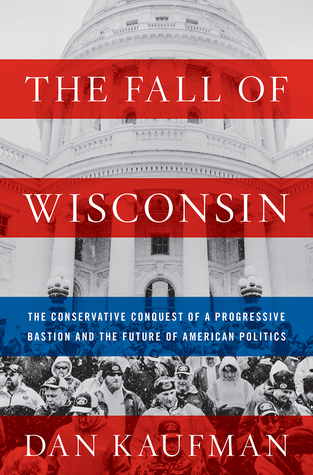
    The Fall of Wisconsin, a 2018 book by New Yorker’s Dan Kaufman, analyzes how conservatives utilized Dark Money, Gerrymandering, and Weak Democratic opposition to enact a radical and dangerous conservative agenda in Wisconsin. “(Their) devastating success has allowed for the transformation of Wisconsin into a laboratory for corporate interests and conservative activists,” Kaufman writes. Act 10 (rightly) receives the majority of the press, but it’s really one of many extreme changes the Republican Party brought to Wisconsin. In the last two years, the Republican-controlled Senate supported a bill to remove all of the state’s air-pollution regulations. This book review will outline Kaufman’s core thesis and help explain how three forces, Dark Money, Gerrymandering, and weak Democratic Opposition created a nightmare scenario.

    Dark Money fueled the Fall of Wisconsin

    The Citizen’s United decision effectively allowed corporations to launder political spending through non-profits. According to Issue One, a non-partisan campaign finance reform organization, just 15 groups have spent more than $600 million “in secret money” influencing our elections. In Wisconsin, no organization has been more potent than the Bradley Foundation. Initially established by a Milwaukee industrialist looking to avoid inheritance taxes, it initially focuses on area hospitals and universities. In the 1980s it transitioned into a weaponized conservative outlet—focusing on school vouchers, destroying unions, and promoting white supremacy masked in academic jargon. The foundation’s assets have ballooned to nearly $850 million.

    The Bradley Foundation’s most significant success has been Act 10—legislation that stripped collective bargaining rights from the state’s public workers (except police and firefighters—two groups who were neutral or supported Walker’s initial election). The legislation kick-started massive teacher protests, which Walker later compared to ISIS. The effects have been devastating for the state’s educational system. According to an analysis by the Milwaukee Journal Sentinel, Act 10 resulted in a 30% drop in state granted education degrees resulting in 25 percent of school districts reporting an “extreme shortage” of qualified applicants. “Teaching,” current Governor-elect Tony Evers remarked at the time, “no longer considered an attractive career path.”

    Perhaps the most insidious effect was villainizing teachers. The last thirty years left many Wisconsinites behind. Instead of asking “Why they no longer had health insurance,” people started asking “Why did teachers have it?” “A Wisconsin labor leader once told me that Act 10 succeeded,” said Kauffman. The leader’s answer is both telling and depressing. “Because Walker transformed the person who spent the day in a classroom teaching his child from “teacher” to “union member.”

    Gerrymandering

    Once in control over Wisconsin’s government, the Republican party launched a full-throated assault on voting rights in the state. They passed restrictive voter identification laws to suppress minority and student votes and cemented control by gerrymandering election boundaries. In the first election after the rigged voting maps, Republican received 175,000 fewer votes but ended the day with a 60-39 majority. This was a fundamental part of the Republican strategy. Restrict the rights of non-Republican voters, while reducing the impact of non-Republican votes. In 2018, after Governor Walker was surprisingly beaten by State Superintendent Tony Evers, Republicans began their second assault on Democracy and voting rights.

    Weak democratic opposition

    A portion of Republican success in the state is due to the Democratic party. Modern democrats had no interest in defending the average working person against the Republican onslaught. President Obama declined to even campaign in Wisconsin during the passage of the bill—creating a boom for Scott Walker. The book doesn’t dive into this, but in the mid-1990s, centrist Democrats began to move away from unions as a source of natural support. The transition started with Jimmy Carter but solidified itself after NAFTA. The logic was that for every union vote they lost, they’d make it up with the professional suburbs. Led by Bill Clinton, liberals began to abandon New Deal policies and adopt market “friendly” positions. The result was market deregulation and globalization—at the same time, Democrats reduced the welfare state. The result was two parties working against working people. This directly led to Donald Trump.

    Should you read The Fall of Wisconsin?

    The point of every review is basically, should I read this book? After I finished The Fall of Wisconsin, I would have said no. I didn’t really learn anything during it. However, I also live in Wisconsin and am active in Wisconsin politics. As I began writing my review, I realized that Kauffman did a solid job of distilling the state’s political revolution. If you don’t live here, you should absolutely read this book. The current state of Wisconsin is the nation’s fate if Progressives don’t start winning office and exterting political power.