Category: Featured

  • TreeHouse Foods and other private label companies face big COVID challenges

    If you’ve been paying attention to any branded consumer goods company’s COVID-era financial returns, you’ll notice a familiar refrain: Things are crazy, but overall, business is going great. Private label companies? Not so much.

    Nowhere is this more apparent than TreeHouse Food’s recent investor call.

    Before discussing the company’s financial results, CEO Steven Oakland led with a bombshell. The $4.3 billion private label product juggernaut, which makes store brands for everyone from Walmart to Wholefoods, is looking to sell off its largest division—meal prep. “We have talked about those businesses as growth engines and cash engines,” Oakland told investors. The meal prep division, which includes products like condiments and mac-and-cheese, is a cash engine. It produces relatively low-margin staples that generate a lot of cash as products fly off the shelves. TreeHouse can use that cash to in higher-margin products within its snack and beverage portfolio. If that sales goes through, “We would simply have that cash available sooner and be able to execute that strategy a little faster.”
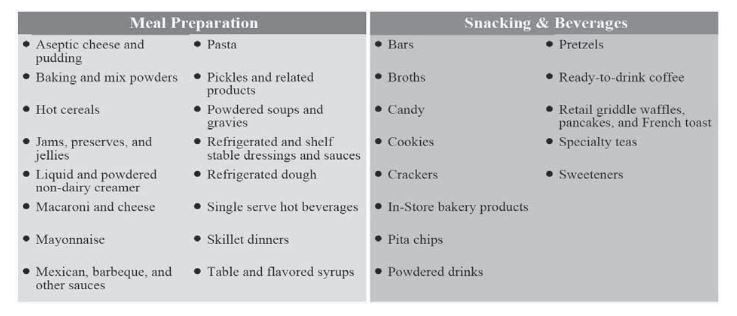
    How TreeHouse Foods is currently structured. Via 2020 Annual Report

    To understand why management is pursuing this new strategy, it’s best to take a step back and look at three things: The value proposition for a private label company, the operations that enable it, and how COVID upended it all.

    A private label company’s value proposition

    Private label brands have been around for about as long as large retail stores have existed. Private-label goods are nothing new, of course,” Matthew Boyle wrote in Fortune Magazine back in 2003, “having been around since the days when A&P owned vast coffee plantation in South America.” For most of the 20th century, private label was associated with cheapness and low quality. Then, in the last 30 years, something changed.

    He continued:

    Retailers—once the lowly peddlers of brands that were made and marketed by big, important manufacturers—are now behaving like full-fledged marketers. And here’s the earthquake part: It is their brands—not those of traditional powerhouses like Kraft or Coke—that are winning over the (consumers) in the greatest numbers.

    Private label manufacturers produce products that retailers can then brand under their own umbrella. However, most retailers don’t want to own their own factories, and with few exceptions, they rely on companies like TreeHouse foods for that. This setup worked pretty well before COVID-19. In the years leading up to the pandemic, sales of private label products typically grew at twice the rate of branded products.

    The operations of a private label company

    Since private label companies don’t handle the sales or marketing of their products, the companies have different core competencies than branded CPG companies.

    If you think back to the six major business processes in consumer products, private label companies handle processes 1-4, while the retailer manages all aspects of Sales and Marketing.

    1. Research and development: Creating a product that consumers want.

    2. Production: Figuring out how to manufacture the improved product at scale.

    3. Supply chain: Ensuring that you have enough raw commodities to manufacture the product.

    4. Transportation: Getting the product to the customer (retailer).

    5. Sales: Ensuring the product gets prime placement for a customer through negotiations and pricing.

    6. Marketing: Generating consumer awareness and demand through advertising

    The result is:

    • Consumers get relatively high-quality and low-cost products.
    • Retailers capture higher margins and generate brand loyalty through their own offerings (think Costco and Kirkland).
    • Private label companies operate as manufacturing partners and supply chains for retailers.

    How COVID upended the private label business model

    If you’ve followed this blog, you’ll know that branded CPG companies have excelled in COVID by maximizing each business process outlined above. Due to the nature of private label products, TreeHouse Foods can’t. “One thing I think to remember about us,” Oakland told analysts, “Is that we are only a supply chain business. We don’t have marketing levers. We don’t have many of the other levers that you have in your branded lives.”

    Here are the levers he is referring to.

    TreeHouse Foods couldn’t increase production to meet demand through third-parties.

    When the initial lock-down started in March of 2020, panicked consumers flooded retail outlets. Stock-outs of common products became a regular occurrence as manufacturers couldn’t keep pace with demand. Most branded consumer goods companies opted to subcontract the production out to third parties to deal with the onslaught. In the case of General Mills, it added 50 additional partners to its production capacity. “If demand starts to taper off, that is the capacity that we will shed first,” Kofi Bruce, the CFO of General Mills, told the Wall Street Journal. Since TreeHouse Foods was the one making the already low-margin products, it didn’t have that luxury.

    Private label companies couldn’t rationalize SKUs.

    Faced with overwhelming demand and production constraints, managers at branded CPG companies embarked on SKU rationalization projects. “We’ve made some choices in our supply chain to — we’ve reduced some of the tail of our portfolio,” the CEO of Pepsi told investors back in July 2020. The company met with its retailers and prioritized production of the best selling SKUs. “We both agreed that it’s probably the best thing to do, to eliminate the smaller SKUs in the portfolio to maximize the best-selling SKUs and be in stock.”

    Private label companies were out of luck. Since they’re focused on producing basic products, their SKU assortment is relatively limited.

    The Wall Street Journal explained:

    In frozen waffles, TreeHouse temporarily cut flavored ones, like chocolate chip, to focus on making the basics. The leading brand, Kellogg’s Eggo, suspended production of more obscure varieties and continued selling popular flavors like chocolate chip. TreeHouse’s frozen-waffle sales took a hit as a result, Mr. Oakland said.

    Private label products have less pricing power.

    Most branded consumer product companies have raised prices to offset rising covid-19 induced inflation. The smart ones have used revenue growth management techniques in a targeted way that boosts profitability. 

    Here’s what I wrote earlier about Kimberly-Clark’s RGM strategy:

    Kimberly-Clark is looking to leverage these same insights. RGM will bring in reams of data that will allow them to understand opportunities. Currently, a 32 pack of Huggies is $8.29 at Target online. Given the current level of online competition, it seems unlikely that the company could increase this SKU price. 

    However, done right, RGM will allow K-C to understand the true cost of selling at each customer—by SKU. RGM uses a variety of COGS, Transportation, and Trade data to reveal profitability. Maybe they can increase the base cost of a less popular item by 25%, but make up the lost volume with a promotional coupon on the 32 pack.

    TreeHouse Foods doesn’t have this flexibility because its products are unbranded. In fact, the cost of producing each item is rising, but the retail price is staying the same. TreeHouse Foods is taking this cost increase! Management claims it’s to maintain good relations with their customers, but in reality, the retailers hold power in the relationship and there isn’t another option.

    Private Label products aren’t optimized for E-commerce.

    In 2021, it’s anticipated that online grocery sales will reach $100 billion. Unfortunately for private label manufacturers, the private label industry isn’t optimized for e-commerce

    Private labels products mainly differentiate through price. Once consumers are in a retail store, they compare and contrast products side-by-side. E-commerce isn’t optimized for that. It’s optimized for keywords, and mobile ordering often shows one product (often promoted) at a time.

    In conclusion

    In 2014, I wrote an article on Li & Fung, the massive Asian supply chain magnate. In it, I argued that their business model was becoming obsolete. Its reliance on just-in-time production across multiple borders made it especially susceptible to the shocks associated with climate change.

    The question is, what will Li & Fung do? Their product isn’t soda or shoes. It is a network that is dependent on the system that is becoming unstable. If they don’t change, they will go from the company that no one knows about to the company no one cares about.

    You can lump the current iteration of TreeHouse Foods into that category. Its entire business model was built around acquiring a massive production infrastructure to produce unbranded products.

    I think management would agree.

    “We had built this supply chain designed for tremendous efficiency but very low volatility,” Steven Oakland said. “When the pandemic hit, we had complexity meet volatility.”
  • What are Consumer Goods? Understanding the companies and categories.

    What are Consumer Goods? Understanding the companies and categories.

    If you live on earth, you’ve purchased consumer goods. After a manufacturer takes raw ingredients and processes them into a final product, any item purchased and utilized by a consumer is considered a consumer good. Flour, plastic cups, alcohol—all consumer goods.  

    Suppose you want to view things from an economic lens. In that case, everything you buy and consume within three years is considered a non-durable consumer good. Everything that you purchase and use for more than three years is regarded as a durable consumer good. Deli meat, pencils, and cleaning supplies? Non-durable consumer goods. Clothes dryer and microwave? Durable consumer goods. I mostly write about non-durable consumer goods companies and the strategies they use to make money. I’m not particularly unique. When most people talk about consumer goods, they’re talking about the nondurable kind.

    Classification is always somewhat flexible. Newell Brands is a major consumer goods company with over $14 billion in annual revenue. One of Newell Brands’ keystone brands is Rubbermaid, and Rubbermaid storage containers will last well over three years. However, most people still consider the Georgia-based company a consumer goods manufacturer. If you can buy it at Walmart, Target, or Amazon, it’s probably a consumer good.

    Given that you purchase consumer goods every week the companies who make them are incredibly powerful. When thinking and analyzing those companies, it’s helpful to break them into distinct categories, where NAICS codes come in.

    NAICS Codes and Categorization

    One of the standard ways to categorize and organize consumer goods companies is through the North American Industry Classification System—NAICS codes for short. NAICS codes are a joint classification system developed by the US, Mexico, and Canada. It’s an attempt to organize a variety of economic activities into a hierarchy. The top of each hierarchy is incredibly broad, with more granular detail in each subsequent level.

    Here’s an example of how you could classify General Mills.

    NAICS CodeNameLevel
    31-33ManufacturingSector
    311Food ManufacturingSub-Sector
    3112Grain and Oilseed MillingIndustry Group
    31123Breakfast Cereal ManufactringNAICS Industry

    Like the Newell example above, General Mills is a massive company that crosses many categories. Not only does General Mills sell Cheerios, but it also sells Pillsbury (3118 – Bakeries and Tortilla Manufacturing) and Hagen-Dazs (3115 – Dairy Product Manufacturing). For this reason, when you’re comparing and analyzing General Mills against other companies, it’s probably best to compare companies at the Sub-sector or Industry Group level.

    Who are the major consumer goods companies?

    The consumer goods industry is immensely profitable and competitive in America. It generates about $654 billion each year and accounts for 34 companies on the Fortune 500. The table below contains the 34 consumer goods companies on the Fortune 500 list, along with their corresponding subsectors, revenue, profit, and net profit margin.

    RankNameSubsectorRevenueProfitsNet Profit Margin
    43P&GChemical Manufacturing$70,950$13,02718%
    44PepsiCoBeverage and Tobacco Product Manufacturing$70,372$7,12010%
    51Archer Daniels MidlandFood Manufacturing$64,355$1,7723%
    73Tyson FoodsFood Manufacturing$43,185$2,0615%
    93Coca-ColaBeverage and Tobacco Product Manufacturing$33,014$7,74723%
    101Philip Morris InternationalBeverage and Tobacco Product Manufacturing$28,694$8,05628%
    103CHSFood Manufacturing$28,406$4221%
    108Mondelez InternationalFood Manufacturing$26,581$3,55513%
    110Kraft HeinzFood Manufacturing$26,185$3561%
    138Altria GroupBeverage and Tobacco Product Manufacturing$20,841$4,46721%
    158Kimberly-ClarkPaper Manufacturing$19,140$2,35212%
    169General MillsFood Manufacturing$17,626$2,18112%
    188Colgate-PalmoliveChemical Manufacturing$16,471$2,69516%
    209Stanley Black & DeckerMachinery Manufacturing$14,534$1,2348%
    213Estee LauderChemical Manufacturing$14,294$6845%
    219Land O’LakesFood Manufacturing$13,948$2642%
    222KelloggFood Manufacturing$13,770$1,2519%
    267Keurig Dr PepperBeverage and Tobacco Product Manufacturing$11,618$1,32511%
    283Conagra BrandsFood Manufacturing$11,054$8408%
    314Molson Coors BeverageBeverage and Tobacco Product Manufacturing$9,654-$949-10%
    317Hormel FoodsFood Manufacturing$9,608$9089%
    325Newell BrandsPlastics and Rubber Products Manufacturing$9,385-$770-8%
    335Campbell SoupFood Manufacturing$9,050$1,62818%
    359Constellation BrandsBeverage and Tobacco Product Manufacturing$8,343-$120%
    366AndersonsFood Manufacturing$8,208$80%
    370HersheyFood Manufacturing$8,149$1,27816%
    378J.M. SmuckerFood Manufacturing$7,801$77910%
    406SeaboardFood Manufacturing$7,126$2834%
    426CotyChemical Manufacturing$6,737-$1,007-15%
    427CloroxChemical Manufacturing$6,721$93914%
    463IngredionFood Manufacturing$5,987$3486%
    474Post HoldingsFood Manufacturing$5,698$10%
    482McCormickFood Manufacturing$5,601$74713%
    494HasbroOther Miscellaneous Manufacturing$5,465$2224%

    Judged by revenue, the top ten are dominated by food, beverage, and tobacco manufacturers. Branded homegoods giant P&G is the only company to reach the top 10 (coming it at #1). 

    But metrics matter. Suppose you sort the table by net profit margin (how much profit is generated by each $ of revenue). In that case, chemical consumer goods companies occupy three of the top ten. Ask yourself, why the sudden change?

    There are many correct answers to the question above, but I hope that after reading this article, you now understand what consumer goods are and why categorization is important when analyzing the major companies.

    Photo by Nathália Rosa on Unsplash

  • LaCroix was a category leader and then National Beverage changed the sales strategy

    LaCroix was a category leader and then National Beverage changed the sales strategy

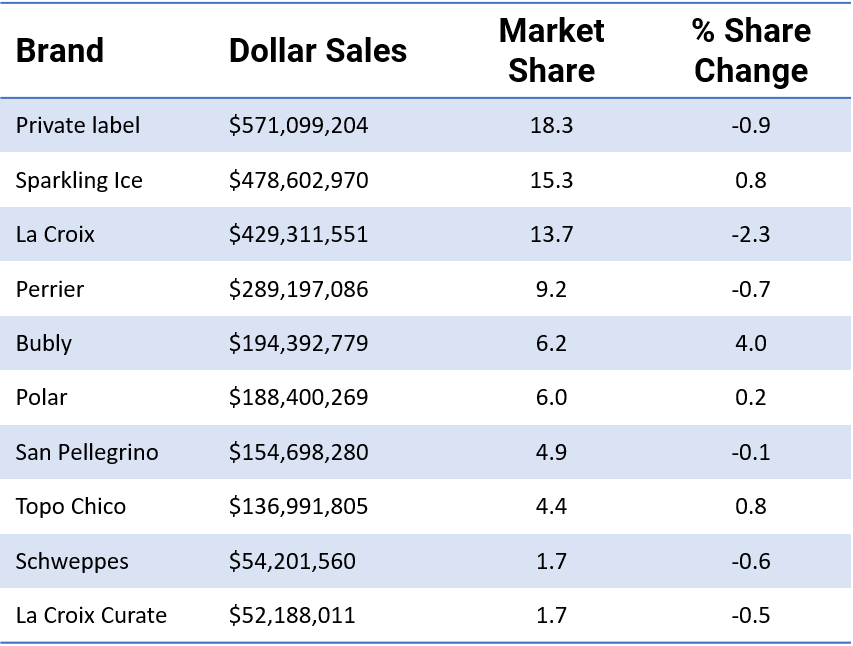
    I’m sure most people reading this have heard of LaCroix, a sparkling water brand owned by National Beverage. It’s an undisputed leader in the sparkling beverage category. Led by smart marketing and forward-looking management, the colorful cans are a bright spot in an otherwise declining aisle. Despite almost a decade of positive results, not everything is sunshine and roses in the land of fizz and refreshment. In the fall of 2019, Businessweek published a cover story on the rise and recent stumbles of the company — most notably around management’s decision not to provide additional sales support to retailers.

    National Beverage’s management believed that LaCroix wasn’t just a brand that added a bit of flavor to carbonated water, but one whose “innocence” and targeted marketing propelled it to the top of the segment. By not acceding to the sales demands, the company decided to play chicken with the most powerful group in the retail industry: retailers.

    Now that some time has passed we can begin to analyze: Did National Beverage’s game of chicken work? Was the LaCroix brand as powerful as they thought? Before we answer that question, it’s best to look at how it went from a third-tier soda company to the sparkling water leader.

    Reinventing LaCroix

    In 1982, Heileman Brewing Company founded LaCroix in La Crosse, WI, as a mass-market alternative to premium European sparkling water brands. About ten years later, it sold the modestly successful brand to National Beverage, where it languished for a few years. This isn’t exactly scientific, but I went to college in La Crosse, and I don’t remember a single person under the age of 65 drinking it. Suddenly, ten years later, LaCroix is one of the most millennial centric food brands in America.

    What happened?

    When customer preferences change

    Within the consumer goods world, sparkling water is categorized as a “sparkling beverage.” Giants like Coca-Cola and Pepsi have long dominated the category with sugary drinks like soda. If you are health conscious, for generations, a walk through the sparkling beverage aisle felt like being surrounded by a bunch of explosives. The explosives had super long fuzes, but each time you pulled a product from the shelf, the inevitable health catastrophe inched closer.

    In the past few years, the risk is now out in the open. Sugary drinks have been linked to everything, from diabetes to poor bone health. Soda, the sales anchor of the category, now faces an existential decline. Almost two-thirds of Americans actively avoid drinking it. “The drop in soda consumption,” Margot Sanger-Katz wrote in the New York Times, “represents the single largest change in the American diet in the last decade.”

    LaCroix is located in the same aisle as soda. Most importantly, with zero calories, it doesn’t have a fuze.

    Businessweek detailed how the transition wasn’t an accident:

    In 2006, Beverage Digest released a report showing that soda sales in the U.S. had declined for the first time in two decades, as consumers grew concerned about obesity and Type 2 diabetes. That year, LaCroix staked out an early position as a health-conscious alternative to soda, becoming a sponsor of the Susan G. Komen Breast Cancer Foundation.

    In hindsight, this was a risky move. Implicit in the branding was pulling demand away from sugary drinks and into sparkling water. There was one problem. National Beverage’s most significant brands were Shasta and Faygo — two sugary drinks. “I would say to him [CEO Nick Caporella], ‘It’s great to be behind it a hundred percent,” a longtime executive told Businessweek, “but we should remember to dance with the one who brung us. This company was built on soft drinks.”

    Caporella made the gutsy decision to cannibalize existing sales.

    In the meantime, a small team of executives quietly began working to revitalize LaCroix. They decided to market it as different from both elegant mineral waters and sugary sodas, aiming squarely at diet soda drinkers. The company expanded LaCroix’s distribution outside its traditional regional markets and into major retailers such as Target and upscale national grocers like Whole Foods that would prominently feature the product. By 2013, National Beverage was touting “double-digit volume gains” for LaCroix.

    Perhaps most impressively, the company did all of this without a massive traditional marketing budget. It didn’t create a single expensive advertisement with a celebrity spokesperson. Instead it gave away coupons on social media to a variety of influencers.

    According to Digiday:

    The brand has specifically turned to Instagram, Alma Pantaloukas, the brand’s former digital strategist, says on her LinkedIn profile. LaCroix looks at the platform to engage with “highly engaged millennials” and “to inspire them to use our products in many different ways and/or stages in life,” she says. It was this focus that turned Instagram into its most engaging platform, growing its fan base from 4,000 to 30,000 within eight months in 2015. (It now has 39,000.)

    One tactic is engaging with people who tag the brand, no matter their follower counts. One marketing pro, Kelly Fox, posted a couple of photos with LaCroix cans for her 2,500-plus followers this month and tagged the brand. The brand then sent her vouchers for cases of LaCroix.

    “I know that I am being genuinely rewarded for being an advocate, and am not going out there posting on behalf of every other brand like some of the large influencers with huge followings,” said Fox. “It’s a smart strategy for the brand to go after the smaller fish instead of the bigger fish.”

    If you think about the six core business processes within a CPG company, LaCroix excelled at four of them.

    • Research and Development: LaCroix targeted flavors at diet soda drinkers. It originally had 6 flavors; it now has 27.
    • Production: National owns 12 production facilities. It could quickly bring new choices to market because it did not have to negotiate with independent bottlers around new products or expansion needs.
    • Transportation: National’s existing transportation network featured delivery to retailer warehouses and directly to stores (DSD). It could expand its product to more stores, because it could get LaCroix to almost any retailer at an affordable cost.
    • Marketing: A targeted social media campaign generated consumer demand in a cost-effective way.

    Put together, the four redirected a niche segment into the mainstream within a category dominated by giants. Against all odds, a once-sleepy regional brand became a category leader in 41/52 metro areas.

    Pepsi and Coca-Cola strike back

    LaCroix’s success did not happen in a vacuum. The CPG world is intensely competitive and filled with smart people. When a new item at the grocery store sees double-digit volume growth, it becomes a fire in the middle of a field. Everything and anything focuses on it.

    Again, Businessweek

    PepsiCo Inc. released Bubly, a sparkling water backed by a marketing arsenal that LaCroix has struggled to match. In 2017, Coca-Cola Co. paid $220 million for Topo Chico, a Mexican mineral water with a cult following. Meanwhile, a legion of startups has rolled out “craft” sparkling water brands that promote artisanal ingredients, antioxidant boosts, and cannabidiol infusions. LaCroix’s sales for the four weeks ended July 14 fell more than 15% from the prior-year period, even as its main competitor, Bubly, saw sales surge 96%, according to Bloomberg Intelligence.

    All of this competition impacted LaCroix. Sure, LaCroix had to respond to new threats to consumers, but it could handle that through its innovative use of social media. The real challenge was with retailers. They want to buy what will sell. For a decade, LaCroix was more or less the only branded sparkling water option. Now there were dozens. Perhaps most troublesome for National Beverage is that retailers don’t care who started the fire in the field, they just want to keep it burning.

    The complicated relationship behind grocery aisles

    Retailers and manufacturers have a complicated relationship. Publicly, both sides will say that they’re partners — working together to make and sell consumers the products they want. In theory, retailers need vibrant manufacturers who create products consumers want to get people in stores. Manufacturers lack a physical store footprint, so they need retailers to sell their products to consumers.

    Initially, the relationship was simple. In the early 1900s small corner stores dominated the industry. Given America’s rudimentary transportation network, it wasn’t practical for manufacturers to deliver to each street corner. Instead, a manufacturer like National Beverage sold to a Broker (who took a percentage of the sale) and delivered the product to a retailer. Over time, retailers got bigger and bigger. Led by A&P, the Walmart of the era, the relationship changed.

    In his book, The Great A&P, Mark Levinson explained what happened next:

    A&P demanded that manufacturers give it advertising allowances in return for promoting their products nationally in whatever way it saw fit. Manufacturers were to sell directly to A&P without using brokers or agents, and A&P would receive the commission normally paid to brokers. If a manufacturer refused to play by those rules, A&P would take its business elsewhere. As the Hartfords [Management] anticipated, allowances became a major source of income. By 1929, allowances paid by manufacturers directly to A&P headquarters accounted for one-quarter of pretax profits.

    In modern times, this activity is called Trade. The advertising allowances that A&P pioneered have grown to everything from bulk discounts and prime shelf placement to end-of-aisle displays. Trade is a vital part of any CPG company’s sales process. The companies are willing to make the investment because a) they don’t have a lot of choice and b) many trade events are almost a sure thing to generate sales.

    That overall cost is huge. Outside of the cost of producing a good, Trade is often the largest line-item on a company’s income statement. A typical CPG firm will spend between fifteen and twenty percent of gross revenue on Trade spend every year — with hyper competitive categories spending upwards of thirty percent. For a company of National Beverage’s size, that’s potentially tens of millions of dollars transferred directly from their pockets to the retailer’s bank account.

    As I said, the relationship between retailers and manufacturers isn’t exactly a partnership. It’s complicated.

    Pepsi and Coke entered the category, armed with hundreds of millions of dollars ear-marked for trade spending. Retailers wanted National Beverage to match the spending. LaCroix management had a choice. They could defend their shelf space with additional spend or withdraw from the arms race and bet on the value of the brand. “In a beverage industry that is dominated by the “cola giants”,” the company wrote in its most recent annual report, “We pride ourselves on being smaller, faster and stronger.”

    In this case, smaller, faster and stronger meant no increase in Trade spend. There would not be an arms race.

    Businessweek explained what happened at Whole Foods:

    The company wanted LaCroix to be more aggressive with matching discounts and promotions being offered by the new brands. When the company didn’t yield, Whole Foods eventually decided to reduce the number of prominent in-store LaCroix displays and replace them with its competitors’, according to people familiar with the decision. A Whole Foods spokesman declined to comment.

    Category goes up, LaCroix goes down

    National Beverage does not break out individual brands on their income statement, but from a high level, the numbers don’t look good. According to Businessweek, the decision to not enter an arms race happened in 2018. Most trade agreements are made annually. Any impact wouldn’t be seen until 2019.

    The numbers aren’t pretty.

    In 2019 the company’s net sales growth submarined from double digits to under four. This happened while retail data provider IRI estimated that the sparkling water segment saw an increase of about 13 percent. According to IRI’s calculations, Bubly, backed by Pepsi and millions of dollars of Trade spend, grew 216 percent.

    I think it’s clear that the LaCroix brand wasn’t as powerful as executives thought.

    CPG retail is an unforgiving place for manufacturers. The LaCroix experience shows that generating consumer demand isn’t enough — even if it’s individualized and targeted. Redefining a category isn’t enough — if companies don’t accede to future trade demands.

    The real battle is over sales and shelf space — one that small brands are increasingly in a weak position to win.

    Photo by Matt Botsford on Unsplash

  • Retail Pricing, Fair Trade Laws, and the Rise of Walmart

    Retail Pricing, Fair Trade Laws, and the Rise of Walmart

    Today, retail pricing, the price you see in stores, is determined by Retailers—not Manufacturers. For example, if you go to Kroger for a 12-pack of Sprite, the price you pay isn’t set by Coca-Cola—it’s set by Kroger.

    This wasn’t always the case.

    In the past, it was legal for manufacturers to determine retail pricing. Often times, manufacturers offered a lowest acceptable retail price—and it was small retailers who pushed for that ability. Here’s the quick story about how that happened.

    Early retailing is a family affair

    Edna Gleason, was a self-educated but state-certified pharmacist who owned three drugstores across California. In the early 1900s, pharmacists were predominately small businesses. A family would own a store, where they would mix drugs and sell a variety of home care goods. Edna and other local pharmacist bought most of her goods from a wholesaler, who bought the goods from the manufacturer. Both links in the retail value chain have cost—which meant a mark-up. The result was a modest selection, with two price mark-ups. It was a simple business considered by most to be key to self-sufficiency.

    Then came Chain Stores and Pineboards—large, wall capitalized corporate structures that entered new markets and undercut locally owned small businesses.

    Chain stores gave retail pricing advantages to stores with big footprints

    They’re everywhere today, but chain stores are a relatively new development. Prior to the early 1900s, national chains stores weren’t widespread.

    Writing in Business History Review, Laura Philips Sawyer explains the rise:

    East Coast chain stores, like the Great Atlantic & Pacific Tea Co. (A&P), and department stores, like R. H. Macy’s, pioneered a business model that captured profits by combining high-volume sales with lower profit margins. Most of these retailers purchased goods from a variety of manufacturers. High-throughput manufacturing revolutionized consumer products from processed foods (e.g., Campbell’s Soup) to cigarettes (e.g., American Tobacco).Taking advantage of manufacturers’ economies of scale, these new retailers up-rooted the existing distribution system, tilting economic power toward large-scale retailers and away from the networks of regional manufacturers, wholesalers, and local retailers. Many manufacturers also complained that they had lost control of their brands.

    Essentially:

    1. Chain stores placed large orders—which meant they were able to negotiate volume discounts
    2. Chain stores placed orders directly with manufacturers—bypassing traditional wholesalers

    Chain stores then passed the price savings on to consumers. The result was a fundamental switch in power from regional manufacturers (who were used to negotiating with thousands of small stores) and small retailers (who held local monopolies in distribution) to chain stores and consumers.

    Pineboards were chain stores on steroids

    Chain stores often had large, clean, well-lit operations that catered to a growing middle class. Pineboards were something completely different. “The distinctive feature of the pineboard,” Laura Philips Sawyer wrote, “was its ability to offer brand-name products at prices below the manufacturers’ retail network, undercutting even the chain stores.”

    This discount model required pineboards to adopt a different strategy than chain stores and locally owned operations. The strategy was strikingly similar to today’s dollar chains.

    PineboardsModern dollar stores
    Lowered fixed costs by renting commercial space on a temporary basis to test competitive waters.Keep fixed costs low by building small stores in low income rural and urban areas
    Reduced variable cost by employing unskilled, low-wage laborers rather than trained pharmacists.Stores are staffed by 1-2 people low-wage laborers. Customer service is not a priority
    Required cash payments and did not offer delivery services.Mostly deal in cash; did not accept credit cards until recently (Dollar General started in 2005)
    A pharmacy by association. No prescription drugs, but sold more basic consumer goods.Very few fresh food items, but enough to be considered a grocery store and “essential”

    The rise of pineboards and chain stores threatened the survival of Edna Gleason’s pharmacy. It also threatened all of small-town America. Local retailers were the life blood of any small town. Unlike chain stores, they bought from local manufacturers, and the money stayed within the community. In contrast, chain stores are arguably extractive—funneling profits to shareholders thousands of miles away. This strategy resulted in cheaper prices and how was she to compete with chain retailers that offered cheaper products?

    She couldn’t.

    So she organized until she could.

    Edna Gleason attempted to standardize retail pricing

    In February 1929, about seven months before the Great Depression officially kicked off, Gleason led a movement to restructure the California pharmacy industry. First she consolidated the statewide lobbying groups into one large organization, the California Pharmaceutical Association. Then she set out to publish a statewide pharmaceutical price list.

    Philips Sawyer summarized the thinking:

    Advocates of fair trade envisioned a strong state association that would publicize standardized price lists and monitor member compliance. The publication of monthly price lists would, they argued, allow businesspeople and regulators alike to monitor price changes.

    The initial price lists were informally enforced; compliant retailers would blacklist and shame non-compliant ones. This behavior is of course anti-competitive, illegal even. Until a new legal theory emerged. It held that when competing against chain and pineboard retailers, independents were no different than employees bargaining against large employers. They were free to combine their buying, marketing and sales power to combat larger competitors.

    The result was The California Fair Trade Act of 1931. It exempted the above agreements from antitrust prosecution and gave the state police powers to enforce the free trade agreements. Essentially, if a group of independent retailers agreed that a manufacturers retail price was fair, the state police would enforce the agreement. Phillips Sawyer concludes, “This public-private approach to managing price competition came to exemplify Depression-era regulation.”

    Fair Trade Goes national and then disappears

    Given the current state of American anti-trust, it’s hard to imagine now, but retail pricing laws, which increased consumer prices, were overwhelmingly popular. Underpinning the legislation was an ideological sentiment: Local control and ownership of commerce were a defense against communism and fascism. That freedom to own and manage production was more important than low prices.

    In the late 1930s, Congress nationalized the California Fair Trade laws, culminating with the Robinson-Patman Act and Miller-Tydings Act. The first banned selling products at a loss to boost volume and secret discounts. The second, made fair trade contracts enforceable across state lines.

    The general Fair Trade framework, spearheaded by Edna Gleason, lasted until the 1975.

    As I’ve outlined before:

    By 1975 prices in America were increasing by around 12 percent every year. The causes of this are vast and debated, but at the time, one of the easy culprits were fair trade laws…The logic was that if Congress got rid of fair-trade laws, prices would drop.

    With the laws gone, national chain stores were free to use their power and footprint in retail pricing negotiations. Economic power shifted from regional manufacturers and local retailers to national chain stores.

    In 1975, Walmart was a regional retailer with around 100 stores.

    Today it has over 4,300 stores across America.

    This isn’t a coincidence.

    Photo by Nicole Y-C on Unsplash

  • Marc Andreessen misses the point with It’s time to build

    Marc Andreessen misses the point with It’s time to build

    Writing on the Andreessen Horowitz blog, influential tech entrepreneur Marc Andreessen published It’s time to build. The essay laments Western civilization’s response to the coronavirus. To Andreessen, who the New Yorker labeled a “farsighted theorist” and sits alongside Bill Gates and Peter Thiel in the pantheon of serious Silicon Valley thinkers, the issue is desire

    He writes:

    The problem is desire. We need to want these things. The problem is inertia. We need to want these things more than we want to prevent these things. The problem is regulatory capture. We need to want new companies to build these things, even if incumbents don’t like it, even if only to force the incumbents to build these things. And the problem is will. We need to build these things.

    With respect to Andreessen, the problem isn’t desire. The problem isn’t inertia. The problem isn’t will. Those are vague passive buzzwords that help distribute blame evenly across society rather than at the specific, powerful groups whose actions created the situation. 

    Let’s take this specific passage of It’s time to build:

    We see this today with the things we urgently need but don’t have. We don’t have enough coronavirus tests, or test materials — including, amazingly, cotton swabs and common reagents. We don’t have enough ventilators, negative pressure rooms, and ICU beds. And we don’t have enough surgical masks, eye shields, and medical gowns — as I write this, New York City has put out a desperate call for rain ponchos to be used as medical gowns.

    1. We don’t have enough coronavirus tests, or test materials — including, amazingly, cotton swabs and common reagents.

    We do not have enough coronavirus test because of mismanagement from the Trump administration—full stop. According to reporting by ProPublica, one of the finest news organizations in the world, the CDC “shunned the World Health Organization test guidelines used by other countries and set out to create a more complicated test of its own that could identify a range of similar viruses.” When that test was sent out to labs—it failed to work. Basically, we needed a car, a friend offered to give us his, but we insisted on building our own—and it didn’t work. America wasted valuable weeks because the decision was made to use a proprietary test.

    2. We don’t have enough ventilators, negative pressure rooms, and ICU beds.

    We do not have enough ventilators because of a combination of greed and lack of antitrust enforcement. In 2006, after the SARS crisis, civil servants realized that the nation was woefully under prepared for a pandemic. They identified ventilators as a hazard point and set out to stockpile 40,000 of them. This again is contrary to Andreessen’s assertions that Western governments were asleep at the wheel.

    They weren’t, they were just outfoxed by private interests. 

    The New York Times explains what happened next:

    The ventilators were to cost less than $3,000 each. The lower the price, the more machines the government would be able to buy.

    Companies submitted bids for the Project Aura job. The research agency opted not to go with a large, established device maker. Instead, it chose Newport Medical Instruments, a small outfit in Costa Mesa, Calif.

    Newport, which was owned by a Japanese medical device company, only made ventilators. Being a small, nimble company, Newport executives said, would help it efficiently fulfill the government’s needs.

    Ventilators at the time typically went for about $10,000 each, and getting the price down to $3,000 would be tough. But Newport’s executives bet they would be able to make up for any losses by selling the ventilators around the world.

    “It would be very prestigious to be recognized as a supplier to the federal government,” said Richard Crawford, who was Newport’s head of research and development at the time. “We thought the international market would be strong, and there is where Newport would have a good profit on the product.”

    By 2011, Newport had three low-cost ventilator prototypes ready. The plan was to have one approved and ready for the use by 2013. Then, like essentially every industry in modern times, the medical device industry consolidated. The business school reason is that bigger medical device companies can offer more products and better services to hospitals. The real reason is that consolidation is pure monopoly strategy. The bigger you are, the more leverage you have in negotiations. 

    In 2012, Covidien, a large medical device company, bought Newport and five other smaller device manufacturers. Within a year, despite the guaranteed contract and profit, Executives at Covidien shut Project Aura down.

    Back to the New York Times: 

    Government officials and executives at rival ventilator companies said they suspected that Covidien had acquired Newport to prevent it from building a cheaper product that would undermine Covidien’s profits from its existing ventilator business.

    In 2014, Covidien was purchased by Medtronic for $42.9 billion and shifted its headquarters from Minnesota to Ireland—to avoid taxes. Today, Medtronic is worth $126 billion. America still doesn’t have enough ventilators. 

    3. And we don’t have enough surgical masks, eye shields, and medical gowns.

    The reason for this is somewhat straightforward. In the early 2000s, private equity started to invest in health care providers. As I’ve written about before, private equity isn’t actually that good at running a traditional business. It is good however, at transferring value from a business into management’s pockets. That’s exactly what happened in healthcare. Costs were cut, services were reduced. It happened in obvious places, like less nurses and doctors, and less obvious places like medical supplies. 

    Additional supplies come with additional storage costs—so private equity backed hospitals adopted just-in-time supply chain principles. “Keeping goods (PPE) on hand costs money,” NBC news reported, “and to private equity, that’s like putting dollar bills on a shelf.” It also accelerated an existing outsourcing trend. On a per unit basis, the difference between made-in-America and made-in-China PPE is tiny. “But when you’re talking about millions of units, it does add up,” Robin Robinson, the former head of the federal agency in charge of stockpiling protective gear told the Dallas Morning News. Today, only five percent of surgical masks are made in America. The rest are made abroad, who are understandably prioritizing their own citizens over exports. 


    Marc Andreessen fills the rest of Its time to build with similar out of touch truisms about education, housing, and life in America. In his mind, there’s nothing that can’t be solved by software.

    We know one-to-one tutoring can reliably increase education outcomes by two standard deviations (the Bloom two-sigma effect); we have the internet; why haven’t we built systems to match every young learner with an older tutor to dramatically improve student success?

    First, I absolutely love how he needlessly drops the “Bloom two-sigma effect.” There is nothing more Silicon Valley than using isolated research as a panacea explanation for a structural problem. Second, 15 percent of American students lack access to the internet at home. How are they supposed to connect to tutors? Through magic? My wife works for a low-income school district. They have mailed out tens of thousands of assignments to students—like they’re running a correspondence class in 1974. Peel back the onion a bit more and ask yourself, “Why don’t student’s have home internet?” The answer is simple. They are poor. The families can barely pay rent, let alone spend $75 a month on home internet. The solution here isn’t tutors, it’s low-cost high-speed internet, provided by the government.

    This gets to the real issue, the real cause of America’s poor coronavirus response—inequality. You can find it in every aspect of the coronavirus, from who gets sick to who gets laid off. It seems like he forgets this.

    Andreessen established himself as a serious Silicon Valley-type with his essay “Software Is Eating The World.” The essay’s general thesis is correct. Software is automating vast swaths of the American economy—making things much more efficient. Andreessen failed to realize that a lot of the past world’s inefficient parts were there by design—and they supported this thing we call society. 

    “Today’s largest direct marketing platform is a software company — Google,” he wrote, “Now it’s been joined by Groupon, Living Social, Foursquare and others, which are using software to eat the retail marketing industry.” This was correct. Prior to the rise of Google, retail marketing was a diverse industry—run by media companies. As software ate the advertising industry, the news industry lost 68 percent of its advertising revenue—a large portion of it transferred to Google’s pockets. The impact wasn’t spread out equally. Large established brands like the New York Times thrived, while 20% of local newspapers disappeared.

    I’m sure proponents could argue that the advertising market was now more efficient. But at what cost? No local news creates news deserts, which leads to more public corruption, which leads to a worse society. From a financial perspective, new research suggests that less local news results in higher bowering costs for municipalities. From a human perspective, the middle-class of journalism was gutted.

    In 2019, Google controlled around 38% of the online advertising market. Today, just five firms control 75% of the nearly $130 billion digital ad market. That’s billions of dollars that used to be distributed across the media landscape, from national to local publications, concentrated into just five firms.

    Again—inequality. We’ve created a system that doesn’t build wealth. It transfers it from one group to another.


    The Master Switch by Tim Wu is a masterful book on the rise and fall of information empires. He traces the evolution and industrial organization of the telegram, telephone, radio, television, and the ultimately the internet. His general thesis is that information technologies start with hobbyists, and gradually transition into gated monopolies as they gain widespread adoption. An information monopoly comes with massive responsibility. At one time, AT&T effectively controlled all of America’s telecommunications. From the wire on a telephone poll, to the phone connected to the jack, Ma Bell designed and maintained every aspect of the system. In exchange for the monopoly, and the profits it generated, Bell invested billions of dollars in basic technological research. Bell Labs, the company’s research arm, earned seven Nobel prizes. Over time, the responsibility mindset evaporated.

    Tim Wu explains: 

    The old empires were suppressive and controlling in their own ways, yet each had some sense of public duty, informal or regulated, that they bore with their power. At their best, they were enlightened despots. But the new industries’ ethos held that profit and shareholder value were the principal duty of an information company. What reemerged was similar in body but different in its soul.

    When Andreessen wrote It’s time to build he probably meant it as a call to arms. But he missed the point. The coronavirus is a reckoning of the new soul. 

    Image via Flickr

  • Kraft Heinz Is Dying a Death by a Thousand Cost Cuts

    Kraft Heinz Is Dying a Death by a Thousand Cost Cuts

    How did things go so wrong for Kraft Heinz, one of the nation’s largest, most recognizable food companies that’s backed by one of the nation’s most beloved investors? In February, Kraft Heinz announced a 2.7% decline in net sales for 2019. This comes just one year after the company wrote down $15.4 billion because legacy brands like Oscar Mayer and Kraft failed to keep up with changing consumer tastes. Its long-term debt was downgraded to junk bond status after management refused to cut its dividend. Oh, and it also was investigated by the Securities and Exchange Commission for misrepresenting financial results.

    During a scheduled conference call reviewing the past year, CEO Miguel Patricio told investors that “2019 was a very difficult year for Kraft Heinz.” The situation is a far cry from just four years ago when the company headlined its annual report “Kraft Heinz Reports Solid Financial Performance with Integration on Track.”

    So what happened? To understand Kraft Heinz’s fall, you need to understand how the company came to be and how its strategy and approach to budgeting differs from the traditional model of a consumer packaged goods (CPG) company.

    Private equity comes to town

    This all goes back to when 3G Capital, a Brazilian private equity firm, entered the picture in 2013. The firm had earned itself a reputation for generating profits. Like most PE firms, its model was based on cash flow and cost cutting. The general strategy looked like this:

    1. Identify an established brand that 3G management believed it could manage more efficiently.
    2. Acquire it with other people’s money.
    3. Maximize its efficiency through cost cutting.
    4. Use the resulting profitability to finance additional deals.

    The firm had used the formula to turn Burger King and Budweiser into cash machines; it sold 1,200 Burger King locations to outside investors and reduced the head count by almost 36,000. In three years, net income rose 34%. “These things are seemingly working at Burger King,an analyst told Businessweek in 2014, “and causing questions to be asked about the strategy of others in fast food.”

    With financing from Warren Buffett, arguably America’s most respected investor, 3G gained control of H.J. Heinz for around $23 billion in 2013. Two years later, the group acquired Kraft for $49 billion. The result was the fourth-largest food company in America with a roster of stable brands, including Oscar Mayer, Jell-O, Maxwell House, and Planters. “This is my kind of transaction,” Buffett said after the deal went through, “uniting two world-class organizations and delivering shareholder value.”

    Financial Times describes what happened next:

    Since 2013, more than 10,000 people — one-fifth of the workforce — have been laid off from Kraft and Heinz, with seven plants shut, highlighting the human cost and upheaval involved in producing the highest profit margins in the food industry. The founders of 3G have transformed the beer, fast food, and food manufacturing industries with bold acquisitions, which are quickly followed by a brutal but disciplined attack on costs, a surge in profitability, and high returns to shareholders.

    The “brutal but disciplined attack on cost” has a name: zero-based budgeting. The logic behind it is compelling while being simultaneously against the branded CPG industry’s entire business model.

    How zero-based budgeting works

    Traditional corporate budgets are derived from historical information. Imagine that you’re in charge of in-store marketing at Kraft. Last year, you spent $15 million on a variety of in-store marketing events. After analyzing inflation, competitor data, and new item distributions, you estimate you’ll need an additional $500,000 in funding to support the business. Your boss agrees, so you get the budget.

    Zero-based budgeting doesn’t work that way. In zero-based budgeting, every single company expense (from in-store food samples to pencils) is classified into a specific category. Each category is assigned a manager who builds a budget from scratch, justifying every single expense. Budgets are analyzed and awarded a cap. Managers are then incentivized based on how much they spend under the cap.

    The result is a ruthless accounting of company expenses.

    In the first few years, Kraft Heinz eliminated over $1.7 billion in annual spending. This included excessive expenses like private executive jets. It also included eliminating things that don’t cost a lot, like taking away free Kraft snacks in break rooms and limiting each employee to 200 printed pages a month. Workers may have hated it, but investors loved it. According to Berstein Research, for every dollar of sales, the food industry typically earns about 16 cents. Eighteen months under the new regime, 3G was earning 26 cents for every dollar it sold.

    There’s nothing inherently wrong with documenting and assigning responsibilities to spend. In fact, 10 to 15 years ago, you could almost certainly make the argument that many CPG firms were bloated. But the problem with this approach is threefold:

    1. It assumes the underlying brands independently operate with stable and strong business infrastructure — and that both are capable of doing more with less.
    2. It discounts the fact that legacy brands — almost all of Kraft Heinz’s portfolio — require promotional spending to maintain past sales performance.
    3. It fails to take into account that businesses aren’t linear. They are a collection of interdependent processes, each one influencing and impacting the bottom line in aggregate. It isn’t always possible to account for and rationalize every single expense because the results are often dependent on numerous factors.

    In year one, a cut in marketing and promotional spending may not impact much. Change doesn’t happen overnight. The initial success means the cuts are repeated for three straight years — because why not? The manager is incentivized to cut. Everything is fine until reality catches up. A legacy brand with reduced promotional support in an ever-changing category is a recipe for disaster. Suddenly, sales stop and management is forced to take one of the largest write-downs in a decade.

    Creating true value

    CPG companies are valuable because of the sum of their interlocking parts. A company can have the best product in the world with a great marketing campaign, but what does it matter if it can’t consistently manufacture it? The following major business processes drive consumer product companies:

    1. Research and development: Creating a product that consumers want.
    2. Production: Figuring out how to manufacture the improved product at scale.
    3. Supply chain: Ensuring that you have enough raw commodities to manufacture the product.
    4. Transportation: Getting the product to the customer (retailer).
    5. Sales: Ensuring the product gets prime placement for a customer through negotiations and pricing.
    6. Marketing: Generating consumer awareness and demand through advertising.

    Zero-based budgeting is about making each process the most efficient version of its current state. But despite how zero-based budgeting operates in theory, business processes aren’t independent. Businesses typically get a greater return on sales spend if they’re backed by a marketing campaign and vice versa. Some processes, like research and development, are not linear. It may take years for a product innovation to break through.

    For an example of a more successful way to acquire a company and integrate it into the core processes — rather than trying to grow through cuts — we can look at what happened with P&G and Charmin.

    Building new value through acquisition

    In 1957, P&G acquired a Green Bay, Wisconsin-based papermaker named Charmin. At that time, Charmin wasn’t the national powerhouse we know today. It was a regional afterthought with about $20 million in sales. To put the acquisition in perspective, P&G had an advertising budget of over $80 million the same year.

    Like the more recent Kraft Heinz deal, the logic for the acquisition was compelling. Acquisitions are evaluated based on how well they plug into a company’s existing operations and strategy — both vertically and horizontally. Vertically, P&G had technical experience with pulp-making, a key component of papermaking itself, through the Buckeye Cotton Seed Oil, a company it owned that manufactured component materials for film. Horizontally, it had a long history — first with soap, then with detergent — in marketing and distributing low-cost consumer products. On paper, everything looked fantastic. P&G had both the technical and business skills to build the brand.

    What could go wrong?

    For starters, Charmin wasn’t a product consumers wanted. Today it’s the most popular branded toilet paper in America, but in the 1950s, it regularly placed last in blind tests against products from paper powerhouses Kimberly Clark and Scott Paper. The poor quality meant that Charmin only controlled about 14% of the Midwest and Great Lakes market. Out-of-market retailers weren’t willing to give shelf space to a product that couldn’t win in its own territory.

    When P&G went up to Green Bay, it realized that Charmin failed in just about every process — specifically production. Rising Tide, the history of P&G, explains:

    Charmin benefited almost immediately from P&G’s more sophisticated financial and marketing techniques, but the transfer of technical knowledge proved troublesome. At the time, papermaking was considered an art, in the same way soap making had been earlier in the century. Charmin “had no clearly established product or process standards.”

    Despite having technical paper experience, P&G struggled to develop a new product. Mass production requires a strong paper to withhold against the stress of the pushing and pulling of papermaking machinery. But making it strong meant a thicker, harder paper — not exactly the words people want to be associated with toilet paper.

    After years of experiments, P&G engineers developed CPF, a paper manufacturing process based on a Japanese technique that involves inserting an air drying step into the manufacturing process. CPF resulted in a softer and more absorbent paper that had a cheaper per-unit production cost than traditional methods. Rival firms got wind of the new process but were powerless to respond because they were locked into extensive and costly legacy manufacturing systems.

    Adapting existing processes

    Investing in research and development and production processes resulted in P&G having a better product, but retailers didn’t want to sell it. Competitors made sales presentations that showcased how poorly the old version of Charmin performed. “Who needs a brand that’s been on the market for five or six years and is a weak number two or a weak number three in its category?” P&G’s former sales director later told interviewers.

    This is where P&G’s existing horizontal sales and marketing processes came into play. P&G put its marketing skills to use, inventing a new branding campaign, “Don’t squeeze the Charmin.” It then redesigned the packaging. Toilet paper was traditionally sold in opaque paper packaging. Charmin marketers put it in clear plastic, creating an attention-grabbing effect on the shelf.

    Armed with a superior product, a revamped brand, and better packaging, Charmin launched pilot programs in select cities. Within months, Charmin climbed to the top of each test market. The initial success gave sales representatives a story to sell. It’s hard to imagine now, but as the brand expanded into new cities, retailers couldn’t keep it stocked. “The thing just took off like nothing had ever taken off before,” Ed Artzt, a sales and marketing executive, recalls.

    After two years, Charmin was the bestselling toilet paper in every region it competed in. R&D created a better product, which led to a great marketing plan, which led to big sales increases in retail stores. The process was long, difficult, and cost millions of dollars, but it was worth it. “The acquisition of Charmin,” David Dreyer wrote in the company’s history book, “became the basis of several billion-dollar brands and one of the company’s leading growth producers.”

    Where does research and development go at Kraft Heinz?

    It’s staggering to contrast Kraft Heinz’s integration approach to P&G and Charmin. It’s even more staggering when you look at one specific business process: research and development.

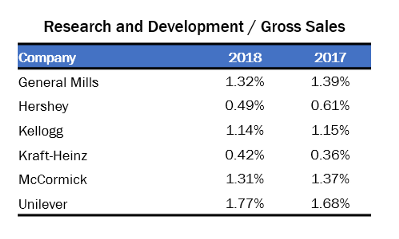
    As the Charmin example showed, research and development is at the center of a branded CPG firm. Consumer preferences change, and it’s up to manufacturers to develop new products that consumers want. In the food industry, consumers are transitioning away from fatty packaged food and toward healthy and fresh alternatives. According to Businessweek, from 2014 to 2017, the top 10 packaged food companies lost over $16 billion in revenue. No one is entirely sure what this means for legacy manufacturers like Kraft Heinz, but during this transition, Kraft Heinz slashed R&D budgets. In the three years before the merger, Kraft spent about 0.8% of revenue on research and development, already somewhat low for CPG firms. The table below shows how it only got worse once Kraft Heinz merged:

    Data via firm annual reports

    Making matters worse, when Kraft Heinz actually made an investment in R&D, it chose poorly. In an attempt to compete with healthier products, the company invested $10 million to reformulate hot dogs — at about the same time the World Health Organization labeled the food as a contributor to the risk of colon cancer.

    A different approach

    To be clear, 3G management took on an almost impossibly tall order with a $72 billion acquisition of Kraft and Heinz. First, history is littered with failed mergers and acquisitions. Billion-dollar transactions rarely work out unless you’re the bank booking the M&A fee. Second, both companies were established CPG firms. Unlike P&G and Charmin, there was no real value in bringing Kraft’s products into Heinz’s existing business processes because Kraft’s processes were probably just as efficient. It’s not like Heinz hadn’t mastered producing and selling ketchup for the last 100 years.

    P&G acquired a regional toilet paper brand and spent enormous sums of money developing a better toilet paper. It supported the product with world-class marketing and sales. Charmin dominated the industry for the last 60 years. 3G could have mimicked this approach. It could have acquired Kraft and then targeted smaller, regional brands that produce healthy options that would benefit from the company’s established scale and business processes.

    Instead, it pursued a strategy centered on two tactics: optimizing operations through cost cutting and generating leverage against retailers by creating the fourth largest food company in America. The former slowly and then suddenly deteriorated the value of the company’s legacy brands. The latter hasn’t materialized. In the case of the reformulated hotdogs, Kraft Heinz struggled to sell them to Walmart, which constitutes about 20% of the company’s yearly sales. The grocery goliath preferred Ballpark Franks and its own private label, leaving the new company in the same position facing many legacy manufacturers.

    The result is a company with legacy brands hemorrhaging sales to healthy upstarts and an organization ill-prepared for the new reality. “[Innovation] is a big driver for growth for the future, has to be especially in the food industry,” Patricio, Kraft Heinz’s CEO, told investors in 2019. “But we have to do bigger innovation. We have to do fewer innovation[s]. We have to do bolder innovation.”

    But because Kraft Heinz is spending so little on R&D, these innovations have yet to yield meaningful results. That’s because without properly funded R&D, Kraft Heinz is stuck either treading the same path while ignoring consumer trends or failing to innovate significantly and quickly enough. Last year, in fact, one of the biggest new product launches from Kraft Heinz was salad frosting.

    Yes, salad frosting.

    Something tells me that salad frosting isn’t the healthy and fresh choice consumers have been looking for.

    Note: This article was originally featured over at Medium’s Marker Magazine.

    Photo by Pedro Ribeiro on Unsplash

  • Why did Dean Foods go Bankrupt? A Porter Model Analysis reveals the truth.

    Why did Dean Foods go Bankrupt? A Porter Model Analysis reveals the truth.

    In November 2019, during an economic expansion, Dean Foods declared bankruptcy. The nation’s largest dairy company, with the number one white and chocolate milk brand, could not make money. In January 2020, Borden Dairy followed suit. Most post-mortems dealt with the fact that both companies produced dairy — a product that fewer and fewer people consume. This is true. According to the USDA, from 2000 to 2017, per capita milk consumption in America declined 24 percent. Very few companies can survive a massive decline in their keystone product. But it’s not the full story.

    To understand how two of America’s largest dairy companies found themselves with hundreds of million in debt and few good options, you need to understand the competitive forces that drove the evolution of the dairy industry.

    The Five Competitive Forces that Shape Strategy

    The most common way to analyze industrial competition was first popularized in Michael Porter’s classic 1979 paper “The Five Competitive Forces That Shape Strategy.” According to Harvard Business School, Porter’s article has been cited over 6,000 times, making it arguably the most influential management paper of all time. The general crux of Porter’s argument is that five disparate forces drive competition within any industry. The forces continuously change based on advances in technology and policy. It is a manager’s job to position the company to compete where they are the weakest.

    In his 2008 update, Porter explained how the five forces drive profitability in the airline sector.

    1. Rivalry Among Existing Competitors: How incumbents compete. For the vast majority of consumers, airlines aggressively compete on price.
    2. Bargaining Power of Suppliers: There are only a few plane and engine manufacturers — giving each one additional leverage over airlines.
    3. Threat of New Entrants: It’s a high-profile industry that new flight providers continuously enter. Some succeed (JetBlue) and some fail (Virgin and Hooters)
    4. Threat of Substitute Products or Services: Train and car travel are always options
    5. Bargaining Power of Buyers: Limited customer loyalty (except business travelers).

    I would add a sixth driver to the list: political economy. Essentially, political economy is how the government decides to organize the economy. If you analyze the dairy industry from this modified Porter’s model, it becomes evident that changing customer tastes were not the primary cause of Deans or Bordens’ problems. Rather, the companies are caught in a vice from all sides, driven by longstanding government policy. The bankruptcies are a warning for all CPG manufacturers. To see why, you need to understand how political economy shaped the retail industry.

    A Brief History of Dairy Processing (1900–1950)

    Before the 1950s, dairy was an intensely local industry. That’s because dairy is a unique industry from an operational point of view. Raw milk supply is effectively constant. Unlike fruits or vegetables that have defined growing and harvesting seasons, cows must be milked every day. Once the raw milk is out in the world, it must be processed immediately, or it goes bad. Once it’s processed, milk must be delivered to consumers quickly for the same reason. The entire system operated under the threat of a couple week countdown. This led to an industry framework where dairy processors congregated outside of major metropolitan areas. Rural farmers provided raw milk to processors, who expanded the shelf-life via processing and distributed it to urban consumers.

    During this era, farmers (suppliers) had limited bargaining power with processors. Unlike farmers, dairy processors were well-capitalized, few in numbers, and could easily drive raw milk prices down by playing small farmers against each other. After years of predatory behavior by processors, the Federal government regulated the industry by prioritizing a co-op model. Essentially, farmers were encouraged to join together to negotiate better prices with dairy processors.

    A recent USDA report explains today’s processing market:

    Firms that produce fluid milk and dairy products are either dairy cooperatives or proprietary companies. Many of the proprietaries are large companies in themselves or are subsidiaries of some larger company. Dairy cooperatives are businesses owned by the farmers who supply them with milk. Farmer cooperatives range from very small, either by volume or membership criteria, to very large. Proprietary companies have gravitated toward the fluid milk and ice cream businesses, cooperatives have dominated butter manufacturing, and both have been important to cheese.

    Today, co-ops handle about 85% of consumer milk.

    From 1900–1950, a Porter’s model of the dairy industry would look something like this.

    • Rivalry Among Existing Competitors: Competed mostly on price and distribution networks. Distribution through a costly direct-to-consumer “milk-man” system.
    • Bargaining Power of Suppliers: Primarily small farmers with no individual bargaining power. Government intervention led to co-ops and greater equality between processors and suppliers.
    • Threat of New Entrants: Milk processing was a capital-intensive industry with high production and distribution costs. A perishability moat protected incumbents from geographic expansion. The primary threat was dairy co-ops transitioning from selling groups to processors.
    • Threat of Substitute Products or Services: Limited. Milk was a consumer staple.
    • Bargaining Power of Buyers: Buyers were primarily individual consumers. Limited leverage due to perishability, transportation issues, and small purchase size. A single consumer could not really play processors off each other.
    • Political Economy: Geared towards regulated competition. The government enforced anti-trust laws to ensure that dairy processors, farmers, and retailers shared an equitable balance of power.

    The model held until technological innovation drastically altered the playing field.

    Technical Disruption (1950s — 1980s)

    The dominance of local dairy processors unraveled in the 1950s. Driven primarily by technology, the industry progressed from a local industry to a regional industry and then finally national.

    The Congressional Research Service explains:

    However, throughout the second half the of 20th century, several factors combined to reduce the cost of moving milk from producers to consumers and ensuring a transition to what is now a national milk and dairy product market. These factors included improved roadways (e.g., the interstate highway system) and larger and faster trucks for bulk transport of milk (tanker trucks). By the 1970s, most retail milk was purchased in stores (or through food service), primarily in lightweight plastic or paper containers.

    Essentially, technology destroyed the perishability moat that protected small local dairy processors. There was now a massive incentive for processors to expand into new geographies — and building a regional brand was the best way to do so.

    At the same time, local grocery stores evolved into regional chains. Now with regional scale, retailers looked to expand to new geographies and viewed low-cost private label milk as a key traffic driver.

    Again, Structural Change in the US Dairy Industry:

    In the 1960’s, most large supermarket chains installed central milk programs. Some built their own plants, especially to capture guaranteed margins in those States where wholesale and retail prices of milk were set by a State agency. The others contracted with one milk company for private label milk at significantly lower prices made possible both by larger volume (one processor instead of three or four) and limited service (delivery to the retailer’s platform instead of arranging individual cartons in the case).

    The following competitive framework developed

    1. Rivalry Among Existing Competitors: Milk processors competed on price and distribution network via a direct-store-delivery network. Regional and private-label milk brands were now common.
    2. Bargaining Power of Suppliers: Advancements in road and refrigeration technologies allowed farmer co-ops to expand their shipment radius and increase their bargaining power. A farm in Iowa could now easily sell to a dairy processor in Wisconsin.
    3. Threat of New Entrants: Advancements in road and refrigeration technologies allowed local processors to expand into new geographies. The perishability moat was removed. There was still a significant capital cost for net-new entrants (distribution, production.) Large retail chains enter the market through private label.
    4. Threat of Substitute Products or Services: Limited. Milk was a consumer staple.
    5. Bargaining Power of Buyers: Primary buyers are now grocery and retail customers — not individual consumers. Most grocery chains are still local — ensuring leverage for processors. But retail chains have more leverage than individual consumers — enabling volume discounts.
    6. Political Economy: Still geared towards regulated competition.

    CPG manufacturers, like dairy processors, excelled in the post-world era of regulated competition. In the 1980s, the political economy changed. Slowly, but surely, the groundwork was being laid for their demise.

    Consolidation lays the groundwork for Bankruptcy at Dean Foods (1980s — on)

    As I’ve explained, the dairy industry was originally structured around a balance of power between suppliers, processors, and retailers. If a proposed acquisition was deemed to give too much power to one party, it was rejected. This framework was true for every CPG company. Starting around the 1980s, the political economy of America became focused on one thing: lowering prices for consumers.

    It may seem like a small thing, but in reality, it drastically changed the power dynamic for every CPG firm. In the 1960s, the US government blocked a grocery store merger because it would control seven percent of the Los Angeles Market. Today, Walmart controls fifty percent of the grocery market in 43 metro areas. This hands-off approach shifted the balance of power to retailers and large manufacturers. Consolidation was now the principal growth strategy for almost every actor. The bigger a company was, the more it can dominate negotiations.

    The LA Times describes how retailers reacted:

    Last year, Kroger Co. announced plans to buy Ralphs Grocery Co. from parent Fred Meyer Inc. and Albertson’s said it would buy American Stores Co., which owns Lucky. A year earlier, Safeway Inc. took over Vons Cos. before later moving into Chicago to buy Dominick’s Supermarkets Inc. Roughly 10% of the supermarkets in the United States have merged just in the last six months.

    Dean Foods did not stand idle. It kicked off the 1990s with a torrent of acquisitions. From 1989–1992 it added $300 million in revenue by acquiring food processors in California, Tennessee and Washington. The strategy was simple. It purchased an established regional brand, modernized the processing plant with cutting edge technology, and folded the operations into the company’s existing infrastructure. The result was more leverage against suppliers, retailers, and the ability to expand into new geographies. The company repeated that strategy throughout the decade.

    Dean wasn’t the only processor following this strategy. Four-firm concentration is a common metric used to measure an industry’s concentration. In 1972, when the political economy was built around regulated competition it was at 17%. By 2002, under a new regime, the top four dairy processors controlled almost 43% of the nation’s dairy market. Deans closest rival, Suiza, entered the market in the early 1990s. In just eight short years the Dallas based company engineered 43 separate acquisitions. By 2000, Suiza, a dairy processor that did not exist in 1980, was the largest dairy processor in the nation.

    That same year, Suiza purchased Dean Foods for $1.6 billion.

    In the end, the new Dean Foods / Suiza divested 11 plants, won regulatory approval and the new Dean Foods became the largest dairy processor in American history. It’s inconceivable that the two companies would even consider the merger just twenty years before.

    The power of buyers increased exponentially, and dairy processors reacted. The result was a new competitive framework.

    1. Rivalry Among Existing Competitors: Milk is still a commodity, but with some innovation — Dean introduced new bottle types. Overall, pricing drives competition. Private label drives prices down. Dairy processors look to get bigger in order to assert leverage.
    2. Bargaining Power of Suppliers: Decreased substantially. Consolidation means fewer processors and less leverage. Family farms enter a crisis.
    3. Threat of New Entrants: Large. Suiza did not exist in 1980. By 2000 it owned Dean Foods.
    4. Threat of Substitute Products or Services: Limited. Milk was a consumer staple.
    5. Bargaining Power of Buyers: Immense. Consolidation enabled retailers to demand, and receive, massive price discounts.
    6. Political Economy: Regulated competition is no longer a priority. Lowering consumer prices drive policy.

    You’d be hard pressed to say that consolidation outright caused the Dean Foods’ or Borden bankruptcy. The Dean / Suiza merger was profitable for a decade. However, it pushed the company to acquire a large and expensive fixed cost production footprint across the nation.

    It seemed like a safe bet. Milk was a consumer staple for 80 years. 

    Then that changed.

    Changing consumer tastes

    We’re about 2,500 words into this post. Now is a good time to bring up changing consumer tastes. In the last decade, people quit drinking milk.

    CNBC has some relevant data points:

    • U.S. milk consumption has been falling for decades. In 1984, milk consumption represented a 15% share of all eating occasions, according to the NPD Group. By 2019, milk represents only a 9% share.
    • In the last four years, sales of non-dairy milks have risen 23%, according to Nielsen data. Alternatives like soy and almond milk have become popular as health-conscious consumers have grown wary of dairy.

    Putting this all into context, to defend itself against predatory retailers, dairy processors took on an incredible amount of debt to acquire a massive milk production infrastructure. Then people quit drinking milk.

    The bottom drops out

    Retailers view milk as a traffic driver. They want it as cheap as possible in order to drive store traffic. This isn’t a new development. Dean Foods’ revenue is split 50:50 between private label and branded. It makes sense for Dean and other dairy processors to produce both because it controls a massive production infrastructure. Now, what happens when profits driven by retail consolidation allows a major customer to capture more value by producing its own commodity? In 2017, Walmart built its own milk processing plant in Indiana.

    The result was a loss was an immediate 2.2% loss in net sales for Dean.

    By 2017, Dean Foods owned a sprawling and expensive production footprint for a commodity CPG. People no longer demanded the product. Its customers then decided it was more cost-effective for them to produce it. A Dean Foods’ bankruptcy went from a possibility to almost a guarantee.

    The Competitive Framework of the Dean Foods Bankruptcy

    If you look at the milk industry from a modified Porter’s model, it’s clear the company had nowhere to go but down.

    1. Rivalry Among Existing Competitors: Brands exists, but competition is primarily based on price — which is continually pushed down by private label.
    2. Bargaining Power of Suppliers: Limited. Approximately two dairy farms go bankrupt in Wisconsin every day.
    3. Threat of New Entrants: Intense. Milk is increasingly viewed as a traffic driver for groceries. Larger chains like Walmart are building their own processing plants in order to offer lower prices that drive traffic.
    4. Threat of Substitute Products or Services: High. Health concerns and changing consumer tastes have increased the demand for milk alternatives.
    5. Bargaining Power of Buyers: Immense. Retailer consolidation is at an all-time high leading to take-it-or-leave-it negotiations.
    6. Political Economy: Regulated competition is no longer a priority. Policy is driven by consumer price — not competition.

    It’s easy to point to changing consumer preferences as the cause of Dean Foods’ bankruptcy. After all, people are drinking less milk.

    But it isn’t that simple.

    By 2019, dairy processors faced incredible pressure from nearly every aspect of Porter’s model. This pressure was evolutionary; driven by a changing political economy, technology, and changing consumer taste. And remember—the same forces that caused Dean Foods’ bankruptcy apply towards every CPG manufacturer in America.

    Photo by Jagoda Kondratiuk on Unsplash