Category: Ideas

  • TreeHouse Foods and other private label companies face big COVID challenges

    If you’ve been paying attention to any branded consumer goods company’s COVID-era financial returns, you’ll notice a familiar refrain: Things are crazy, but overall, business is going great. Private label companies? Not so much.

    Nowhere is this more apparent than TreeHouse Food’s recent investor call.

    Before discussing the company’s financial results, CEO Steven Oakland led with a bombshell. The $4.3 billion private label product juggernaut, which makes store brands for everyone from Walmart to Wholefoods, is looking to sell off its largest division—meal prep. “We have talked about those businesses as growth engines and cash engines,” Oakland told investors. The meal prep division, which includes products like condiments and mac-and-cheese, is a cash engine. It produces relatively low-margin staples that generate a lot of cash as products fly off the shelves. TreeHouse can use that cash to in higher-margin products within its snack and beverage portfolio. If that sales goes through, “We would simply have that cash available sooner and be able to execute that strategy a little faster.”
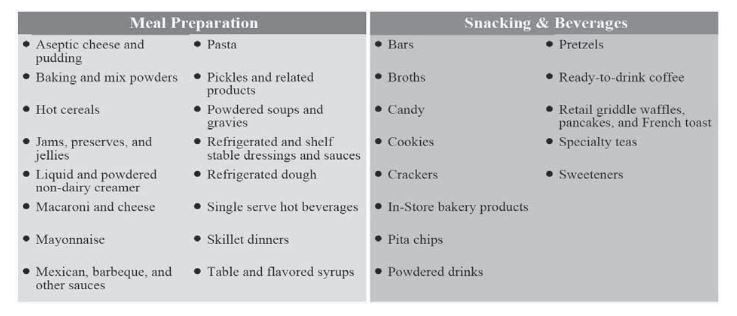
    How TreeHouse Foods is currently structured. Via 2020 Annual Report

    To understand why management is pursuing this new strategy, it’s best to take a step back and look at three things: The value proposition for a private label company, the operations that enable it, and how COVID upended it all.

    A private label company’s value proposition

    Private label brands have been around for about as long as large retail stores have existed. Private-label goods are nothing new, of course,” Matthew Boyle wrote in Fortune Magazine back in 2003, “having been around since the days when A&P owned vast coffee plantation in South America.” For most of the 20th century, private label was associated with cheapness and low quality. Then, in the last 30 years, something changed.

    He continued:

    Retailers—once the lowly peddlers of brands that were made and marketed by big, important manufacturers—are now behaving like full-fledged marketers. And here’s the earthquake part: It is their brands—not those of traditional powerhouses like Kraft or Coke—that are winning over the (consumers) in the greatest numbers.

    Private label manufacturers produce products that retailers can then brand under their own umbrella. However, most retailers don’t want to own their own factories, and with few exceptions, they rely on companies like TreeHouse foods for that. This setup worked pretty well before COVID-19. In the years leading up to the pandemic, sales of private label products typically grew at twice the rate of branded products.

    The operations of a private label company

    Since private label companies don’t handle the sales or marketing of their products, the companies have different core competencies than branded CPG companies.

    If you think back to the six major business processes in consumer products, private label companies handle processes 1-4, while the retailer manages all aspects of Sales and Marketing.

    1. Research and development: Creating a product that consumers want.

    2. Production: Figuring out how to manufacture the improved product at scale.

    3. Supply chain: Ensuring that you have enough raw commodities to manufacture the product.

    4. Transportation: Getting the product to the customer (retailer).

    5. Sales: Ensuring the product gets prime placement for a customer through negotiations and pricing.

    6. Marketing: Generating consumer awareness and demand through advertising

    The result is:

    • Consumers get relatively high-quality and low-cost products.
    • Retailers capture higher margins and generate brand loyalty through their own offerings (think Costco and Kirkland).
    • Private label companies operate as manufacturing partners and supply chains for retailers.

    How COVID upended the private label business model

    If you’ve followed this blog, you’ll know that branded CPG companies have excelled in COVID by maximizing each business process outlined above. Due to the nature of private label products, TreeHouse Foods can’t. “One thing I think to remember about us,” Oakland told analysts, “Is that we are only a supply chain business. We don’t have marketing levers. We don’t have many of the other levers that you have in your branded lives.”

    Here are the levers he is referring to.

    TreeHouse Foods couldn’t increase production to meet demand through third-parties.

    When the initial lock-down started in March of 2020, panicked consumers flooded retail outlets. Stock-outs of common products became a regular occurrence as manufacturers couldn’t keep pace with demand. Most branded consumer goods companies opted to subcontract the production out to third parties to deal with the onslaught. In the case of General Mills, it added 50 additional partners to its production capacity. “If demand starts to taper off, that is the capacity that we will shed first,” Kofi Bruce, the CFO of General Mills, told the Wall Street Journal. Since TreeHouse Foods was the one making the already low-margin products, it didn’t have that luxury.

    Private label companies couldn’t rationalize SKUs.

    Faced with overwhelming demand and production constraints, managers at branded CPG companies embarked on SKU rationalization projects. “We’ve made some choices in our supply chain to — we’ve reduced some of the tail of our portfolio,” the CEO of Pepsi told investors back in July 2020. The company met with its retailers and prioritized production of the best selling SKUs. “We both agreed that it’s probably the best thing to do, to eliminate the smaller SKUs in the portfolio to maximize the best-selling SKUs and be in stock.”

    Private label companies were out of luck. Since they’re focused on producing basic products, their SKU assortment is relatively limited.

    The Wall Street Journal explained:

    In frozen waffles, TreeHouse temporarily cut flavored ones, like chocolate chip, to focus on making the basics. The leading brand, Kellogg’s Eggo, suspended production of more obscure varieties and continued selling popular flavors like chocolate chip. TreeHouse’s frozen-waffle sales took a hit as a result, Mr. Oakland said.

    Private label products have less pricing power.

    Most branded consumer product companies have raised prices to offset rising covid-19 induced inflation. The smart ones have used revenue growth management techniques in a targeted way that boosts profitability. 

    Here’s what I wrote earlier about Kimberly-Clark’s RGM strategy:

    Kimberly-Clark is looking to leverage these same insights. RGM will bring in reams of data that will allow them to understand opportunities. Currently, a 32 pack of Huggies is $8.29 at Target online. Given the current level of online competition, it seems unlikely that the company could increase this SKU price. 

    However, done right, RGM will allow K-C to understand the true cost of selling at each customer—by SKU. RGM uses a variety of COGS, Transportation, and Trade data to reveal profitability. Maybe they can increase the base cost of a less popular item by 25%, but make up the lost volume with a promotional coupon on the 32 pack.

    TreeHouse Foods doesn’t have this flexibility because its products are unbranded. In fact, the cost of producing each item is rising, but the retail price is staying the same. TreeHouse Foods is taking this cost increase! Management claims it’s to maintain good relations with their customers, but in reality, the retailers hold power in the relationship and there isn’t another option.

    Private Label products aren’t optimized for E-commerce.

    In 2021, it’s anticipated that online grocery sales will reach $100 billion. Unfortunately for private label manufacturers, the private label industry isn’t optimized for e-commerce

    Private labels products mainly differentiate through price. Once consumers are in a retail store, they compare and contrast products side-by-side. E-commerce isn’t optimized for that. It’s optimized for keywords, and mobile ordering often shows one product (often promoted) at a time.

    In conclusion

    In 2014, I wrote an article on Li & Fung, the massive Asian supply chain magnate. In it, I argued that their business model was becoming obsolete. Its reliance on just-in-time production across multiple borders made it especially susceptible to the shocks associated with climate change.

    The question is, what will Li & Fung do? Their product isn’t soda or shoes. It is a network that is dependent on the system that is becoming unstable. If they don’t change, they will go from the company that no one knows about to the company no one cares about.

    You can lump the current iteration of TreeHouse Foods into that category. Its entire business model was built around acquiring a massive production infrastructure to produce unbranded products.

    I think management would agree.

    “We had built this supply chain designed for tremendous efficiency but very low volatility,” Steven Oakland said. “When the pandemic hit, we had complexity meet volatility.”


  • McDonald’s corporate officers: Are they still a big strategic asset?

    McDonald’s corporate officers: Are they still a big strategic asset?

    The composition of a company’s corporate officers or board can tell you a lot about a company’s operations and culture. “If a corporation has two executives who think alike,” Ray Kroc, the man who transformed McDonald into an international juggernaut, told a bunch of college students. “One of them is unnecessary.” In the case of McDonald’s corporate officers, during Kroc’s time, the group’s diverse background was viewed as a key strategic asset.

    In Kroc’s mind, McDonald’s wasn’t building a typical company. At that time, franchise businesses made most of their money off up-front franchising fees. Kroc wanted to invert that model. Instead of charging $50,000 for a franchise fee, McDonald’s would charge just $950 upfront and 1.5% of future revenue. To ensure that 1.5% generated sustainable income, Kroc had to perfect the firm’s business operations—a first for a food service company.

    He didn’t want to hire a bunch of MBAs to manage his business because they were all trained in a specific management approach–one that prioritized upfront fees over a long term partnership. In McDonald’s: Behind the Arches author John F. Love summarized Kroc’s situation, “Even the best hotel and restaurant schools had no notion of the type of business Kroc was building.”

    McDonald’s corporate officers: Kroc’s ideal

    This ethos resulted in a preference for hiring action-orientated people over academics. College and advanced degrees weren’t needed. What McDonald’s needed was people who had common sense and were willing to work the long hours necessary to build an innovative new model.

    Love highlights the McDonald’s commitment to this ideal.

    When he joined McDonald’s personnel department in 1962, Jim Kuhn was greatly relieved to learn that McDonald’s did not require (and still does not) a college degree for managerial slots. ‘ ‘The thing that I loved at McDonald’s,” Kuhn says, “was that they just told me to go out and get the best damn people I could get and to look at them, not their credentials. We hired people that would not have gotten through the door at other companies, not because they were losers but because they were not traditional.”

    That philosophy is intact today and is reflected in the surprising lack of college degrees inside McDonald’s executive suite. Of the twenty-six executives at the senior management level of McDonald’s Corporation, fully twelve are without college degrees, including Chairman Turner. Among the company’s eighty corporate officers—from assistant vice president on up—forty-three (or 54 percent) do not have baccalaureates. For its size, McDonald’s also has relatively few MBAs (twenty-eight), and it is likely the only company in America with more than $1 1 billion in sales that does not boast a single Harvard MBA. “Our people all have real-world degrees,” Kuhn says.

    This ideal turned hiring into a core strategic asset. While its competitors focused on perfecting the now, they were building towards the future.

    Modern composition..still an asset?

    Does McDonald’s carry on this same preference for action and results over academic achievement? Well, the short answer seems to be no. Obviously, times have changed. America’s view towards college attainment has shifted tremendously. In 1960, when Kroc was laying the foundation of the McDonald’s empire, just 7.7% of Americans were college graduates. In 1986, when Behind the Arches was published, the number was around 20%. Today, that number is 35%. But still, I was surprised by the results.

    According to their website, there are 14 corporate officers. Of these McDonald’s corporate officers, all 14 have college degrees. 8 of the 14 (57%) have advanced degrees. 5 have MBAs.

    As McDonald’s heads into new and unproven areas of business, namely e-commerce, it’s easy to wonder if Kroc’s vision may be better suited.

    But on the bright side, there is now at least one Harvard MBA within the company: CEO Chris Kempczinski.

    Photo by Erik Mclean on Unsplash

  • CPG and E-Commerce. What company is winning?

    CPG and E-Commerce. What company is winning?

    For nearly a decade, CPG and e-commerce was a strategic priority for most firms. For years managers investigated the possibility of an entirely new channel—one with potentially higher margins than traditional brick-and-mortar retail. There were plenty of unknowns: How would this impact our main distribution channels? What about pack counts? How can you stimulate impulse purchases? How do you drive conversion without paying an arm and a leg for customer acquisition? 

    Consumer packaged goods companies invested millions of dollars on theoretical scenarios. Then overnight, things changed. CPG e-commerce was no longer a mythical goal; it was a revolution in real-time. The catalyst wasn’t a killer app or a perfectly designed marketing campaign. Rather, a global pandemic that upended life as we know it. Almost overnight, consumers gave up in-person shopping—replacing it with a mixture of online delivery or omnichannel. The pandemic fueled CPG e-commerce stats are pretty staggering.

    From Boston Consulting Group:

    The numbers reflecting the shift to e-commerce are dramatic: the use of online grocery services (across all fulfillment models) more than doubled from February to March 2020, from 13% to greater than 30% of US consumers, according to Brick Meets Click. And BCG analysis reveals that about 40% of these consumers are trying online grocery for the very first time. Perhaps the more important finding is that approximately 35% of US shoppers new to e-commerce in March plan to continue making grocery purchases online after COVID-19 restrictions are over. 

    It begs the question, what CPG companies are excelling in e-commerce?

    CPG e-Commerce Leaders

    If you’re going to declare any CPG firm a leader in any category, there needs to be some sales data behind it. Unfortunately, there isn’t an open-source data repository for e-commerce sales. There’s a reason for that. It’s valuable. Almost all the specific data is either proprietary or behind heavily guarded paywalls. 

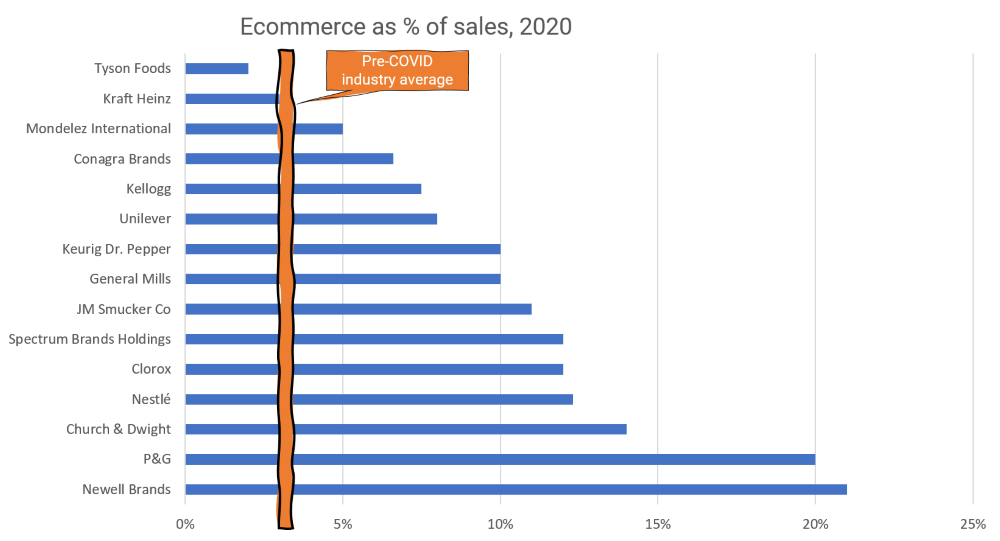
    That was until I spent a few hours reviewing investor calls and annual reports. Some firms (P&G and Unilever) are incredibly open about their e-commerce success and call it out their website or annual report. Others, like Church & Dwight and Kellogg, let it slip in investor calls or media features. 

    The result is the following graphic, which I’ll periodically update. 

    Newell Brands and P&G are clear leaders in cpg e-commerce. The reason is clear–they’re selling mostly home goods that are easily shipped and distributed through the mail. I’m fairly blown away by JM Smucker and Nestlé, the two food companies with more than 10 percent of sales coming from online. 

    Photo by Joshua Golde on Unsplash

  • Are e-commerce buying groups the future of grocery delivery?

    Are e-commerce buying groups the future of grocery delivery?

    One of the big issues facing CPG manufacturers, retailers, and e-commerce companies is the last-mile delivery cost. Most FMCG direct-to-consumer companies fail because it often costs more to deliver the item to consumers than the item itself. However, the daunting economics doesn’t stop people from wanting the convenience of grocery delivery.

    Enter Instacart and Postmates. Both offer grocery delivery by partnering with local retailers to create an individual delivery network. I’m incredibly skeptical of the long-term viability of either Instacart or Postmates. Part of this is history. America is littered with failed grocery delivery companies. Webvan lost over $800 million. Instacart shifted the business model from a retail play to logistics. These new “grocery delivery” companies don’t own any inventory. It seems to be the most promising, but it took a pandemic to make either profitable.

    The biggest reason for my skepticism is that its success comes at the expense of traditional grocers and retailers. Instacart decimates already razor-thin grocery margins when it charges a reported 10% commission on every transaction. I have a hard time believing that grocery stores will give away margin in post-pandemic times.

    The Chinese Approach to Grocery Delivery

    So what’s the solution? There is a clear demand for grocery and other fast-moving consumer product delivery services. There should be a business model that is financially viable. A recent article in Businessweek on Chinese tuan zhangs (e-commerce buying groups) offers a potential fix.

    From the article:

    While managing her convenience store in the central Chinese city of Changsha, Chen Shishun always has an eye on her phone. In part, she’s just talking on WeChat and sharing photos with her improbably large network of friends and neighbors. But Chen also monitors grocery apps for bulk deals on fruits and vegetables, then gathers orders from people she knows and has the food delivered to her store.

    The role of neighborhood e-commerce middleman, or tuan zhang, has become an increasingly vital one in Chinese cities since the first Covid-19 lockdowns. Chen, the kind of local merchant who does things like help customers carry purchases home, took charge of placing online grocery orders for the neighborhood when it was locked down this February. Word of her services spread quickly, and she now has almost a thousand people seeking to take advantage of steep discounts and cheaper shipping fees she gets by placing big orders—on the busiest days, she and an assistant handle 800—and centralizing deliveries.

    There are hundreds of thousands of such operations across China. People form community buying groups based on shared neighborhoods, districts, or even apartment blocks. While some version of this has existed since rural farmers banded together to buy seeds and fertilizer, it’s been supercharged by smartphones and a growing e-commerce market.

    There’s an old-school business model staring us in the face. The author misses it, instead referring to it as a consumer facing buying groups as a fad, echoing Groupon.

    Consumer facing wholesalers

    E-commerce buying groups are effectively consumer facing wholesalers. Like retail wholesalers C&S and US Foods, whose entire business model is buying in bulk from manufacturers and selling smaller retail outlets, buying groups make bulk orders and distribute to individuals.

    Only they’re better positioned, because unlike traditional wholesalers, who are largely nameless, e-commerce buying groups are branded.

    This makes people like Chen surprisingly influential. “My group members just buy what I recommend,” she says. “After all, I’m their next-door neighbor who knows them well, from what dishes they cook in the kitchen to what fruits they like.”

    Buying groups could provide a sustainable business model to grocery delivery. It would spread delivery costs over multiple orders while allowing retailers to maintain higher margins via bulk purchases.

    Image via Flickr

  • Proctor and Gamble 2021 Q1 Earnings Call – E-commerce and the battle for shaving

    Proctor and Gamble 2021 Q1 Earnings Call – E-commerce and the battle for shaving

    On October 20, 2020, Proctor Gamble held its’ 2021 Q1 earnings call with financial analysts. Overall, like many CPG companies, P&G had a fantastic quarter. Organic sales grew 9% across the company, with 9 of 10 categories experiencing top-line growth—led by Homecare, which grew 30%. The progress was seemingly sustainable, with the Cincinnati based manufacturer adding a point of mix and price.

    Jon Moeller, Vice Chairman, COO and CFO of Proctor and Gamble, summarized the quarter:

    A very strong start to the fiscal year, strong volume, sales and market share trends, strong operating earnings, margins advancing, strong core earnings-per-share growth. We’ve built strong momentum heading into the COVID crisis and have been able to maintain this through the most recent quarter, supporting the guidance increase for all key financial metrics, organic sales, core earnings per share, cash productivity and cash return.

    What else did we learn?

    1. Proctor and Gamble believes long-standing consumer preferences are changing.

    COVID changed everything within the CPG world. Companies that spent decades building brands suddenly saw themselves in prime position—as customers flocked to trusted partners. To keep up with the influx of demand, management reduced SKU counts. E-Commerce exploded—both changing the relationship between manufacturers and retailers. According to Jon Moeller, that change may be permanent.

    We do expect that there is some stickiness to new habits that are being formed and new awareness that’s been raised. It’s hard for us to see in our interactions with consumers that we’re going to snap back and revert to the same attitudes and the same behaviors that we had collectively pre-COVID. Even things like the amount of inventory — pantry inventory I keep, and in some way, this is analogous that some of us remember our grandparents. For example, having survived The Great Depression, and they continued to hold on to more brewed and canned items that I could never understand. But it was because of what they’ve been through.

    2. E-commerce is growing, but retail is still king at Proctor and Gamble

    There was an interesting question by an Evercore ISI analyst. Essentially, P&G has 22 billion-dollar brands who are leaders in traditional brick and mortar retail, but that hasn’t translated to across the board e-commerce success. Crest dominates online, but the company is struggling, even losing, with diapers and bath tissue. How does P&G think about that the market?

    Moeller’s answer pointed to the bigger picture.

    And we don’t see a lot of — there is some, but we don’t see a ton of differentiation between our ability to succeed in an e-commerce format and a offline format, when we execute our strategies and when our products in categories where performance drives brand choice are truly superior. So that’s our focus. We look carefully at overall share progress online versus offline and margin progress online versus offline. In an aggregate, which is always dangerous of course operationally, we move to lower levels of aggregation, we’re indifferent between online and offline shopping, which is exactly where we want to be. I mentioned we grew e-commerce sales 50% in the quarter that we just completed, e-commerce sales are now probably 11% to 12% of our total. So they are important and we’re just as focused on being successful in that channel as we are the others.

    Essentially, e-commerce is important, but it’s just 12 percent of P&G’s total volume. Proctor and Gamble wants to be wherever household products are sold. I’m very curious to see if this statement “When we execute our strategies and when our products in categories where performance drives brand choice are truly superior. So that’s our focus.” holds true. I’m not convinced that brand power is as vital in a land of online monopolies as it is in traditional retail.

    3. P&G is keeping an eye on DTC, but it’s a balancing act

    Direct-to-consumer (DTC) is a huge push within the fast-moving consumer product’s world. One of the issues is that it is really hard to be profitable within the space. P&G should know. Earlier this year Proctor & Gamble purchased female-centric shaving company, Billie. Much of the coverage was about the exciting DTC possibilities.

    I disagreed.

    I wrote after the official announcement:

    You’ll notice that there isn’t much here about Billie’s direct-to-consumer capabilities, a major talking point of early coverage and the whole reason Unilever acquired Dollar Shave Club. Instead, Moeller describes the benefits of plugging Billie into P&G’s established manufacturing and sales organization. In fact, the only reference to online distribution is about P&G’s own established abilities (The company’s Venus brand has a D2C service.) Apart from individualized marketing, he talks about it as he would any other brand acquisition… With P&G to buy Billie, the plan isn’t to build an online direct-to-consumer giant, it’s to add a young digital native brand to its traditional brick-and-mortar line-up.

    In my view, Moeller confirmed this thinking in his comments of DTC.

    Within that, DTC clearly can play a role. As you mentioned, in some of our businesses, it’s already a significant part of the operating model. It’s – it allows us to get closer to consumers to understand, to have an even better understanding of their needs and their habits, including their purchase habits, and that all can be very complementary and important in the broader context. So, you will see us continue to increase our DTC presence, but again, not at the preference of – or the de-prioritization of any other channel of trade.

    Notice how there wasn’t anything about it being a growth driver, but rather, ancillary benefits.

    4. P&G is preparing for a coming battle for razors

    Gillette has long-been a cash cow for P&G. An influx of hip, and low-cost competitors have entered the market. It saw its market share drop from 70% to around 50% in just a few years. Earlier this year, Unilever announced that Dollar Shave Club, perhaps the biggest challenger, was pivoting to an omnichannel brand—with Walmart as its first major retail distribution. P&G didn’t address the competition specifically, but it outlined how it would combat the move to brick-and-mortar.

    1. Product Innovation: SkinGuard line of shaving aids for men with sensitive skin.
    2. Moving into the premium space with King C. Gillette.
    3. Expanding into dry shave.

    Image via Flickr

  • What is e-commerce? A look behind the buzzwords.

    What is e-commerce? A look behind the buzzwords.

    On the surface, e-commerce is a straightforward idea. If traditional retail is when you buy a good or service from a store, e-commerce is when you buy a good or service on the internet. Underneath the surface is where things get complicated. This article looks to further define e-commerce, with an eye towards the business structure of the industry.

    How big is e-commerce in America?

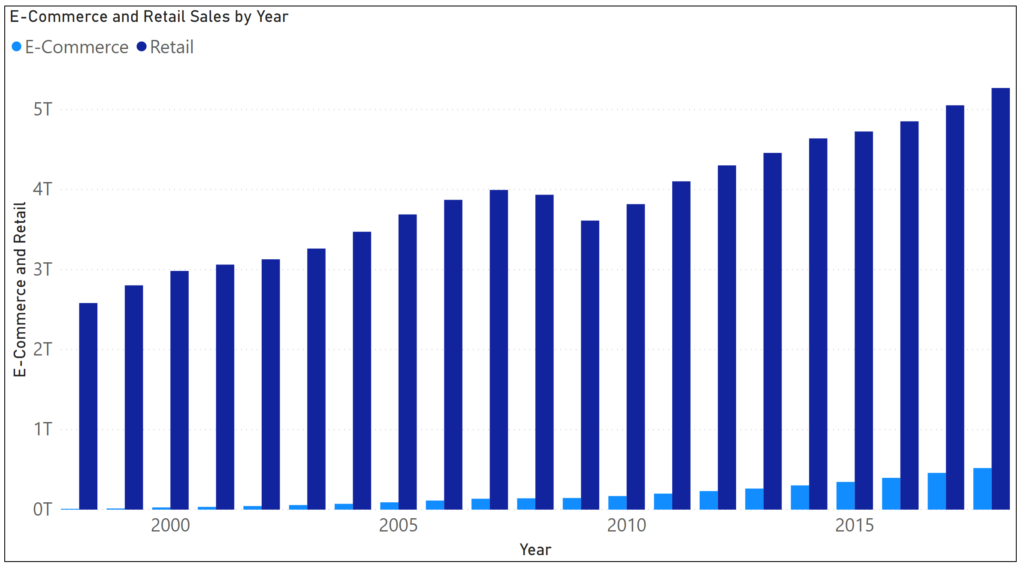
    According to the U.S. Census Bureau, in 2018 total e-commerce sales in America were approximately $520 billion. As the chart below shows, that’s barely 10 percent of overall US retail sales.

    E-commerce as a proportion of retail
    Data via the US Census

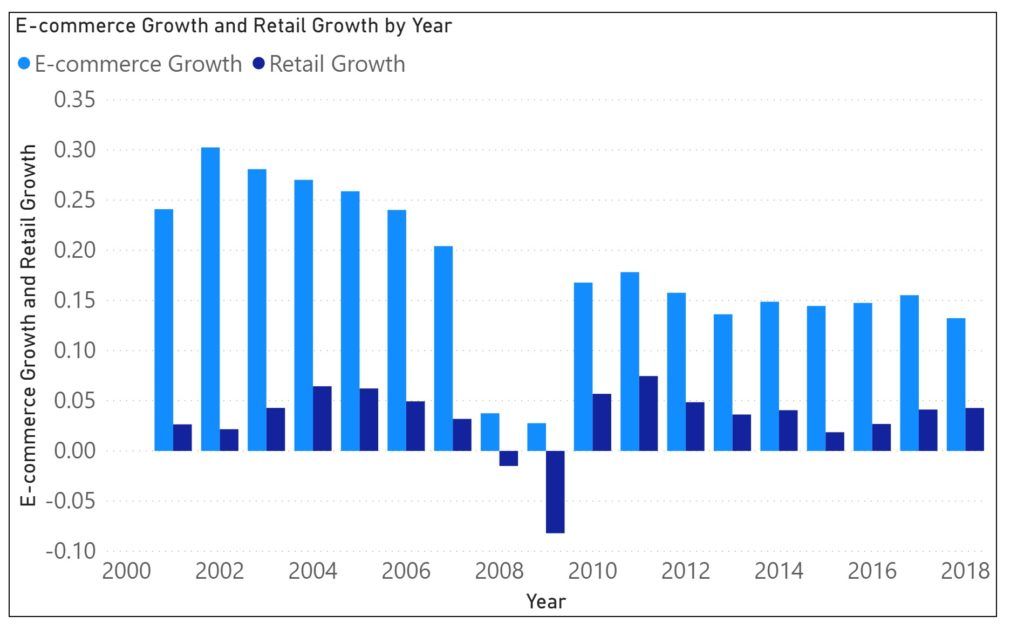
    However, e-commerce is one of the fastest-growing segments of retail. This includes before COVID shifted millions of consumers online.

    Annual Growth: E-commerce vs Retail
    Data via the US Census

    Who are the major players in e-commerce?

    The major players are all household names. While their total market share is unknown, Amazon is by far the largest player in the space. What’s interesting is the subtle differences between leaders in overall retail (via NRF) and e-commerce.

    RankAll RetailE-Commerce
    1WalmartAmazon
    2AmazonWalmart
    3The Kroger CoeBay
    4CostcoApple
    5Walgreens Boots AllianceHome Depot
    6The Home DepotWayfair
    7CVS Health CorporationBest Buy
    8TargetTarget
    9Lowe’s CompaniesCostco
    10Albertsons CompaniesMacy’s

    What channels are there in e-commerce?

    Retailers were forced to specialize in specific channels because of the physical limitations of real estate. No physical store has room to stock a wide selection of furniture and a wide selection of baseball gloves. Looking at the above charts, the major retailers are in fairly straight forward channels: Consumer Staples (Walmart, Kroger, Walgreens), Multi-sector (Target, Costco) and e-commerce (Amazon).

    Drilling into e-commerce is a bit more complicated. It’s best to look not at what e-commerce sites sell, but how they sell it. The major channels in this view are: Marketplaces and Direct-to-Consumer (DTC).

    Marketplaces

    From an outside perspective, e-commerce marketplaces function like traditional retail. Companies buy a variety of brands and products, store them in warehouses, sell them online to consumers, and ship them out. Examples include Amazon.com, Wayfair.com, and Crutchfield.

    Direct-to-Consumer

    When a manufacturer sells directly to consumers through a website. Traditionally, this was the domain of big-ticket items, like apparel (Nike) but has recently moved into smaller and cheaper fast-moving consumer goods (Clif Bar, Pepsi). It was recently a focus of P&G’s latest investor call.

    What’s the e-commerce business model?

    This is where things get interesting. E-commerce often functions as both a retailer and a platform. It allows them to make money in a variety of ways. Here are a few.

    Direct-to-consumer

    Here, consumers are buying a good, directly from a manufacturer’s website. In theory, the direct-to-consumer model is incredibly appealing for all manufacturers. It allows companies to capture more margin or offer lower prices by bypassing retailers, and the wholesalers who service them, and selling directly to consumers. In practice however, it doesn’t always work that way. That’s because manufacturers must manage existing retailer relationships and direct-to-consumer website shoulder all the customer acquisition costs.

    Traditional Wholesale Mark-Up

    A company buys a good from a manufacturer, stores it in a warehouse, and sells it to a consumer at a higher price through a website. Example: Crutchfield, NewEgg, Amazon

    Third-Party Market Place

    A company never takes physical ownership of a good, rather, it offers a platform for independent sellers who shoulder the inventory and storage costs. In exchange for access to the network, independent sellers pay the e-commerce site a percentage of the final sales price. Example: Ebay and Amazon.

    Logistic Services

    For traditional retail, getting the goods to a physical store is a significant cost center for both manufacturers and retailers. In e-commerce, merchants like Amazon have shifted that cost to third-party sellers and internalized the profit. In Fulfillment by Amazon, third-party sellers store their goods in Amazon’s warehouses. Amazon handles all fulfillment processes and distributes the item to buyers. In exchange, third-party sellers pay Amazon a portion of the sale.

    Membership

    Like Sam’s Club and Costco, some e-commerce requires a paid membership in order to purchase. The membership is both a significant revenue driver and “lock-in” device—driving loyalty and increasing the long-term value of the consumer to the company.

    Sales and Marketing Expenses

    In traditional brick-and-mortar retail, this is commonly referred to as “trade.” It is mostly promotional expenses that help drive volume for both retailers and manufacturers. Think price reductions, coupons and buy-one-get one deals. The function is still evolving in e-commerce, but sales and marketing expenses typically relate to better product placement within a store’s search returns. The Congressional Investigation on Digital Markets explains:

    Amazon generates a significant amount of revenue from the fees that it charges third-party sellers. According to a recent SEC filing, net sales for services provided to third-party sellers increased from $23 billion in the first six months of 2019 to $32 billion over the same period in 2020—an increase of 39%. For the ability to sell a product on the platform, a seller might pay the company a monthly subscription fee, a high-volume listing fee, a referral fee on each item sold, and a closing fee on each item sold. Amazon charges additional fees for fulfillment and delivery services, as well as for advertising.

    If a website is suggesting that you buy something, there’s a good chance someone paid for that suggestion.

    Where does Amazon fit into e-commerce?

    Amazon is the dominant force in American e-commerce. A recent Congressional report estimates the company controls 50% of online retail. In fact, 60 percent of all online purchases start on Amazon.

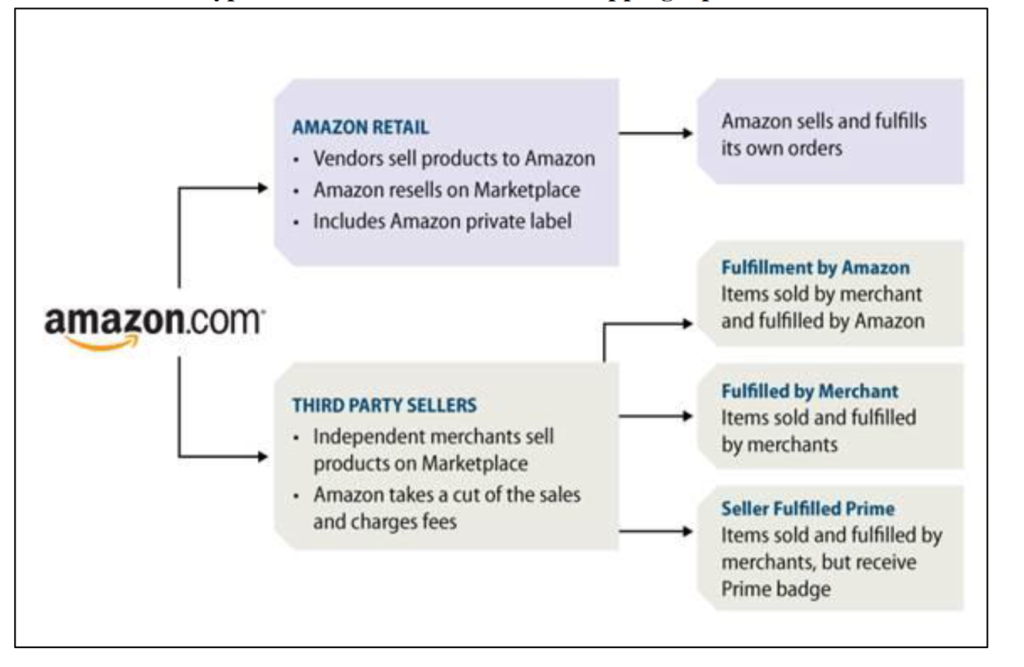
    The Competition in Digital Markets report provided a useful graphic to understand Amazon’s structure.

    Image via the Competition in Digital Markets Report

    As you can see, Amazon’s business model is a hybrid of all six outlined above. In fact, third party sellers on Amazon are both customers and suppliers.

    In conclusion, what is e-commerce?

    At a high level, e-commerce is when a good or service is sold through the internet. It’s a small segment of the overall retail market but is growing in both size and impact. Since e-commerce is unrestricted by shelf space, online stores can offer nearly limitless products—meaning the best way to view them from a channel perspective is if they are vertically integrated (direct-to-consumer) or serve as a platform for commerce. E-commerce makes money in traditional and untraditional ways, with the most successful companies functioning as hybrid platforms.

    Photo by 🇨🇭 Claudio Schwarz | @purzlbaum on Unsplash

  • The business impact of COVID-19 on 4 major CPG companies

    The business impact of COVID-19 on 4 major CPG companies

    COVID-19 has had a tremendous business impact across the CPG landscape. Seemingly overnight the competitive landscape shifted. Faced with concerns about quality and safety, consumers returned to long-established brands. Some brands even exploded after restaurant demand evaporated overnight. This left major companies with an interesting operational decision. For years, CPG companies expanded and structured themselves to deliver unlimited choice for consumers—trying desperately to capture the ever-changing preferences. In the midst of unprecedented demand and uncertainty, retail partners are overwhelmed, preferring to stock safe SKUs—not experiment.

    I’ve written before about how small CPG firms that focused on foodservice were forced to transition to retail and the uncertain results that follow.

    Internet or direct-to-consumers is always trotted out as the silver bullet for struggling companies in the coronavirus era. It’s basically the business version of telling unemployed people to ‘learn to code.’ It’s an unserious idea for a structural issue.

    Food service involves selling and delivering one fifty-pound bag of coffee to one customer, retail involves selling fifty one pound bags to fifty customers. They have entirely different cost structures and operations.

    But what about the largest CPG companies? They have the resources to pivot on a dime. I combed the largest CPG firm’s public statements to understand the business impact of COVID-19.

    CompanyApproachDescription
    NestléLarger Pack Sizes“The other one, while still early days, that we saw, is an interest in larger pack sizes. That’s also not surprising when people spend more time at home, rather than consuming lots of small packs, they rather buy fewer large packs. As I said, our strategic business units are now working overtime to really understand, not only in light of the health care crisis, but also the economic pressure, what that means for each of our categories. To me,that is super interesting work because clearly this is not going to be a quick recovery. This is going to be several-quarter, if not several-year kind of process, where it is safe to expect some changed category dynamics. We want to recognize those early and adapt to those early and be a leader when it comes to those trends.”
    Proctor and GambleSKU Rationalization“Increased demand has focused retailers on the core SKUs that drives the business. There is potential for this to result in a cutting of the long tail of inefficient SKUs and brands in our categories. We’re discovering daily lower cost ways of working with fewer resources. Today’s necessity birthing the productivity intentions of tomorrow. New digital tools are being brought to the forefront, providing another productivity rocket booster on the factory floor and in the office environment.”
    PepsiSKU Rationalization, Delivery Adjustments“We’ve made some choices in our supply chain to — we’ve reduced some of the tail of our portfolio. We’ve discussed that with our partners, retail partners. And we both agreed that it’s probably the best thing to do, to eliminate the less — let’s say, the smaller SKUs in the portfolio to maximize the best-selling SKUs and be in stock. As I said earlier, our DSD system, I think, is a fundamental advantage in the way we’re able to service our customers. And I think they appreciate that, that we’ve made the effort, adjusting delivery schedules and increasing delivery schedules to make sure that we keep our brands in stock and we help, obviously, our partners.”
    UnileverSKU Rationalization“The first test of this theory came early in the pandemic when demand for Unilever’s more essential products, such as cleaning supplies, shot up 600% in some cases. To deliver, the company converted production lines and reduced the number of total SKUs it produced by 65%.”

    Photo by Ross Sneddon on Unsplash

  • Wheel of retailing: What it is and why Dollar General may not move up

    Wheel of retailing: What it is and why Dollar General may not move up

    For as long as there has been business, there have been theories that attempt to explain the outcomes of the market. Some, like creative destruction and the innovator’s dilemma, are far-reaching and offer a universal framework to analyze the political economy. Others, like the wheel of retailing, concentrate on individual industries—and attempt to explain specific niches. 

    What is the Wheel of Retailing?

    The wheel of retailing is fairly straight forward. Here is how Professors Peter Scott and James Walker defined it at Business History:

    New retail modes frequently emerge at the bottom end of the price and service spectrum, using low-cost, low margin, `no frills’ formats to undercut incumbent competitors. However, once well-established, such retailers typically up-grade services and facilities, raising costs and prices and leaving themselves vulnerable to a new wave of low-cost entrants.

    Walmart is proof of the theory. Founded in 1962 on the mantra of “Always Low Prices,” the company spread like wildfire when fair trade laws left America. Manufacturers were no longer able to control the retail pricing of their products, and Walmart took advantage. It used its size to demand steep discounts and passed the savings to consumers. This newfound pricing power was supported by cutting edge real estate strategies, operations, and logistics—leading to it becoming the most dominant retailer of a generation. 

    In the late 2000s, Walmart’s strategy switched. Walmart entered grocery and created “superstores.” Low prices were still important to the company’s strategy, but so was the overall shopping experience. In 2019, the company announced plans to invest $11 billion updating over 500 storefronts, which includes redesigning automotive and cosmetics. They aren’t selling the cheapest or the best—but somewhere in between. The company’s mantra is now “Save Money. Live Better.” 

    As Walmart moved up the wheel of retailing, a new discounter followed in its wake—Dollar General. Like Walmart in the 1960s, Dollar General offers low prices. The low prices are profitable because of their operations. Consider assortment. A typical Walmart superstore carries about 120,000 items. That’s 10x as many items as a Dollar General. From a staffing perspective, Walmart averages one associate per 475 square feet of sales space. Dollar General averages one to about 777 square feet. Dollar General offers less selection, with less customer service, but lower prices.

    Will Dollar General ever move up the wheel of retailing? 

    I don’t think so, but before I get into why it’s important to understand why discounters become successful, and why the transition up the wheel of retailing is often difficult.

    Strategy differ across the wheel of retailing

    In their 2017 history of five-and-dime stores, Peter Scott and James Walker argue that earlier discounters (like Woolworth) declined because the operations that allowed them to discount profitability didn’t translate when the stores attempt to move up the wheel of retailing. 

    One of those operations is their personnel strategy.

    Today, both Dollar General and Walmart rely on low-wage workers to serve as sales associates. Dollar General pays around $8.50 an hour; Walmart is around $12. Here’s Woolworth’s CEO describing the same sentiment in 1892: 

    We must have cheap help or we cannot sell cheap goods. When a sales clerk gets so good she can get better wages elsewhere, let her go –for it does not require skilled and experienced salesladies to sell our goods.

    This business strategy may work when the store is selling commodity goods like toilet paper and sponges. It falls flat when selling specialized products like clothing and automotive parts. Scott and Walker quote another discounter in 1932, who recently transitioned up the wheel of retailing, highlighting the importance of suggestive selling and bemoaning low-paid worker’s ability to execute it.

    You should possess this information in order to properly train your salesgirls in the art of increasing each sale. Of equal importance is a thorough understanding of the best methods for presenting your merchandise to the customer in such a manner that interest is aroused and the salesgirls’ service appreciated…Verbal suggestions must be followed up by intelligent comment… Few salesgirls are instinctively able to do this.

    Walmart has been able to manage this transition. History isn’t so kind to others.

    Discount strategies struggle when selling higher-value goods

    Discount retailers ran into department stores when they attempted to move into high margin products. Retailers like Macy’s, and JP Penny, carried high-end products, carefully purchased by specialized buyers, and sold by well-paid salespeople. 

    FunctionDiscounterDepartment Store
    AdvertisingNo-advertising, rely on word-of-mouth generated by low prices.Incremental volume driven by frequent sales and newspaper promotions.
    AssortmentStandardized products via centralized and direct purchasing at HQ.Individual department managers are category specialists who have wide discretion in what they purchase and carry.
    Personnel Low wage hourly sales associates.Associates are relatively well paid by sales commission.

    Discounters never really had a chance. Discounters were designed to bulk purchase a variety of commoditized goods and sell them cheaply—the opposite of higher-end retail.

    So this begs the question, why did previous discounters move up the wheel of retailing?

    Market saturation moves discounters up the wheel of retailing

    Scott and Walker conclude that discounters moved up the wheel of retailing because they had nowhere else to go for growth. Given that the business model relied on no advertising and standardized commodity products, the only way in a new market was to cut prices—a disaster in waiting. They couldn’t enter new territories, because all the territories were taken. According to their analysis, Woolworth, a dominant player, faced competition in just 22 percent of their 238 locations. 

    Our model views shifts from low to higher value merchandise as being driven by retail format saturation in the low price niche. No frills retail formats compete primarily on price. However, for very low price merchandise substantial gross margins are necessary to cover high handling cost to price ratios. Price wars between rival stores adopting the same format are thus potentially ruinous. The alternative is to move into higher value lines, but this necessarily involves adding more services –to meet the minimum expectations of consumers and provide the information and advice they require. (Emphasis mine)

    Dollar General faces different social dynamics

    Scott and Walker were writing about an era of unbridled economic growth. As more Americans became middle class, more and more Americans wanted to purchase higher quality goods. 

    The opposite is now true.

    As long as the economy continues to drive inequality, modern dollar stores will continue to excel, giving no incentive to move up the wheel of retailing.

    From a New Yorker article detailing how Dollar General became a target for crime:

    The chains’ executives are candid about what is driving their growth: widening income inequality and the decline of many city neighborhoods and entire swaths of the country. Todd Vasos, the CEO of Dollar General, told The Wall Street Journal in 2017, “The economy is continuing to create more of our core customer.”

    Given what we’ve seen in the last ten years, it seems highly unlikely that Dollar General will ever need to move up the wheel of retailing.

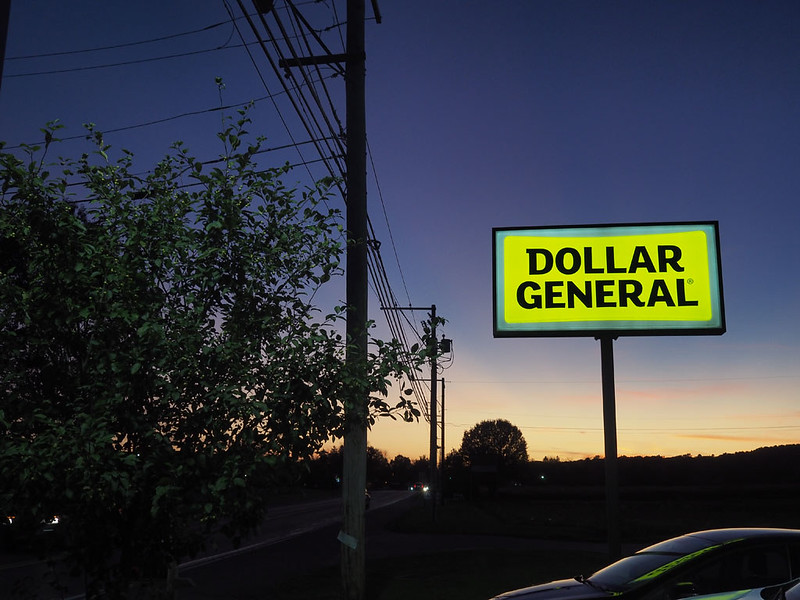
    Image via Flickr.

  • Retail Pricing, Fair Trade Laws, and the Rise of Walmart

    Retail Pricing, Fair Trade Laws, and the Rise of Walmart

    Today, retail pricing, the price you see in stores, is determined by Retailers—not Manufacturers. For example, if you go to Kroger for a 12-pack of Sprite, the price you pay isn’t set by Coca-Cola—it’s set by Kroger.

    This wasn’t always the case.

    In the past, it was legal for manufacturers to determine retail pricing. Often times, manufacturers offered a lowest acceptable retail price—and it was small retailers who pushed for that ability. Here’s the quick story about how that happened.

    Early retailing is a family affair

    Edna Gleason, was a self-educated but state-certified pharmacist who owned three drugstores across California. In the early 1900s, pharmacists were predominately small businesses. A family would own a store, where they would mix drugs and sell a variety of home care goods. Edna and other local pharmacist bought most of her goods from a wholesaler, who bought the goods from the manufacturer. Both links in the retail value chain have cost—which meant a mark-up. The result was a modest selection, with two price mark-ups. It was a simple business considered by most to be key to self-sufficiency.

    Then came Chain Stores and Pineboards—large, wall capitalized corporate structures that entered new markets and undercut locally owned small businesses.

    Chain stores gave retail pricing advantages to stores with big footprints

    They’re everywhere today, but chain stores are a relatively new development. Prior to the early 1900s, national chains stores weren’t widespread.

    Writing in Business History Review, Laura Philips Sawyer explains the rise:

    East Coast chain stores, like the Great Atlantic & Pacific Tea Co. (A&P), and department stores, like R. H. Macy’s, pioneered a business model that captured profits by combining high-volume sales with lower profit margins. Most of these retailers purchased goods from a variety of manufacturers. High-throughput manufacturing revolutionized consumer products from processed foods (e.g., Campbell’s Soup) to cigarettes (e.g., American Tobacco).Taking advantage of manufacturers’ economies of scale, these new retailers up-rooted the existing distribution system, tilting economic power toward large-scale retailers and away from the networks of regional manufacturers, wholesalers, and local retailers. Many manufacturers also complained that they had lost control of their brands.

    Essentially:

    1. Chain stores placed large orders—which meant they were able to negotiate volume discounts
    2. Chain stores placed orders directly with manufacturers—bypassing traditional wholesalers

    Chain stores then passed the price savings on to consumers. The result was a fundamental switch in power from regional manufacturers (who were used to negotiating with thousands of small stores) and small retailers (who held local monopolies in distribution) to chain stores and consumers.

    Pineboards were chain stores on steroids

    Chain stores often had large, clean, well-lit operations that catered to a growing middle class. Pineboards were something completely different. “The distinctive feature of the pineboard,” Laura Philips Sawyer wrote, “was its ability to offer brand-name products at prices below the manufacturers’ retail network, undercutting even the chain stores.”

    This discount model required pineboards to adopt a different strategy than chain stores and locally owned operations. The strategy was strikingly similar to today’s dollar chains.

    PineboardsModern dollar stores
    Lowered fixed costs by renting commercial space on a temporary basis to test competitive waters.Keep fixed costs low by building small stores in low income rural and urban areas
    Reduced variable cost by employing unskilled, low-wage laborers rather than trained pharmacists.Stores are staffed by 1-2 people low-wage laborers. Customer service is not a priority
    Required cash payments and did not offer delivery services.Mostly deal in cash; did not accept credit cards until recently (Dollar General started in 2005)
    A pharmacy by association. No prescription drugs, but sold more basic consumer goods.Very few fresh food items, but enough to be considered a grocery store and “essential”

    The rise of pineboards and chain stores threatened the survival of Edna Gleason’s pharmacy. It also threatened all of small-town America. Local retailers were the life blood of any small town. Unlike chain stores, they bought from local manufacturers, and the money stayed within the community. In contrast, chain stores are arguably extractive—funneling profits to shareholders thousands of miles away. This strategy resulted in cheaper prices and how was she to compete with chain retailers that offered cheaper products?

    She couldn’t.

    So she organized until she could.

    Edna Gleason attempted to standardize retail pricing

    In February 1929, about seven months before the Great Depression officially kicked off, Gleason led a movement to restructure the California pharmacy industry. First she consolidated the statewide lobbying groups into one large organization, the California Pharmaceutical Association. Then she set out to publish a statewide pharmaceutical price list.

    Philips Sawyer summarized the thinking:

    Advocates of fair trade envisioned a strong state association that would publicize standardized price lists and monitor member compliance. The publication of monthly price lists would, they argued, allow businesspeople and regulators alike to monitor price changes.

    The initial price lists were informally enforced; compliant retailers would blacklist and shame non-compliant ones. This behavior is of course anti-competitive, illegal even. Until a new legal theory emerged. It held that when competing against chain and pineboard retailers, independents were no different than employees bargaining against large employers. They were free to combine their buying, marketing and sales power to combat larger competitors.

    The result was The California Fair Trade Act of 1931. It exempted the above agreements from antitrust prosecution and gave the state police powers to enforce the free trade agreements. Essentially, if a group of independent retailers agreed that a manufacturers retail price was fair, the state police would enforce the agreement. Phillips Sawyer concludes, “This public-private approach to managing price competition came to exemplify Depression-era regulation.”

    Fair Trade Goes national and then disappears

    Given the current state of American anti-trust, it’s hard to imagine now, but retail pricing laws, which increased consumer prices, were overwhelmingly popular. Underpinning the legislation was an ideological sentiment: Local control and ownership of commerce were a defense against communism and fascism. That freedom to own and manage production was more important than low prices.

    In the late 1930s, Congress nationalized the California Fair Trade laws, culminating with the Robinson-Patman Act and Miller-Tydings Act. The first banned selling products at a loss to boost volume and secret discounts. The second, made fair trade contracts enforceable across state lines.

    The general Fair Trade framework, spearheaded by Edna Gleason, lasted until the 1975.

    As I’ve outlined before:

    By 1975 prices in America were increasing by around 12 percent every year. The causes of this are vast and debated, but at the time, one of the easy culprits were fair trade laws…The logic was that if Congress got rid of fair-trade laws, prices would drop.

    With the laws gone, national chain stores were free to use their power and footprint in retail pricing negotiations. Economic power shifted from regional manufacturers and local retailers to national chain stores.

    In 1975, Walmart was a regional retailer with around 100 stores.

    Today it has over 4,300 stores across America.

    This isn’t a coincidence.

    Photo by Nicole Y-C on Unsplash

  • Why Influencer Marketing may be more Dollar Store than QVC

    Why Influencer Marketing may be more Dollar Store than QVC

    Influencer marketing is a big business. Business Insider estimates that by 2022, brands will spend up to $15 billion on influencers pitching their products. In most respects, the United States is lagging behind China in its reach and impact.

    Bloomberg recently published an article on Huang Wei, China’s dominant live online shopping influencer. She’s expanded from blogs and Instagram posts, to livestreaming.

    They write:

    In April, Huang—known professionally as Viya—sold a rocket launch for around 40 million yuan ($5.6 million). The live, online shopping extravaganza the 34-year-old hosts most nights for her fans across China is part variety show, part infomercial, part group chat. Last month, she hit a record-high audience of more than 37 million—more than the “Game of Thrones” finale, the Oscars or “Sunday Night Football.”

    Each night, Viya’s audience places orders worth millions of dollars—typically for cosmetics, appliances, prepared foods or clothing, but she’s also moved houses and cars. On Singles Day, China’s biggest shopping event of the year, she did more than 3 billion yuan in sales. The spread of coronavirus, which put most Chinese people under stay-at-home orders, doubled her viewership.

    The numbers here are staggering–37 million people watch a person sell goods online. The manufacturer’s appeal here is obvious. One of the toughest parts of the consumer goods world is getting in front of consumers’ eyeballs, where they can purchase it. Viya solves this—while spreading overall awareness.

    Influencer marketing combines sales and marketing functions

    Earlier, I defined the six key business processes that drive consumer product companies.

    The following major business processes drive consumer product companies:

    1. Research and Development: Creating a product that consumers want.

    2. Production: Figuring out how to manufacture the improved product at scale.

    3. Supply chainEnsuring that you have enough raw commodities to manufacture the product.

    4. Transportation: Getting the product to the customer (retailer).

    5. Sales: Ensuring the product gets prime placement for a customer through negotiations and pricing.

    6. Marketing: Generating consumer awareness and demand through advertising.

    Viya combines processes 5 and 6. Traditionally, Marketing would spread mass awareness and tell consumers where they can buy the product. Sales then work with retailers to make sure consumers easily find the product (through slotting and placement fees) and are enticed to buy it (through promotional allowances).

    Bloomberg describes how the livestream works (Emphasis mine):

    And, of course, everything is available at a deep discount, as long as it lasts. The link to buy a product isn’t released until after Viya’s done pitching and counts down: “5, 4, 3, 2, 1.” If a particularly popular deal runs out, she sometimes pleads with her off-camera producers on behalf of her audience to release more. It’s an honest question—the team is keeping track of inventory and sales in real-time—and a heck of a tactic.

    Each one of the bolded tactics is just a modern application of traditional promotional allowances. There’s a price cut, supported by artificial scarcity (limited time offer), but instead of executing them within a store, Viya executes them over the internet.

    Influencer Marketing and the QVC comparison

    The standard and obvious Western comparison for Viya is QVC or the Home Shopping network. After all, each features people pitching products over video, supported by an advanced technological back-end that ensures consumers can quickly and securely purchase and receive the product.

    Ron Popeil was a legendary infomercial and QVC pitchman. On the surface, he doesn’t seem that different from Viya. Ron invented a variety of kitchen gadgets–from the Chop-o-Matic, “Ladies and gentlemen, I’m going to show you the greatest kitchen appliance ever made,” to the Showtime Rotisserie, “Set it and forget”–He rose to prominence filming infomercials. As cable became widespread and the QVC network gained exposure, Popeil became a regular host. In essence, he was a live streamer. He was, of course, great at it, routinely selling $1 million worth of merchandise in one hour.

    Here’s Malcolm Gladwell, in “The Pitchman,” describing his marketing strategy (emphasis mine):

    There were no buttons being pressed, no hidden and intimidating gears: you could show-and-tell the Veg-O-Matic in a two-minute spot and allay everyone’s fears about a daunting new technology. More specifically, you could train the camera on the machine and compel viewers to pay total attention to the product you were selling. TV allowed you to do even more effectively what the best pitchman strove to do in live demonstrations—make the product the star.

    The result of this approach was an enticing proposition to manufacturers.

    A 1994 US News Report article on the rise of QVC explains why:

    And since QVC deals directly with manufacturers and sells in such vast quantities, its cost of goods is lower than that of many traditional retailers. Designer Diane Von Furstenberg, who now sells her clothes exclusively through QVC, estimates she can price her blouses, skirts and blazers on television at less than half what a department store would have to charge. “Being on QVC allows me to pass up the middleman, the double shipping, the double warehousing, the showroom costs,” says Von Furstenberg. With fewer layers nibbling away at profits, QVC enjoys a larger gross profit margin — 42 percent in 1992 — than a typical department store. “And they don’t pay rent, sales help or advertising,” adds consultant Millstein, listing three of the largest costs for traditional store owners.

    Manufacturers maintain their margin but gain access to a huge pool of buyers. Consumers get lower prices for high-quality goods. QVC facilitates it all and takes a cut. 

    The result was a win/win/win for consumers, manufacturers, and QVC.

    Viya and other influencers act as a discounter

    Viya shuns the infomercial strategy. Instead, she is the star of the show. It’s Viya, Viya alone that approves the product and pleads with producers to release more goods. 

    To bolster their own credibility, live streamers demand deep discounts and generous add-ons from the brands they work with. And the long-term effects of a successful promotion can be modest. Less than 10% of customers through live streams become repeat buyers, compared with 40% of the customers who come directly through Tmall, said Roger Huang, China CEO for Saville & Quinn, a U.K. skincare company. “It’s just one wave, and then it’s over. They’re Viya’s fans, and they follow her call,” he said. “Livestreaming is very effective, but we can’t get addicted.”

    On the surface, live streamers and other social media influencers seem like an ideal pitchman. However, in reality, they have more in common with Dollar General or Family Dollar than QVC or the Home Shopping Network.

    The product will never be the star–instead, it will always be second to the live streamer or store. People go to discount stores because they know they can get deals; they’ll never go because of a brand–it’s the same game with influencer marketing.

    Like discounters, it makes sense to engage with influencers like Viya–given the reach of the major players. However, like discounters, manufacturers should consider adjusting quantity counts, creating new SKUs, and limiting trade spend.

    Or else influencer marketing led growth could become a mirage, propped up by trade spend.