Author: Eric Gardner

  • Kraft Heinz Is Dying a Death by a Thousand Cost Cuts

    Kraft Heinz Is Dying a Death by a Thousand Cost Cuts

    How did things go so wrong for Kraft Heinz, one of the nation’s largest, most recognizable food companies that’s backed by one of the nation’s most beloved investors? In February, Kraft Heinz announced a 2.7% decline in net sales for 2019. This comes just one year after the company wrote down $15.4 billion because legacy brands like Oscar Mayer and Kraft failed to keep up with changing consumer tastes. Its long-term debt was downgraded to junk bond status after management refused to cut its dividend. Oh, and it also was investigated by the Securities and Exchange Commission for misrepresenting financial results.

    During a scheduled conference call reviewing the past year, CEO Miguel Patricio told investors that “2019 was a very difficult year for Kraft Heinz.” The situation is a far cry from just four years ago when the company headlined its annual report “Kraft Heinz Reports Solid Financial Performance with Integration on Track.”

    So what happened? To understand Kraft Heinz’s fall, you need to understand how the company came to be and how its strategy and approach to budgeting differs from the traditional model of a consumer packaged goods (CPG) company.

    Private equity comes to town

    This all goes back to when 3G Capital, a Brazilian private equity firm, entered the picture in 2013. The firm had earned itself a reputation for generating profits. Like most PE firms, its model was based on cash flow and cost cutting. The general strategy looked like this:

    1. Identify an established brand that 3G management believed it could manage more efficiently.
    2. Acquire it with other people’s money.
    3. Maximize its efficiency through cost cutting.
    4. Use the resulting profitability to finance additional deals.

    The firm had used the formula to turn Burger King and Budweiser into cash machines; it sold 1,200 Burger King locations to outside investors and reduced the head count by almost 36,000. In three years, net income rose 34%. “These things are seemingly working at Burger King,an analyst told Businessweek in 2014, “and causing questions to be asked about the strategy of others in fast food.”

    With financing from Warren Buffett, arguably America’s most respected investor, 3G gained control of H.J. Heinz for around $23 billion in 2013. Two years later, the group acquired Kraft for $49 billion. The result was the fourth-largest food company in America with a roster of stable brands, including Oscar Mayer, Jell-O, Maxwell House, and Planters. “This is my kind of transaction,” Buffett said after the deal went through, “uniting two world-class organizations and delivering shareholder value.”

    Financial Times describes what happened next:

    Since 2013, more than 10,000 people — one-fifth of the workforce — have been laid off from Kraft and Heinz, with seven plants shut, highlighting the human cost and upheaval involved in producing the highest profit margins in the food industry. The founders of 3G have transformed the beer, fast food, and food manufacturing industries with bold acquisitions, which are quickly followed by a brutal but disciplined attack on costs, a surge in profitability, and high returns to shareholders.

    The “brutal but disciplined attack on cost” has a name: zero-based budgeting. The logic behind it is compelling while being simultaneously against the branded CPG industry’s entire business model.

    How zero-based budgeting works

    Traditional corporate budgets are derived from historical information. Imagine that you’re in charge of in-store marketing at Kraft. Last year, you spent $15 million on a variety of in-store marketing events. After analyzing inflation, competitor data, and new item distributions, you estimate you’ll need an additional $500,000 in funding to support the business. Your boss agrees, so you get the budget.

    Zero-based budgeting doesn’t work that way. In zero-based budgeting, every single company expense (from in-store food samples to pencils) is classified into a specific category. Each category is assigned a manager who builds a budget from scratch, justifying every single expense. Budgets are analyzed and awarded a cap. Managers are then incentivized based on how much they spend under the cap.

    The result is a ruthless accounting of company expenses.

    In the first few years, Kraft Heinz eliminated over $1.7 billion in annual spending. This included excessive expenses like private executive jets. It also included eliminating things that don’t cost a lot, like taking away free Kraft snacks in break rooms and limiting each employee to 200 printed pages a month. Workers may have hated it, but investors loved it. According to Berstein Research, for every dollar of sales, the food industry typically earns about 16 cents. Eighteen months under the new regime, 3G was earning 26 cents for every dollar it sold.

    There’s nothing inherently wrong with documenting and assigning responsibilities to spend. In fact, 10 to 15 years ago, you could almost certainly make the argument that many CPG firms were bloated. But the problem with this approach is threefold:

    1. It assumes the underlying brands independently operate with stable and strong business infrastructure — and that both are capable of doing more with less.
    2. It discounts the fact that legacy brands — almost all of Kraft Heinz’s portfolio — require promotional spending to maintain past sales performance.
    3. It fails to take into account that businesses aren’t linear. They are a collection of interdependent processes, each one influencing and impacting the bottom line in aggregate. It isn’t always possible to account for and rationalize every single expense because the results are often dependent on numerous factors.

    In year one, a cut in marketing and promotional spending may not impact much. Change doesn’t happen overnight. The initial success means the cuts are repeated for three straight years — because why not? The manager is incentivized to cut. Everything is fine until reality catches up. A legacy brand with reduced promotional support in an ever-changing category is a recipe for disaster. Suddenly, sales stop and management is forced to take one of the largest write-downs in a decade.

    Creating true value

    CPG companies are valuable because of the sum of their interlocking parts. A company can have the best product in the world with a great marketing campaign, but what does it matter if it can’t consistently manufacture it? The following major business processes drive consumer product companies:

    1. Research and development: Creating a product that consumers want.
    2. Production: Figuring out how to manufacture the improved product at scale.
    3. Supply chain: Ensuring that you have enough raw commodities to manufacture the product.
    4. Transportation: Getting the product to the customer (retailer).
    5. Sales: Ensuring the product gets prime placement for a customer through negotiations and pricing.
    6. Marketing: Generating consumer awareness and demand through advertising.

    Zero-based budgeting is about making each process the most efficient version of its current state. But despite how zero-based budgeting operates in theory, business processes aren’t independent. Businesses typically get a greater return on sales spend if they’re backed by a marketing campaign and vice versa. Some processes, like research and development, are not linear. It may take years for a product innovation to break through.

    For an example of a more successful way to acquire a company and integrate it into the core processes — rather than trying to grow through cuts — we can look at what happened with P&G and Charmin.

    Building new value through acquisition

    In 1957, P&G acquired a Green Bay, Wisconsin-based papermaker named Charmin. At that time, Charmin wasn’t the national powerhouse we know today. It was a regional afterthought with about $20 million in sales. To put the acquisition in perspective, P&G had an advertising budget of over $80 million the same year.

    Like the more recent Kraft Heinz deal, the logic for the acquisition was compelling. Acquisitions are evaluated based on how well they plug into a company’s existing operations and strategy — both vertically and horizontally. Vertically, P&G had technical experience with pulp-making, a key component of papermaking itself, through the Buckeye Cotton Seed Oil, a company it owned that manufactured component materials for film. Horizontally, it had a long history — first with soap, then with detergent — in marketing and distributing low-cost consumer products. On paper, everything looked fantastic. P&G had both the technical and business skills to build the brand.

    What could go wrong?

    For starters, Charmin wasn’t a product consumers wanted. Today it’s the most popular branded toilet paper in America, but in the 1950s, it regularly placed last in blind tests against products from paper powerhouses Kimberly Clark and Scott Paper. The poor quality meant that Charmin only controlled about 14% of the Midwest and Great Lakes market. Out-of-market retailers weren’t willing to give shelf space to a product that couldn’t win in its own territory.

    When P&G went up to Green Bay, it realized that Charmin failed in just about every process — specifically production. Rising Tide, the history of P&G, explains:

    Charmin benefited almost immediately from P&G’s more sophisticated financial and marketing techniques, but the transfer of technical knowledge proved troublesome. At the time, papermaking was considered an art, in the same way soap making had been earlier in the century. Charmin “had no clearly established product or process standards.”

    Despite having technical paper experience, P&G struggled to develop a new product. Mass production requires a strong paper to withhold against the stress of the pushing and pulling of papermaking machinery. But making it strong meant a thicker, harder paper — not exactly the words people want to be associated with toilet paper.

    After years of experiments, P&G engineers developed CPF, a paper manufacturing process based on a Japanese technique that involves inserting an air drying step into the manufacturing process. CPF resulted in a softer and more absorbent paper that had a cheaper per-unit production cost than traditional methods. Rival firms got wind of the new process but were powerless to respond because they were locked into extensive and costly legacy manufacturing systems.

    Adapting existing processes

    Investing in research and development and production processes resulted in P&G having a better product, but retailers didn’t want to sell it. Competitors made sales presentations that showcased how poorly the old version of Charmin performed. “Who needs a brand that’s been on the market for five or six years and is a weak number two or a weak number three in its category?” P&G’s former sales director later told interviewers.

    This is where P&G’s existing horizontal sales and marketing processes came into play. P&G put its marketing skills to use, inventing a new branding campaign, “Don’t squeeze the Charmin.” It then redesigned the packaging. Toilet paper was traditionally sold in opaque paper packaging. Charmin marketers put it in clear plastic, creating an attention-grabbing effect on the shelf.

    Armed with a superior product, a revamped brand, and better packaging, Charmin launched pilot programs in select cities. Within months, Charmin climbed to the top of each test market. The initial success gave sales representatives a story to sell. It’s hard to imagine now, but as the brand expanded into new cities, retailers couldn’t keep it stocked. “The thing just took off like nothing had ever taken off before,” Ed Artzt, a sales and marketing executive, recalls.

    After two years, Charmin was the bestselling toilet paper in every region it competed in. R&D created a better product, which led to a great marketing plan, which led to big sales increases in retail stores. The process was long, difficult, and cost millions of dollars, but it was worth it. “The acquisition of Charmin,” David Dreyer wrote in the company’s history book, “became the basis of several billion-dollar brands and one of the company’s leading growth producers.”

    Where does research and development go at Kraft Heinz?

    It’s staggering to contrast Kraft Heinz’s integration approach to P&G and Charmin. It’s even more staggering when you look at one specific business process: research and development.

    As the Charmin example showed, research and development is at the center of a branded CPG firm. Consumer preferences change, and it’s up to manufacturers to develop new products that consumers want. In the food industry, consumers are transitioning away from fatty packaged food and toward healthy and fresh alternatives. According to Businessweek, from 2014 to 2017, the top 10 packaged food companies lost over $16 billion in revenue. No one is entirely sure what this means for legacy manufacturers like Kraft Heinz, but during this transition, Kraft Heinz slashed R&D budgets. In the three years before the merger, Kraft spent about 0.8% of revenue on research and development, already somewhat low for CPG firms. The table below shows how it only got worse once Kraft Heinz merged:
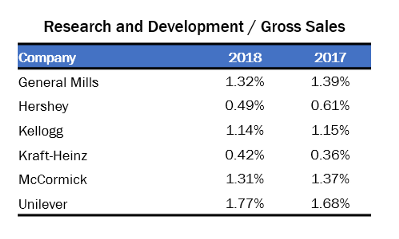
    Data via firm annual reports

    Making matters worse, when Kraft Heinz actually made an investment in R&D, it chose poorly. In an attempt to compete with healthier products, the company invested $10 million to reformulate hot dogs — at about the same time the World Health Organization labeled the food as a contributor to the risk of colon cancer.

    A different approach

    To be clear, 3G management took on an almost impossibly tall order with a $72 billion acquisition of Kraft and Heinz. First, history is littered with failed mergers and acquisitions. Billion-dollar transactions rarely work out unless you’re the bank booking the M&A fee. Second, both companies were established CPG firms. Unlike P&G and Charmin, there was no real value in bringing Kraft’s products into Heinz’s existing business processes because Kraft’s processes were probably just as efficient. It’s not like Heinz hadn’t mastered producing and selling ketchup for the last 100 years.

    P&G acquired a regional toilet paper brand and spent enormous sums of money developing a better toilet paper. It supported the product with world-class marketing and sales. Charmin dominated the industry for the last 60 years. 3G could have mimicked this approach. It could have acquired Kraft and then targeted smaller, regional brands that produce healthy options that would benefit from the company’s established scale and business processes.

    Instead, it pursued a strategy centered on two tactics: optimizing operations through cost cutting and generating leverage against retailers by creating the fourth largest food company in America. The former slowly and then suddenly deteriorated the value of the company’s legacy brands. The latter hasn’t materialized. In the case of the reformulated hotdogs, Kraft Heinz struggled to sell them to Walmart, which constitutes about 20% of the company’s yearly sales. The grocery goliath preferred Ballpark Franks and its own private label, leaving the new company in the same position facing many legacy manufacturers.

    The result is a company with legacy brands hemorrhaging sales to healthy upstarts and an organization ill-prepared for the new reality. “[Innovation] is a big driver for growth for the future, has to be especially in the food industry,” Patricio, Kraft Heinz’s CEO, told investors in 2019. “But we have to do bigger innovation. We have to do fewer innovation[s]. We have to do bolder innovation.”

    But because Kraft Heinz is spending so little on R&D, these innovations have yet to yield meaningful results. That’s because without properly funded R&D, Kraft Heinz is stuck either treading the same path while ignoring consumer trends or failing to innovate significantly and quickly enough. Last year, in fact, one of the biggest new product launches from Kraft Heinz was salad frosting.

    Yes, salad frosting.

    Something tells me that salad frosting isn’t the healthy and fresh choice consumers have been looking for.

    Note: This article was originally featured over at Medium’s Marker Magazine.

    Photo by Pedro Ribeiro on Unsplash
  • Retailer Shelf Space: Another potential loss for CPG Manufacturers

    Retailer Shelf Space: Another potential loss for CPG Manufacturers

    In theory, the relationship between CPG manufacturers and retailers is one of mutual interest and cooperation. A retailer needs healthy manufacturers to stock their stores with quality products that consumers want. One of the subtexts to my earlier article on Dean Foods is that retailer consolidation is weakening the power of manufacturers to the point where they are now at a significant disadvantage. This was the key section.

    Starting around the 1980s, the political economy of the United States became focused on one thing: lowering prices for consumers.

    It may seem like a small thing, but in reality, it drastically changed the power dynamic for every CPG firm. In the 1960s, the U.S. government blocked a grocery store merger because it would control 7% of the Los Angeles market. Today, Walmart controls 50% of the grocery market in 43 metro areas. This hands-off approach shifted the balance of power to retailers and large manufacturers. Consolidation was now the principal growth strategy for almost every actor. The bigger a company was, the more it can dominate negotiations.

    Manufacturers got bigger to counter strong retailers. Retailers got bigger to counter growing manufacturers. It was an arms race — only it favored stores. Manufacturers had to sell to retailers to reach consumers. Retailers didn’t have to buy from branded manufacturers. In fact, since antitrust enforcement declined, stores grew private labels to directly compete.

    Despite the arms race, it devolved into a cold war, because retailers relied on major manufacturers to plan their shelf offerings. Companies like Kraft or General Mills claimed expertise in consumer preferences and told retailers where to stock products within specific categories. Retailers listened because they could outsource the consumer research expense and charge manufacturers hefty slotting fees to enact the plans.

    This tactic arrangement hurt consumers because major manufacturers were often biased towards their own offerings at the expense of new upstarts. If a retailer wanted to stock more craft beer, a manufacturer typically suggested a craft brand it owned.

    A recent Wall Street Journal article shows how that’s changing:

    Retailers such as Kroger Co. and Walmart Inc. are using increasingly sophisticated software to decide where to place items and which products to shelve next to one another — factors that can move sales up or down several percentage points — according to food-industry executives. The software, which can incorporate video-surveillance and other data, helps them create so-called planograms of the products on their shelves.

    This is going to be a huge issue for large CPG companies. Despite facing seemingly insurmountable odds, manufacturers could still assert some pressure during negotiations because they had better data.

    Now, more and more retailers are foregoing slotting fees and stocking more store-brand and niche products. “Retailers began to realize that when they rely heavily on category captains, they are at a disadvantage because there’s an inherent bias,” said AlixPartners managing partner Jonathan Greenway, who consults for brands and retailers.

    When consumer preferences changed, it was the manufacturer, not the retailer, left holding the bag. Now they’re increasingly left without a say in what the preference is.

    At some level, it’s hard to feel bad for large manufacturers. The previous arrangement benefited them at the expense of small manufacturers. However, we’re entering into an era where manufacturers are going to be almost entirely commoditized. Barring some antitrust action, the only solution is for large companies to innovate their way out of it.

    Given large CPGs innovation track-record, I think we can expect a tidal wave of acquisitions in the next few years.

    Photo by Franki Chamaki on Unsplash

  • When negative externalities threaten Dart Container, it threatens back

    When negative externalities threaten Dart Container, it threatens back

    Negative externalities are an economics concept that is not often talked about, but incredibly intuitive. A negative externality is when an interaction between two parties harms a third party. If I buy new speakers from Sonos, Sonos gets money, and I get speakers. If I play them at all hours of the night, my neighbor gets less sleep. That’s a negative externality. It’s a trivial example, but according to economic theory, I should compensate my neighbor for the lost sleep. What does this have to do with consumer products? Many major consumer goods company’s products are priced artificially low because they don’t account for negative externalities. The company sells the product, captures the profit, and outsources the cost. 

    A recent New York Times articles explains the case of Dart Container.

    Cities and states are increasingly banning one of Dart’s signature products, foam food and beverage containers, which can harm fish and other marine life. In December, Gov. Andrew M. Cuomo of New York proposed a statewide ban on single-use food containers made of “expanded polystyrene” foam, more commonly, but inaccurately, known as Styrofoam. (Styrofoam is a trademarked material typically used as insulation.) Maine and Maryland banned polystyrene foam containers last year, and nearly 60 nations have enacted or are in the process of passing similar prohibitions. Some elected officials and environmental groups say polystyrene containers are difficult to recycle in any meaningful way.

    “There is overwhelming evidence that this material is seriously damaging the earth,” said Brooke Lierman, a Maryland lawmaker who sponsored her state’s ban.

    Right now, you can go to the store and purchase fifty Dart foam containers for about $8.00. Once used and thrown away, the containers are effectively impossible for cities to recycle. Foam, which is mostly air and plastic, isn’t biodegradable. It gets broken into pieces and ingested by fish and wildlife. An additional cost of $8 foam containers is a water and food supply tainted with plastic. It’s impossible to quantify, but if Dart accounted for the negative externalities its’ product inflicts, the containers would have a significantly higher cost—making them less attractive to consumers.

    According to Dart, foam containers make up about one fifth of the companies $3 billion a year in annual revenue. Obviously, they aren’t taking the proposed laws idly. 

    Dart is waging a broader campaign to argue that its products are being used as scapegoats for a society fueled by on-the-go consumerism. Dart says that critics of polystyrene are ignoring the negative environmental impacts of other products, like many paper cups, which are derived from trees and can emit greenhouse gases as they degrade in landfills. By Dart’s reasoning, most materials inflict some negative impact on the environment, so it doesn’t make sense to ban one and not another.

    Dart’s logic seems absurd to me, but that hasn’t stopped the company from shuttering distribution centers and recycling programs from cities who enact laws outlawing foam containers. They’re effectively holding workers hostage against environmental legislation. The Times points out that both Dart heirs renounced their US citizenship to avoid paying taxes. That seems relevant to really understand the company’s response. 

    Climate change will change business. How it changes depends on the actions of policy makers and executives. Let’s hope it’s for the better.

    Photo by Caleb Lucas on Unsplash

  • Reading the tea leaves; Unilever looks to move Lipton

    Reading the tea leaves; Unilever looks to move Lipton

    Unilever, the world’s largest tea producer, is looking to get out of the tea business.

    From Reuters:

    The company said the review was triggered by the sales slowdown of traditional black tea in developed markets as consumers shift towards herbal tea. Black tea is the dominant part of Unilever’s tea business, Pitkethly said, selling in 60 countries and generating 3 billion euros ($3.3 billion) in annual sales.

    After air and water, tea is the most consumed substance on earth, but that doesn’t mean it’s a good business to be in—specifically the type of tea it sells through its Lipton brand. Black tea is a commodity, one that less and less people are drinking. Instead, consumers are gravitating towards higher-end drinks.

    The Financial Times explains:

    Unilever has been particularly hurt by a shift to more upmarket brands. While retail sales volumes of black tea dropped in the five years to 2019 — by 15.3 per cent to 71,400 tonnes in the UK — the value sold rose over the same period, as many buyers traded up to premium versions. That left established mid-market brands struggling.

    A divestment makes sense. CPG companies like Unilever excel at building value added brands. Unilever is focused on building brands centered around purpose. What purpose does a commodity drink, like black tea, serve? None, really.

    What will happen to Unilever’s tea business?

    In 2017, Unilever faced a similar dilemma with its Spreads division, where it owned brands “Country Crock” and “I Can’t Believe It’s Not Butter.” Sales of both brands were effectively flat for a decade. Like what is happening to gum, consumers overwhelmingly stopped buying artificial spreads. They switched to butter (Irish butter specifically) and other natural options. Stuck with declining brands in a shrinking category, Unilever sold the spreads division to KKR & Co (of Barbarians at the Gate fame) for $8 billion.

    The facts work against Unilever. Despite owning a few powerhouse brands, the lack of overall category revenue growth means that it’s incredibly unlikely that a consumer goods company would even consider purchasing the unit. That means the likely outcome here is similar to spreads—private equity.

    Private Equity has different priorities than a consumer goods company. A consumer goods company is looking to build sustained revenue growth. They’re in the business for the long haul. A private equity company is looking for cash flow.

    Here’s how KKR & Co overall strategy was described in Barbarians at the Gate:

    During this period the trio fine-tuned its craft. They found larger companies could be acquired as easily as small ones, for the simple reason that they had larger cash flows; by diverting that money to pay down its debt, Kohlberg Kravis was able to use a company’s own strengths to acquire it. They began accumulating pools of money from investors, allowing them fast access to larger amounts of cash. Beginning with a $30 million fund in 1978, they raised a series of steadily larger pools, eventually reaching $1 billion in their fourth fund in 1983. The size of the deals grew in lockstep, reaching a peak during this period with the $440 million buyout of a Hawaiian construction company, Dillingham Corp.

    In short, a private equity firm will streamline operations and then use the cash flow to pay down the debt associated with the acquisition, and then finance more and more deals.

    Tea may be in decline, but it certainly generates stable and reliable cash flow for this purpose. In 2018 it generated about $3 billion in sales, or about 14% of Unilever’s food and refreshment revenue.

    Photo by Manki Kim on Unsplash

  • Revenue Growth Management: Coca-Cola profit rises investment pays off

    Revenue Growth Management: Coca-Cola profit rises investment pays off

    Coke announced it achieved or exceeded revenue and profits expectations for 2019. This came in stark contrast to 2017 when it looked like the Atlanta based fast-moving consumer product company faced an existential crisis over sugar. Consumers didn’t want to drink it anymore—bad news for a company whose portfolio revolved around sugary drinks. In two years, the company repositioned itself around sugar-free sodas and other healthier alternatives. It included the acquisition of Fair Life, a brand in the struggling dairy market, that was successfully integrated into the company’s distribution network. The result, according to CEO James Quincy, was growth “in a more sustainable way.” Despite the prevailing narrative, I don’t think it was just a transition to healthier products that drove results. It was also a successful execution of revenue growth management.

    What is Revenue Growth Management?

    The consumer goods value chain is broken down into three parts:

    1. Manufacturers
    2. Customers (Retailers)
    3. Consumers.

    Successful companies look to maximize their bargaining position between each part in the chain. The ideal position is a monopoly, but If that’s not possible, managers look to streamline and optimize each connecting point. The connecting point between Manufacturers and Retailers is called trade spend. Trade spend is a mixture of manufacturer to retailer pricing discounts and slotting payments to maximize the manufacturers position between Retailers and Consumers. It drives in-store pricing, shelf placement, and promotional activity (think buy-one-get one.) Revenue Growth Management is about optimizing trade spend between 1 and 2, to grow demand at 3.

    Here’s how Coca-Cola COO Brian Smith described Coke’s approach in 2019.

    It’s the ability to look at the total market, all of the offerings that are there, both ours and our competitors, and look at what consumers want, and to be able to then –with a lot of information, a lot of data, be able to figure out where the big opportunity areas are for us…

    Now, that’s a lot of information and it can be super complicated. And so, once you have that, you need to figure out within that how to sequence the things that you’re going to go after, based on what your system capability is, because you can’t necessarily do everything at once, but if you do that in an organized, disciplined fashion, then you begin to grab those opportunities and to drive your revenues and your profits.

    Basically, it’s the ability to analyze consumer consumption data against retailer activity to identify better opportunities for trade spend to “grab those opportunities and to drive your revenues and your profits.” It may sound simple, but it is incredibly complex. Coca-Cola sells to hundreds of thousands of retailers across the globe—each with a different product assortment and level of data sophistication. Coke must not only identify the opportunities but create the right mechanisms to ensure the company actually executes them with the retailer.

    In the most recent earnings call, Coke CEO James Quincey made it clear that Coke has laid a revenue growth management foundation. In fact, he gave a concrete example of it.

    Working with one of our European bottling partners, we added an incremental 100,000 transactions per week for one of our largest customers through insights driven by our RGM capabilities. This kind of collaboration helps drive results, leveraging the power of our consumer insights to support growth for us, our bottling partners, and our customers. It’s another example of how we create shared value for all who touch the Coca-Cola business. And we’re still in the early stages of building out these capabilities and see this as a source of growth for a long time to come.

    What’s really interesting, and exciting for Coca-Cola shareholders, is that there is a lot of low-hanging fruit here. The connecting point between manufacturers and retailers has long been relatively opaque. Trade spend has traditionally been viewed as a simple cost of doing business—not an opportunity to optimize a manufacturers return. With the advent of big data and cloud-based computing, it’s never been more affordable or practical for CPG manufacturers to maximize their trade spend through revenue growth management.

    Photo by Maximilian Bruck on Unsplash

  • Why did Dean Foods go Bankrupt? A Porter Model Analysis reveals the truth.

    Why did Dean Foods go Bankrupt? A Porter Model Analysis reveals the truth.

    In November 2019, during an economic expansion, Dean Foods declared bankruptcy. The nation’s largest dairy company, with the number one white and chocolate milk brand, could not make money. In January 2020, Borden Dairy followed suit. Most post-mortems dealt with the fact that both companies produced dairy — a product that fewer and fewer people consume. This is true. According to the USDA, from 2000 to 2017, per capita milk consumption in America declined 24 percent. Very few companies can survive a massive decline in their keystone product. But it’s not the full story.

    To understand how two of America’s largest dairy companies found themselves with hundreds of million in debt and few good options, you need to understand the competitive forces that drove the evolution of the dairy industry.

    The Five Competitive Forces that Shape Strategy

    The most common way to analyze industrial competition was first popularized in Michael Porter’s classic 1979 paper “The Five Competitive Forces That Shape Strategy.” According to Harvard Business School, Porter’s article has been cited over 6,000 times, making it arguably the most influential management paper of all time. The general crux of Porter’s argument is that five disparate forces drive competition within any industry. The forces continuously change based on advances in technology and policy. It is a manager’s job to position the company to compete where they are the weakest.

    In his 2008 update, Porter explained how the five forces drive profitability in the airline sector.

    1. Rivalry Among Existing Competitors: How incumbents compete. For the vast majority of consumers, airlines aggressively compete on price.
    2. Bargaining Power of Suppliers: There are only a few plane and engine manufacturers — giving each one additional leverage over airlines.
    3. Threat of New Entrants: It’s a high-profile industry that new flight providers continuously enter. Some succeed (JetBlue) and some fail (Virgin and Hooters)
    4. Threat of Substitute Products or Services: Train and car travel are always options
    5. Bargaining Power of Buyers: Limited customer loyalty (except business travelers).

    I would add a sixth driver to the list: political economy. Essentially, political economy is how the government decides to organize the economy. If you analyze the dairy industry from this modified Porter’s model, it becomes evident that changing customer tastes were not the primary cause of Deans or Bordens’ problems. Rather, the companies are caught in a vice from all sides, driven by longstanding government policy. The bankruptcies are a warning for all CPG manufacturers. To see why, you need to understand how political economy shaped the retail industry.

    A Brief History of Dairy Processing (1900–1950)

    Before the 1950s, dairy was an intensely local industry. That’s because dairy is a unique industry from an operational point of view. Raw milk supply is effectively constant. Unlike fruits or vegetables that have defined growing and harvesting seasons, cows must be milked every day. Once the raw milk is out in the world, it must be processed immediately, or it goes bad. Once it’s processed, milk must be delivered to consumers quickly for the same reason. The entire system operated under the threat of a couple week countdown. This led to an industry framework where dairy processors congregated outside of major metropolitan areas. Rural farmers provided raw milk to processors, who expanded the shelf-life via processing and distributed it to urban consumers.

    During this era, farmers (suppliers) had limited bargaining power with processors. Unlike farmers, dairy processors were well-capitalized, few in numbers, and could easily drive raw milk prices down by playing small farmers against each other. After years of predatory behavior by processors, the Federal government regulated the industry by prioritizing a co-op model. Essentially, farmers were encouraged to join together to negotiate better prices with dairy processors.

    A recent USDA report explains today’s processing market:

    Firms that produce fluid milk and dairy products are either dairy cooperatives or proprietary companies. Many of the proprietaries are large companies in themselves or are subsidiaries of some larger company. Dairy cooperatives are businesses owned by the farmers who supply them with milk. Farmer cooperatives range from very small, either by volume or membership criteria, to very large. Proprietary companies have gravitated toward the fluid milk and ice cream businesses, cooperatives have dominated butter manufacturing, and both have been important to cheese.

    Today, co-ops handle about 85% of consumer milk.

    From 1900–1950, a Porter’s model of the dairy industry would look something like this.

    • Rivalry Among Existing Competitors: Competed mostly on price and distribution networks. Distribution through a costly direct-to-consumer “milk-man” system.
    • Bargaining Power of Suppliers: Primarily small farmers with no individual bargaining power. Government intervention led to co-ops and greater equality between processors and suppliers.
    • Threat of New Entrants: Milk processing was a capital-intensive industry with high production and distribution costs. A perishability moat protected incumbents from geographic expansion. The primary threat was dairy co-ops transitioning from selling groups to processors.
    • Threat of Substitute Products or Services: Limited. Milk was a consumer staple.
    • Bargaining Power of Buyers: Buyers were primarily individual consumers. Limited leverage due to perishability, transportation issues, and small purchase size. A single consumer could not really play processors off each other.
    • Political Economy: Geared towards regulated competition. The government enforced anti-trust laws to ensure that dairy processors, farmers, and retailers shared an equitable balance of power.

    The model held until technological innovation drastically altered the playing field.

    Technical Disruption (1950s — 1980s)

    The dominance of local dairy processors unraveled in the 1950s. Driven primarily by technology, the industry progressed from a local industry to a regional industry and then finally national.

    The Congressional Research Service explains:

    However, throughout the second half the of 20th century, several factors combined to reduce the cost of moving milk from producers to consumers and ensuring a transition to what is now a national milk and dairy product market. These factors included improved roadways (e.g., the interstate highway system) and larger and faster trucks for bulk transport of milk (tanker trucks). By the 1970s, most retail milk was purchased in stores (or through food service), primarily in lightweight plastic or paper containers.

    Essentially, technology destroyed the perishability moat that protected small local dairy processors. There was now a massive incentive for processors to expand into new geographies — and building a regional brand was the best way to do so.

    At the same time, local grocery stores evolved into regional chains. Now with regional scale, retailers looked to expand to new geographies and viewed low-cost private label milk as a key traffic driver.

    Again, Structural Change in the US Dairy Industry:

    In the 1960’s, most large supermarket chains installed central milk programs. Some built their own plants, especially to capture guaranteed margins in those States where wholesale and retail prices of milk were set by a State agency. The others contracted with one milk company for private label milk at significantly lower prices made possible both by larger volume (one processor instead of three or four) and limited service (delivery to the retailer’s platform instead of arranging individual cartons in the case).

    The following competitive framework developed

    1. Rivalry Among Existing Competitors: Milk processors competed on price and distribution network via a direct-store-delivery network. Regional and private-label milk brands were now common.
    2. Bargaining Power of Suppliers: Advancements in road and refrigeration technologies allowed farmer co-ops to expand their shipment radius and increase their bargaining power. A farm in Iowa could now easily sell to a dairy processor in Wisconsin.
    3. Threat of New Entrants: Advancements in road and refrigeration technologies allowed local processors to expand into new geographies. The perishability moat was removed. There was still a significant capital cost for net-new entrants (distribution, production.) Large retail chains enter the market through private label.
    4. Threat of Substitute Products or Services: Limited. Milk was a consumer staple.
    5. Bargaining Power of Buyers: Primary buyers are now grocery and retail customers — not individual consumers. Most grocery chains are still local — ensuring leverage for processors. But retail chains have more leverage than individual consumers — enabling volume discounts.
    6. Political Economy: Still geared towards regulated competition.

    CPG manufacturers, like dairy processors, excelled in the post-world era of regulated competition. In the 1980s, the political economy changed. Slowly, but surely, the groundwork was being laid for their demise.

    Consolidation lays the groundwork for Bankruptcy at Dean Foods (1980s — on)

    As I’ve explained, the dairy industry was originally structured around a balance of power between suppliers, processors, and retailers. If a proposed acquisition was deemed to give too much power to one party, it was rejected. This framework was true for every CPG company. Starting around the 1980s, the political economy of America became focused on one thing: lowering prices for consumers.

    It may seem like a small thing, but in reality, it drastically changed the power dynamic for every CPG firm. In the 1960s, the US government blocked a grocery store merger because it would control seven percent of the Los Angeles Market. Today, Walmart controls fifty percent of the grocery market in 43 metro areas. This hands-off approach shifted the balance of power to retailers and large manufacturers. Consolidation was now the principal growth strategy for almost every actor. The bigger a company was, the more it can dominate negotiations.

    The LA Times describes how retailers reacted:

    Last year, Kroger Co. announced plans to buy Ralphs Grocery Co. from parent Fred Meyer Inc. and Albertson’s said it would buy American Stores Co., which owns Lucky. A year earlier, Safeway Inc. took over Vons Cos. before later moving into Chicago to buy Dominick’s Supermarkets Inc. Roughly 10% of the supermarkets in the United States have merged just in the last six months.

    Dean Foods did not stand idle. It kicked off the 1990s with a torrent of acquisitions. From 1989–1992 it added $300 million in revenue by acquiring food processors in California, Tennessee and Washington. The strategy was simple. It purchased an established regional brand, modernized the processing plant with cutting edge technology, and folded the operations into the company’s existing infrastructure. The result was more leverage against suppliers, retailers, and the ability to expand into new geographies. The company repeated that strategy throughout the decade.

    Dean wasn’t the only processor following this strategy. Four-firm concentration is a common metric used to measure an industry’s concentration. In 1972, when the political economy was built around regulated competition it was at 17%. By 2002, under a new regime, the top four dairy processors controlled almost 43% of the nation’s dairy market. Deans closest rival, Suiza, entered the market in the early 1990s. In just eight short years the Dallas based company engineered 43 separate acquisitions. By 2000, Suiza, a dairy processor that did not exist in 1980, was the largest dairy processor in the nation.

    That same year, Suiza purchased Dean Foods for $1.6 billion.

    In the end, the new Dean Foods / Suiza divested 11 plants, won regulatory approval and the new Dean Foods became the largest dairy processor in American history. It’s inconceivable that the two companies would even consider the merger just twenty years before.

    The power of buyers increased exponentially, and dairy processors reacted. The result was a new competitive framework.

    1. Rivalry Among Existing Competitors: Milk is still a commodity, but with some innovation — Dean introduced new bottle types. Overall, pricing drives competition. Private label drives prices down. Dairy processors look to get bigger in order to assert leverage.
    2. Bargaining Power of Suppliers: Decreased substantially. Consolidation means fewer processors and less leverage. Family farms enter a crisis.
    3. Threat of New Entrants: Large. Suiza did not exist in 1980. By 2000 it owned Dean Foods.
    4. Threat of Substitute Products or Services: Limited. Milk was a consumer staple.
    5. Bargaining Power of Buyers: Immense. Consolidation enabled retailers to demand, and receive, massive price discounts.
    6. Political Economy: Regulated competition is no longer a priority. Lowering consumer prices drive policy.

    You’d be hard pressed to say that consolidation outright caused the Dean Foods’ or Borden bankruptcy. The Dean / Suiza merger was profitable for a decade. However, it pushed the company to acquire a large and expensive fixed cost production footprint across the nation.

    It seemed like a safe bet. Milk was a consumer staple for 80 years. 

    Then that changed.

    Changing consumer tastes

    We’re about 2,500 words into this post. Now is a good time to bring up changing consumer tastes. In the last decade, people quit drinking milk.

    CNBC has some relevant data points:

    • U.S. milk consumption has been falling for decades. In 1984, milk consumption represented a 15% share of all eating occasions, according to the NPD Group. By 2019, milk represents only a 9% share.
    • In the last four years, sales of non-dairy milks have risen 23%, according to Nielsen data. Alternatives like soy and almond milk have become popular as health-conscious consumers have grown wary of dairy.

    Putting this all into context, to defend itself against predatory retailers, dairy processors took on an incredible amount of debt to acquire a massive milk production infrastructure. Then people quit drinking milk.

    The bottom drops out

    Retailers view milk as a traffic driver. They want it as cheap as possible in order to drive store traffic. This isn’t a new development. Dean Foods’ revenue is split 50:50 between private label and branded. It makes sense for Dean and other dairy processors to produce both because it controls a massive production infrastructure. Now, what happens when profits driven by retail consolidation allows a major customer to capture more value by producing its own commodity? In 2017, Walmart built its own milk processing plant in Indiana.

    The result was a loss was an immediate 2.2% loss in net sales for Dean.

    By 2017, Dean Foods owned a sprawling and expensive production footprint for a commodity CPG. People no longer demanded the product. Its customers then decided it was more cost-effective for them to produce it. A Dean Foods’ bankruptcy went from a possibility to almost a guarantee.

    The Competitive Framework of the Dean Foods Bankruptcy

    If you look at the milk industry from a modified Porter’s model, it’s clear the company had nowhere to go but down.

    1. Rivalry Among Existing Competitors: Brands exists, but competition is primarily based on price — which is continually pushed down by private label.
    2. Bargaining Power of Suppliers: Limited. Approximately two dairy farms go bankrupt in Wisconsin every day.
    3. Threat of New Entrants: Intense. Milk is increasingly viewed as a traffic driver for groceries. Larger chains like Walmart are building their own processing plants in order to offer lower prices that drive traffic.
    4. Threat of Substitute Products or Services: High. Health concerns and changing consumer tastes have increased the demand for milk alternatives.
    5. Bargaining Power of Buyers: Immense. Retailer consolidation is at an all-time high leading to take-it-or-leave-it negotiations.
    6. Political Economy: Regulated competition is no longer a priority. Policy is driven by consumer price — not competition.

    It’s easy to point to changing consumer preferences as the cause of Dean Foods’ bankruptcy. After all, people are drinking less milk.

    But it isn’t that simple.

    By 2019, dairy processors faced incredible pressure from nearly every aspect of Porter’s model. This pressure was evolutionary; driven by a changing political economy, technology, and changing consumer taste. And remember—the same forces that caused Dean Foods’ bankruptcy apply towards every CPG manufacturer in America.

    Photo by Jagoda Kondratiuk on Unsplash

  • Ranking the 35 best books I read in 2019

    Ranking the 35 best books I read in 2019

    Like most people online, I’m always looking for book recommendations. So each year I’ve made it a habit of recapping every book I’ve read. If book recommendations are you thing, here are my book recommendations from 2014, 2015, 2016, and 2018.

    On to 2019’s list.

    35. Tyrant: Shakespeare on Politics – Stephen Greenblatt

    A Harvard Professor analyzes the rise of Trump through Shakespeare. It’s somewhat amusing how much of our current climate Shakespeare predicted. Trump basically is Coriolanus. However, it’s the ultimate #Resistance book, and I mean that in the worst way possible.

    34. How to Talk to a Widower – Jonathan Tropper

    Light and breezy guy-lit. This is Where I Leave You is much better.

    33. Good Omens: The Nice and Accurate Prophecies of Agnes Nutter, Witch – Neil Gaiman and Terry Pratchett

    It’s a cool premise, a satirical look at what happens when afterlife bureaucracy leads to both Heaven and Hell pushing for war, and a demon and angel try to stop it. This is my second Neil Gaiman book, and despite his popularity, I just can’t get into him.

    32. The New Science of Retailing: How Analytics are Transforming the Supply Chain and Improving Performance – Marshall Fisher

    31. Reengineering Retail: The Future of Selling in a Post Digital World – Doug Stephens

    Two books that are basically long advertisements for the authors’ consulting work. New Science gets fairly technical—in the right way. I wrote a more extended review of Reengineering Retail here.

    30. Howard Stern Comes Again – Howard Stern

    I grew up listening to Stern and think he’s easily the most gifted radio broadcaster in history. However, this book isn’t terribly insightful. What sounds deep and reflective over the air doesn’t always translate to the page.

    29. On Power – Robert Caro

    28. Working: Researching, Interviewing and Writing – Robert Caro

    Robert Caro, America’s best living researcher, and biographer, wrote a mini-memoir and the craft of writing. My only complaint is that I’m kind of obsessed with Caro, and if you search in the right places, you can find most of what’s in here online. A good chunk of it is in On Power.

    27. Fall, or Dodge in Hell – Neal Stephenson

    There are two books in this 900-page opus. One is about a future world where fake news has destroyed reality. The rich employ personal filters to root out fake news, while poor people are inundated with conspiracy theories. This part is fantastic. The other is about creating a virtual afterlife and a video-game-like war for its future. I found the “real world” portions of this book amazing, but the battle for a virtual immortality fell flat.

    26. Underground Airlines – Ben Winters

    A bleak but well-paced book set in an alternative reality. The Civil War never happened, slavery still exists in four states, and America is relegated to a pariah-state. A former slave unwittingly uncovers that America’s largest corporation is fully supported by slave labor.

    25. Red Card: How the U.S. Blew the Whistle on the World’s Biggest Sports Scandal – Ken Bensinger

    The 2015 FIFA corruption case made global headlines but has been mostly forgotten in America. Basically, FIFA is a massive money-laundering scheme, and this book tells the story about how the FBI uncovered it. Bonus – Donald Trump is of course, tangentially involved.

    24. One Buck at a Time: An Insider’s Account of How Dollar Tree Remade American Retail – Macon Brock

    A surprisingly detailed and well-written account of the founding and expansion of a discount retail empire. I enjoyed the operational details–how many memoirs go into ship-to/sold-to decisions? It does not, however, read very well in 2020 America. There’s basically a 5-page defense of Dollar Tree’s indirect use of child labor.

    23. The Walmart Effect: How the World’s Most Powerful Company Really Works and How it’s Transforming the American Economy – Charles Fishman

    Written in 2006, the book examines Walmart’s holistic impact on communities, suppliers, and consumers. It details how it uses its market power to crush domestic suppliers and force outsourcing. It’s surprisingly prescient but suffers from being written 10 years too early. Instead of reading the book, I’d check out the original article in Fast Company.

    21. The Golden Compass (Graphic Novel) – Stephane Melchior-Durand

    20. The Secret Commonwealth – Phillip Pullman

    The His Dark Materials series is my favorite fictional series of all time. I read the graphic novel version of The Golden Compass to get ready for HBO’s excellent adaption. The Secret Commonwealth is the latest installment of a series that has long been accused of being anti-church. Pullman somewhat addresses the criticism by building an entire plot around asking the question: What happens when you live your life 100% by rationality?

    19. Raise in Captivity: Fictional Nonfiction – Chuck Klosterman

    A short story collection by Chuck Klosterman. I would say about 70% of the stories work, which isn’t a bad ratio.

    18. The Last Days of August – Jon Ronson

    I firmly believe Jon Ronson is one of the best living nonfiction writers. In this podcast series, he focuses his talents on the suicide of adult film star August Ames. He uncovers a complicated situation. Allegations of domestic abuse, online shaming, and ultimately an industry almost as hypocritical as it is controversial.

    17. Out on the Wire: Uncovering the Secrets of Radio’s New Masters of Story with Ira Glass – Jessica Abel

    A really good “text-book” that helped me create The New Deal Podcast.

    16. Hotel Florida: Truth, Death, and the Spanish Civil War– Amanda Vaill

    The Spanish Civil war is somewhat forgotten in modern American memory, and it’s a shame because there are too many modern parallels to list. A leftist government was democratically elected in Spain. The conservative and monied interests promptly called it illegitimate and led a civil war for control of the country. The Fascists won and rules for the next 40+ years. Vaill tells the story through the artists and journalists who covered it.

    15. Grocery: The Buying and Selling of Food in America – Michael Ruhlman

    Grocery is a fantastic book that nicely melds personal narrative into the evolution and future of grocery retailing in America. Unlike Reinventing Retail, which focuses on buzz-words, Ruhlman explains how modern grocers are succeeding in operational and strategic terms.

    14. Circe – Madeline Miller

    A retelling of the classic Greek myth using modern prose. I haven’t read Miller’s original The Song of Achilles, but it’s on my list for this year.

    13. The Stand: Stephen King

    I finally got around to reading Stephen King’s magnus-opus. It features over 1000 pages of fantastic character development and the enthralling story of a virus that kills 90+ percent of the world—and the world’s struggle to rebuild. I’m looking forward to the modern television adaption.

    12. The Curse of Bigness: Antitrust in the New Gilded Age – Tim Wu

    A quick and readable history of modern antitrust thought in America and what it means for today. I wrote a more extensive review here.

    11. The Fifth Season – N.K. Jemisin

    This book originated when Jemisin attended a NASA event for science fiction writers. What happens to society when climate change leaves vast geographies barren? She investigates with a blend of magic and ingenious narrative.

    10. Replay – Ken Grimwood

    Replay, originally published in 1986, was an inspiration for Harold Ramis’ classic comedy Groundhog Day. A man dies and wakes up in his 18-year old body. This repeatedly happens until suddenly the timing shifts. The replays become shorter and shorter. I found the book to be both entertaining and oddly spiritual.

    9. Death’s End – Cixin Liu

    The conclusions of Liu’s epic Three-Body Problem series doesn’t disappoint. The series, which is considered a foundational work in Chinese science-fiction, imagines a scenario where humans contact a dangerous alien race that needs to invade earth to save its civilization. Parts of the finale dragged, but the ending was one of the most impactful that I can remember reading. Eight months later and I still think about it.

    8. The Name of the Wind – Patrick Rothfuss

    7. The Wise Man’s Fear – Patrick Rothfuss

    According to the experts, Rothfuss set out to redefine fantasy literature with his Name of the Wind series. Judging by the first two books, he’s succeeded. Filled with stories-within-stories, reexamined fantasy tropes, lyrical prose, and unreliable narrators, the book reads like an epic poem.

    6. Winter War: Hoover, Roosevelt, and the First Clash Over the New Deal – Eric Rauchway

    The general narrative around modern politics is that it’s more divisive than it’s ever been. Unlike the past, Republicans and Democrats have no interest in compromise. Rauchway, a Professor of History, proves this idea wrong. We’ve just forgotten. Winter War looks at the four months between FDR’s election and inauguration. During that time, his predecessor Herbert Hoover tried to force his failed monetary policies onto FDR administration. FDR rejected them outright, and as a result, Hoover declared war on the administration. It’s forgotten now, but Hoover spent the rest of his life delivering fiery speeches on the imminent threat the New Deal posed to America.

    5. The Great A&P and the Struggle for Small Business in America – Marc Levinson

    I often write about how most modern business books are terrible. They’re filled with self-help platitudes without any analytical look at the current structure of the economy. Levinson’s insightful look at A&P is not one of those books. He tells the story about how A&P became the Walmart of the first half of the century, and political backlash that ensued. If you’re interested in modern retail, this book should be at the top of your reading list.

    4. Fatherland – Nina Bunjevac

    An incredibly moving graphic memoir about a Serbian immigrant’s experience with nationalism and war.

    3. All the King’s Men – Robert Penn Warren

    It’s considered a classic for a reason. Rumored to be modeled after Huey Long, Robert Penn Warren traces the rise and fall of Willie Stark, a political outsider who becomes Governor of Louisiana. The story offers an insightful look at the forces that drive political and human corruption. I would highly recommend listening to the audiobook. The narration is fantastic.

    2. Kochland: The Secret History of Koch Industries and Corporate Power in America – Christopher Leonard

    Kochland is, without a doubt, one of the best business books written in the last twenty years. Leonard, a former AP reporter, spent a decade researching one of the most powerful private corporations in world history. Most reporting on Koch tends to follow ideological lines. The left views them as a creeping menace, while the right reveres them for their political influence. Leonard does neither. Instead, he analyzes the company through a strategic and operational perspective. The result is a clear-eyed picture of Koch’s industrial empire and its corresponding political influence. Koch Industries is a vertically integrated energy company that processes raw materials and then uses the information gleaned from energy markets to trade financial products. I personally abhor the family’s political views, but I can’t help but be in awe of their company. One of the most enlightening bits of information is that the entire empire is built off a market and regulatory inefficiency at a Minnesota oil refinery. The same inefficiency the Koch brothers political network claims to fight against.

    1. Dignity: Seeking Respect in Back Row America – Chris Arnade

    Very few books fundamentally change your outlook on life. Dignity is one of those books. Chris Arnade is a financer-turned-photographer who became disillusioned with his industry after the 2008-09 financial collapse. He turned to photography. After working at in investment bank in lower Manhattan he would walk towards the poor and forgotten parts of New York—taking pictures and talking with its residents.

    He developed a framework to view modern America: The Front Row and Back Row. The Front Row is the overachievers, the ones who sat in the front row of class, got the right credentials and found themselves upwardly mobile in today’s information economy. They tend to migrate towards cities. The other, the back row, are those who didn’t. They either lacked the skills or didn’t value the credentials our new economy required. They were left behind.  

    Major politicians have spent the last two decades, arguing that our modern economy requires upskilling and movement. It’s an individual’s choice to be left behind. Sure, manufacturing is moving overseas, but so what? We’ll get cheaper socks, and if you’re a factory worker who lost their job, you should learn to code and move to a city. Do “value-added” work.

    The problem with this mindset, and one Arnade articulates exceptionally well, is that it fails to account for the immeasurable aspects of life. What if you can’t move? Or you don’t want to? Social networks are incredibly hard to build as an adult. What if all you want is to put in 8-solid hours a day, provide for your family and support your community? These decisions aren’t cut and dry, and despite the common perception, they can’t be measured in an employment report.

    I have a feeling that the last thirty years have been the loneliest thirty years in America’s existence. Churches, unions, and other community groups provided people with a sense of belonging. All are now increasingly irrelevant in American life. They’ve been replaced by a cutthroat competition that devalues the average individual’s contribution.

    I think part of my appreciation is that, despite being a member of the front-row with multiple degrees, I spent about 10 months of my mid-twenties unemployed. I worked for a small business that went bankrupt. Obviously, being unemployed sucks because you have no idea how you’re going to pay rent. However, it wasn’t the worst part. The worst part was the social stigma attached to it. In America, and especially New York City (where I lived at the time), what you did for a living is a fundamentally part of your identity. I would go to parties and dates and mostly have no identity. It wears at you. You become increasingly isolated. During this time I joined Crossfit. Despite being unemployed I still spend $200 a month on exercise. Why? It gave me a sense of belonging. Meaning. Without it, I’m not sure how I would have coped.

    Arnade shows, through photographs and narrative, that this cycle has destroyed entire communities. We’ve managed to individualize a structural problem, and the result is an onslaught of depression and despair. Thirty years ago, rural communities had keystone manufacturers that provided meaning for an area. Now people make minimum wage at Dollar General. Sure, they could move, but where? Who would they watch football with? Where would they go to church? But hey, they can buy cheap socks!

    Obama famously said that de-industrialization meant that rural people increasingly clinging to guns and religion. He said it in a somewhat disparaging way. At the time, I agreed with him. I thought that if people are struggling, they should get new skills or better their life—not cling to the past.

    Arnade’s book made me re-think this entire paradigm, which is about the biggest compliment you can give a book.

    Image via Flickr

  • P&G to buy Billie. It may work, but not for the reason you think

    P&G to buy Billie. It may work, but not for the reason you think

    In early January, P&G announced plans to buy Billie, a subscription-based, direct-to-consumer brand focused on women razors. Female razors have long been a consistent revenue generator for CPG companies—not due to product quality—but because of a strange mix of sexism, product development and market concentration. The US female razor market is a $1 billion industry dominated by three firms: P&G, Bic, and Edgewell (Schick.) Historically, female razors grew out existing male technology—an already expensive product. These two points allowed manufacturers to charge a “pink tax” on female products. On average, despite being similar technology, female razors are seven percent more expensive than male.

    Billie positioned itself to address each one of these market inefficiencies head on. In 2017 the company launched itself as a direct-to-consumer brand, centered around authentic engagement, and confronting the sexist pink tax. The result was a viral marketing campaign reminiscent of Dollar Shave Club, and a lot of positive coverage for ‘disrupting’ an industry through a direct-to-consumer strategy. Three years later P&G acquired the company for an undisclosed sum.

    This week’s investor call was the first time P&G talked in any detail about the acquisition.

    CFO and COO Jon Moeller explains:

    We’re pretty excited about the Billie acquisition. That’s something that obviously needs to pass regulatory clearance and we need to remain separate from that business until that happens. But there is a real unique set of skills, experiences and knowledge between Billie and P&G that we think has the potential to create some real magic.

    Clearly they’ve created very effectively a fresh new brand that extends across several categories and they’ve done it and we can benefit from their experience on this in a digital fashion with one-to-one mass marketing, which is something we’re continuing to increase our focus and keep focus on and capabilities related to.

    We have innovation capability across the majority of their categories. We have best-in-class manufacturing across the majority of their categories, and we have a go-to-market presence both online and bricks-and-mortar certainly in omnichannel that can accelerate the growth in that business. So we’re very excited about the potential and are working through the clearance process.

    You’ll notice that there isn’t much here about Billie’s direct-to-consumer capabilities, a major talking point of early coverage and the whole reason Unilever acquired Dollar Shave Club. Instead, Moeller describes the benefits of plugging Billie into P&G’s established manufacturing and sales organization. In fact, the only reference to online distribution is about P&G’s own established abilities (The company’s Venus brand has a D2C service.) Apart from individualized marketing, he talks about it as he would any other brand acquisition.

    That’s because this is just a normal acquisition. Despite the large amount of attention paid to the business model, a direct-to-consumer strategy for consumables isn’t profitable.

    Here’s the WSJ revisiting Unilever’s high profile acquisition of Dollar Shave Club:

    The venture proved more challenging than Unilever had anticipated. Executives discovered the average expense of winning each new customer was about the same online as in stores, one of the people familiar with the matter said. And Unilever realized the business would be faring even worse if not for an unusual quirk: Many men were neglecting to cancel their subscriptions even after they quit using the blades.

    Dollar Shave Club is expected to break even next year, the person said, but Unilever has concluded that selling staples as online subscriptions doesn’t make financial sense. The company still values the data gathered from the direct-to-consumer brand.

    Executives know this. With P&G to buy Billie, the plan isn’t to build an online direct-to-consumer giant, it’s to add a young digital native brand to its traditional brick-and-mortar line-up.

    Image via Flickr

  • Counterfeit products on Amazon is harming CPG innovation

    Counterfeit products on Amazon is harming CPG innovation

    Combatting counterfeit products on Amazon is one of the most significant issues facing brands today. According to a Gartner-L2 study, 1/3 of all reviews for products listed by third-party sellers contain the words “fake” or “counterfeit.” Marker recently ran an interesting article on S’well, the fashionable water bottle company. The company, which reached sales of $100 million in just four years, managed to build a premium brand targeted at millennials, only to find itself dragged into the mud fighting counterfeit products on Amazon.

    Stephanie Clifford explains:

    Some companies, like eBay, have clear and quick procedures for taking down fakes, explains Roethel’s boss, Elliott Champion, CSC’s global product director. When I ask about Amazon, he says, “I won’t necessarily call out the worst offenders on the record,” but “there are lots of brands that find it very difficult to do takedowns on major platforms.”

    In 2016, six years into her business, Kauss didn’t sell on Amazon out of similar concerns. However, when she saw that more than half of online searches for S’well originated from Amazon, it became clear “it was a marketplace that we needed to be a part of,” she says. What clinched it was when she read a review of a S’well on Amazon — a real one, but not an authorized sale — and reviewer wrote that it wasn’t worth $85. The actual price was $35, but a reseller had marked it way up. “You almost want to show up there before someone shows up for you,” she says.

    So to recap, S’well did not want to sell through Amazon because it feared the prevalence of counterfeit products on Amazon would erode its’ brand value. The massive unregulated storefront we call Amazon allowed an unauthorized retailer to sell S’well’s product at a much higher price point—damaging the company’s reputation. But since Amazon’s massive size and dominance drives 50% of potential sales through its gates, S’well decided it had to sell through Amazon rather than allow a random person to destroy its brand.

    If it isn’t clear yet, a massive unregulated storefront is destroying CPG innovation. Building a brand is hard. Small businesses spent billions of dollars creating and marketing new products for consumers. All of that work and goodwill is squandered when Amazon allows merchants to sell opened items, knock offs, or uses its market power to rip-off manufacturers. Why invest years of blood, sweat, and tears only to see it eroded in an instant.

    One of the biggest problems with Amazon is its’ scale, and the limited amount of human interaction baked into its ecosystem. This is good for Amazon, but terrible for everyone else. The company contends that it uses a mixture of machine learning and data science to fight counterfeits and bad listings. According to the press release, this allowed the company to block 3 billion suspected bad listings. This is presented as a good thing. In reality, is that it reveals just how insane this system is for brands and manufacturers.
    Amazon blocked 3,000,000,000 bad listings, but the 3,000,000,001 got through. In 2018, about $142 billion in sales flowed through Amazon. The company is so massive that S’well’s bad listing has effectively no impact on Redmond’s bottom line. That means it has no real incentive to actively police and monitor the situation. Meanwhile, counterfeit products have a disproportionate impact on a brand’s value.

    We seem to be entering a world where you have to do business with Amazon, even if it hurts the long-term prospects of your company. That’s not a good recipe for CPG innovation or an economy at large.

    Image via Flickr

  • Fair Trade: The arcane reason small retailers can’t compete with chains

    Fair Trade: The arcane reason small retailers can’t compete with chains

    If you want to understand why small retailers struggle in modern America, you need to understand one thing: fair trade laws. Today, fair trade is typically presented in the context of international trade. Essentially, a regulation that allows producers in the developing world to compete with large multinational conglomerates who have massive scale and purchasing power. In the past, American fair trade laws were centered around small local retailers who were competing with large chain stores that had massive scale and purchasing power.

    Sound familiar?

    The WSJ recently detailed the dilemma facing every small specialty retailers who compete on service and selection. Keep in mind, this is the exact dilemma fair trade laws try to fix.

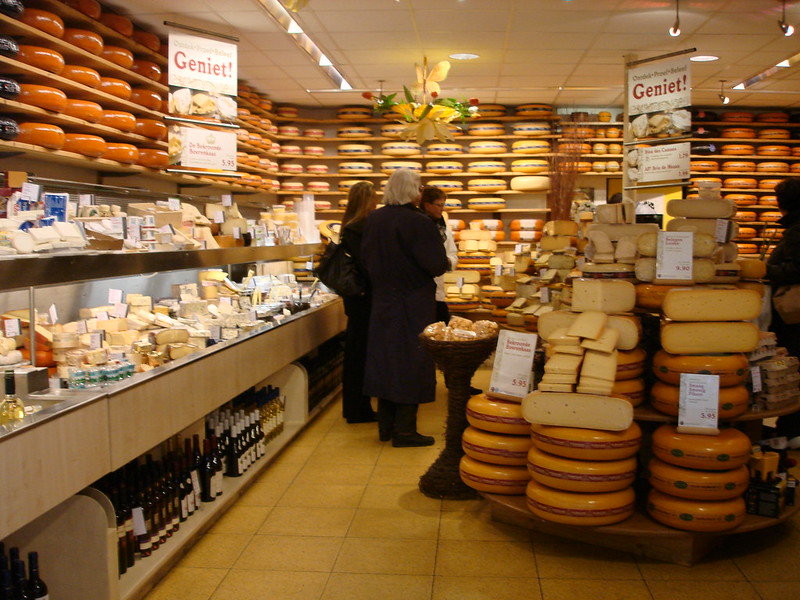
    IT’S BEEN a challenging couple of years for independent cheese shops in the U.S., as the specialty-cheese boom they fostered is absorbed by big-box retailers who sell some of the same brands they do at lower prices.

    Independent cheese shops are the front line, connecting consumers (and their dollars) to small-scale and local cheese producers as well as makers of cheese-adjacent products such as yogurt, butter, charcuterie, jam, pickles, crackers, and beer. A brigade of cut-to-order cheesemongers care for cheeses, answer questions, offer tastes, make customized cuts and, most important, tell the stories of the cheeses they sell.

    Much of what consumers learned about cheese over the last 30 years or so, they learned at a cheese case staffed by an evangelizing monger. These shops invest in consumer education and experience because they have to. Challenged to compete with large retailers on price, they use their intimate venues to offer an experience the national chains rarely can, which often extends to classes, farm trips, and “meet the cheesemaker” events that connect consumers to other enthusiasts.

    The Journal described a nightmare scenario for independent retailers. They can’t compete on price and are stuck competing on the most expensive inputs into the retail value chain. You can’t automate intimate knowledge about a niche industry. You can, however, easily and quickly use market power to negotiate advantageous pricing agreements. Independent retailers are doomed to invest resources that build new markets only to have large corporations undercut them with price once the markets are made.

    This is a societal choice, not fate.

    The Original Fair Trade Laws

    What is happening to independent cheese shops is what millions of people feared in the 1930s—predatory behavior by large chain retail stores. At that time, A&P, the Walmart of the era, used its massive size to bully food producers into volume discounts. It would aggressively discount products. Consumers flocked to the low prices. Local retailers couldn’t match the prices and went bankrupt. Once they went bankrupt, A&P rose prices. It was classic predatory behavior. In 1937 the Roosevelt Administration passed the Miller-Tydings Act of 1937. The legislation exempted retail price-maintenance agreements (commonly known as fair-trade laws) from federal anti-trust.

    What are retail price-maintenance agreements?

    Today, if you go to Walmart to purchase a block of cheese, the price in the aisle is the price the retailer determines—not the manufacturer. This price is, of course, influenced by the wholesale cost of the item, but a manufacturer has no recourse against a retailer if a retailer wants to sell a product at a loss to gain market share. It also has no remedy for the opposite. In the late 2010s, a plastic bag manufacturer instituted a price cut to gain market share. Almost every retailer kept the sticker price the same and pocketed the extra margin.

    Retail price-maintenance agreements put an end to this practice. It allowed manufacturers, of select products, to mandate a sticker price for their product. This allowed small retailers to compete against large chain retailers because they could compete on selection, service, and price.

    The end of state-level fair trade

    By 1975 prices in America were increasing by around 12 percent every year. The causes of this are vast and debated, but at the time, one of the easy culprits were fair trade laws. As the WSJ explained, large retailers can distribute more cheese at a lower price. The logic was that if Congress got rid of fair-trade laws, prices would drop. You still hear the reframe from Walmart supporters.

    That year Congress held hearings to determine their fate. In his book, Goliath, Matt Stoller recounts the testimony of Curtis Brunner, a small high quality car-wax manufacturer.

    In 1965, Brunner began trying to sell his high-qualty car wax, most of the large chains wouldn’t even talk to him, preferring to sell cheap wax in a market dominated by DuPont and three other giants. Smaller retailers wouldn’t stock it either, because they feared being undercut by discounters. Then Bruner discovered fair trade contracts.

    When he began promising small stores that his high quality car wax would be sold at the same price in small stores and discount stores, small stores stocked the item and told cusomters about it. Bruner’s product became popular, and discount stores began stocking it. Bruner could now break into what had been monopolistic market in car wax, by competing on quality, not just price. It was the same basic story that retailers and producers of branded goods had been telling for a hundred years, the same story that motivated Brandeis to call predatory discounting “competition that kills.”

    Bruner was telling the members of Congress that the laws against predatory pricing were working. Discount chains, supermarkets, and large department stores existed side by side with independently owned retailers with good service and local roots. But if the fair trade laws disappeared he said, the country would be “dominated by big businesses.” He was not asking for protection from big business He was telling Congress how we would react if forced to compete in a country dominated by big businesses. “I intended to be one of them,” he said.

    Bruner predicted the plight of cheesemakers and cheese sellers 40 years before it happened. If only he could have seen how Amazon changed the CPG landscape.

    That same year Congress invalidated state-level fair trade laws.

    Image via Flickr